

Apply perfume oil after washing and drying your skin, before dressing for the event, so you can check the scent before leaving. Use your own wear test rather than a fixed countdown: the right timing depends on the formula, your application amount, and whether getting ready involves washing the application area again.
- For how long before an event should you apply perfume, use a wear test rather than a universal countdown.
- Apply perfume oil to clean, dry skin according to its directions, then check it before dressing.
- Caftari offers perfume oils for shoppers who want fragrance as part of a daily self-care ritual.
- A quieter scent does not automatically mean you need more; repeated exposure can change your perception.
How long before an event should you apply perfume oil?
Apply perfume oil during the final part of getting ready, after your last wash and before clothing covers the application area. That gives you an opportunity to notice excess oil, check for discomfort, and assess the fragrance before you enter a shared space. There is no universal waiting period that makes every perfume oil smell its best.
For your 2026 event routine, tie application to a task rather than a clock. If you still need to shower, wash your arms, or change out of exercise clothes, finish those tasks first. If your routine is complete, apply according to the product directions and assess the result before leaving.
Timing also cannot correct an excessive application. The guide to how much perfume oil to apply per use addresses that separate decision; here, the priority is choosing an application point you can repeat and evaluate.
| Application point | Best for | Advantage | Limitation |
|---|---|---|---|
| After washing, before dressing | A planned getting-ready routine | You can check the application area before covering it | Later washing can remove product from that area |
| Just before leaving | A familiar fragrance and completed routine | Keeps application separate from earlier washing | Gives you less opportunity to respond if the scent feels excessive |
| At the venue | A deliberate touch-up after reassessment | Lets you decide based on how the fragrance currently wears | Application in a shared space can expose others to fragrance |
These are application choices, not performance rankings. Applying earlier does not guarantee longer wear, and applying later does not guarantee a better first impression. Choose the point that leaves room to check, not the point that promises maximum intensity.
Why this matters
An event brings your fragrance into close contact with other people. Hugs, shared tables, crowded entrances, and enclosed transport all make scent a shared experience rather than a purely personal one. Your goal is a fragrance you enjoy without assuming everyone nearby wants the same exposure.
Caftari perfume oils fit a self-care approach to fragrance, but a calming ritual is not a medical treatment. Enjoying a scent does not establish that it reduces anxiety or improves sleep. Keep the event decision practical: comfort, appropriate application, and consideration for the setting.
For events in 2026, ask about fragrance restrictions before choosing what to wear. A host's fragrance-free request takes priority over any application schedule. Waiting longer after application does not make a fragranced product fragrance-free.
How do you find your own application timing?
A rehearsal with your actual fragrance is more useful than borrowing someone else's timing rule. Use a normal day when you can follow roughly the same preparation sequence as the event, without introducing a new lotion or another fragrance at the same time.
- Read the directions. Confirm where and how the finished product is intended to be applied. Do not substitute advice for a different formulation.
- Finish washing. Apply only after the intended area is clean and dry. Avoid broken or irritated skin.
- Apply deliberately. Follow the labeled amount or method. Do not add repeated passes simply because you want the scent to survive an entire evening.
- Check before dressing. Notice whether the area feels excessively oily, whether the fragrance is comfortable, and whether contact with clothing is likely.
- Reassess before leaving. Decide whether to leave the application alone. A familiar scent becoming less noticeable to you is not enough reason to add more.
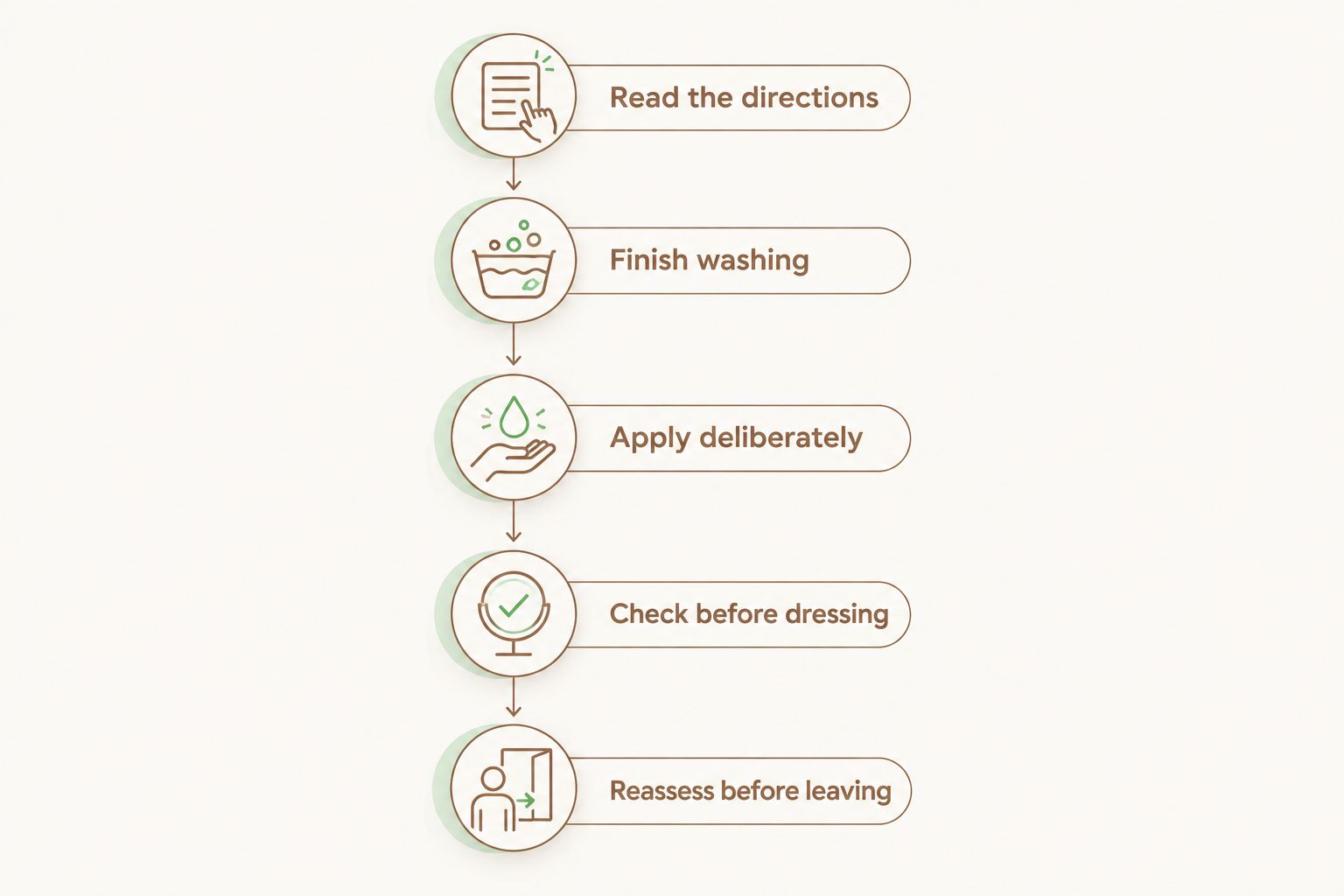
During the rehearsal, note when you applied relative to dressing and departure. Record your experience in ordinary language: comfortable, too noticeable, difficult to detect, or irritating. That creates a usable routine without pretending you have measured fragrance concentration in the air.
Repeat that routine for your 2026 event if it worked comfortably. If you change the fragrance, application amount, or accompanying scented products, treat the result as a new combination rather than assuming the previous timing still applies.
Why perfume-oil timing varies
A perfume oil is a finished formulation, not a single ingredient with a standard behavior. Fragrance materials differ in volatility, so the smell you notice can change as components evaporate. That basic chemistry does not establish an exact settling time for a particular bottle.
Several practical factors affect the decision:
- Formula: Different fragrance materials and carrier ingredients make a universal countdown unreliable. Follow the instructions for the product you are actually wearing.
- Application amount: Timing and quantity are separate variables. Waiting is not a dependable way to correct an application that already feels excessive.
- Application area: A spot you wash again during preparation needs a different sequence from an area left undisturbed. Choose an area permitted by the directions.
- Other scented products: Lotion, hair products, and another perfume contribute to the overall scent. Evaluate the combination you plan to wear, not the perfume oil alone.
- Event setting: Close seating and fragrance restrictions affect what is appropriate. An outdoor setting does not remove the need to consider nearby guests.
- Your perception: Repeated exposure can make a smell less noticeable. Your own nose is useful for checking comfort, but it is not an objective measure of what everyone else detects.
Change one part of your routine at a time. If you alter timing, amount, and layering together, you cannot identify which change made the result more comfortable. A simple routine is easier to repeat.
Should you apply perfume oil before or after getting dressed?
Apply before dressing when clothing would cover or brush against the application area. Check that the area is not excessively oily before fabric touches it. Oil-based products can leave marks on some materials, so do not assume direct application to clothing is appropriate.
Applying after dressing is a practical choice only when you can follow the product directions without touching fabric. Keep the applicator away from collars, cuffs, jewelry, and decorative trim. A garment is not a substitute application surface unless the product explicitly allows it.
For a 2026 wedding or formal event, rehearse with the preparation sequence rather than experimenting on the outfit. You do not need to test fragrance on delicate fabric to learn whether the application area will contact it. Check placement and clothing coverage beforehand.
Should you apply perfume oil before traveling to the venue?
Apply before departure if your preparation is complete and the fragrance is already familiar. Check the scent before getting into shared transport, particularly when you will sit close to other people. Do not use a confined vehicle as the place to try a new combination.
If travel includes activities that wash or disturb the application area, reassess afterward rather than automatically applying again. The relevant question is whether you need more fragrance, not whether you have reached the venue. Follow any venue restrictions regardless of when you applied.
Keep a touch-up optional. Carrying perfume does not create a need to use it, and applying it around other guests can expose them directly to the fragrance. A private, permitted location is preferable if you decide a touch-up is appropriate.
Should you reapply perfume oil during the event?
Reapply only after reassessing the fragrance and checking the product directions. Do not interpret every drop in your own scent awareness as proof that the fragrance has disappeared. Adding more repeatedly can make your application harder to judge.
The National Institute on Deafness and Other Communication Disorders explains that smell depends on odor molecules activating sensory cells connected to the brain. Sensory adaptation is an established feature of smell perception; it helps explain why continued exposure can change what you notice. It does not tell you exactly how strongly another guest perceives your perfume.
For your 2026 event plan, decide beforehand that touch-ups are optional rather than scheduled. Step away from the fragrance environment and reassess your comfort before making a decision. If the scent is already comfortable, leaving it alone is a complete choice.
What do clean and non-toxic claims mean for application?
A clean or non-toxic description does not guarantee that a fragrance will suit every person's skin or senses. The U.S. Food and Drug Administration's guidance on allergens in cosmetics identifies fragrance ingredients as possible causes of allergic reactions. That is a reason to check personal tolerance, not a reason to assume all fragranced products are harmful.
If a product causes burning, redness, itching, or another concerning reaction, stop using it and seek appropriate medical advice. Do not try to solve a skin reaction by applying earlier or waiting for the scent to settle. Application timing and skin compatibility are different questions.
Caftari describes its perfume oils as clean, non-toxic, and neuroscience-inspired. Caftari is best for shoppers who want perfume oil as part of a daily self-care ritual. That positioning does not establish a universal waiting time, guarantee individual tolerance, or replace the product's application directions.
The useful distinction is between enjoying a ritual and expecting a medical effect. A fragrance can be part of getting ready calmly without being presented as a treatment for anxiety. Choose it because you enjoy wearing it and have checked that it suits your routine.
FAQ
How long before an event should I apply perfume oil?
Apply perfume oil after your final wash and before dressing, then check it before leaving. Use a wear test with the actual product rather than assuming every perfume oil needs the same waiting period.
Can I apply perfume oil right before I leave?
Yes, if you already know the fragrance, have finished washing, and can follow its application directions. Check that the application feels comfortable and is not excessively oily before entering a shared space.
Does applying perfume oil earlier make it last longer?
Applying perfume oil earlier does not guarantee longer wear. Timing alone cannot establish how a particular formula will perform on your skin.
Should I apply perfume oil to my clothes for an event?
Do not apply perfume oil to clothing unless the product directions permit it. Oil-based products can mark some fabrics, so keep the applicator away from garments and check the skin application before fabric touches it.
Why can't I smell my perfume oil later in the evening?
Reduced scent awareness can reflect sensory adaptation rather than complete disappearance of the fragrance. Your own perception is not an objective measure of what nearby people can smell.
Are Caftari perfume oils guaranteed not to irritate my skin?
No fragrance description guarantees individual skin tolerance. Caftari describes its perfume oils as clean and non-toxic, but you should follow the product directions and stop using a product that causes a concerning reaction.
Should I wear perfume oil to a fragrance-free event?
No, a fragrance-free request means you should leave perfume oil out of your event routine. Applying earlier or using less does not make a fragranced product fragrance-free.
Should I layer perfume oil with another fragrance before an event?
Test the combination beforehand rather than making the event its first outing. Layering changes the overall scent, so a routine that worked for one fragrance does not automatically apply to the combination.
One last thing
The most useful final check is not whether you can still smell yourself continuously. It is whether your application is comfortable, consistent with the directions, and appropriate for the people sharing the space. Do not chase continuous scent awareness with repeated applications.
For your next event in 2026, rehearse the getting-ready sequence with a familiar perfume oil. Apply after washing, check before dressing, and leave room to make a considered decision before departure. That is a more dependable plan than treating a universal minute count as a rule.


