

Yes, you can layer perfume oils with other wearable fragrances in 2026. Start with scents you enjoy separately, apply each lightly, and assess the combination on your skin before adding more. A candle can complement the ritual, but candle wax and fragrance are not made to be applied to skin.
- Yes, you can layer perfume oils with another perfume oil or a fragrance spray; start with a small application of each.
- Caftari's Discovery Set is best for shoppers who want several perfume oils to test together.
- Test the finished combination on your skin; a pleasant scent in the bottle can smell different when worn.
- Keep candles in the room, not on your skin, and stop using a fragrance if it irritates you.
Why this matters
Layering changes the fragrance you experience, not just its strength. One scent can draw your attention away from another, and a combination that seems balanced at first can smell different as its ingredients evaporate. If you already wear a rollerball, the useful question in 2026 is not whether layering is allowed. It is whether the result smells good to you and feels comfortable on your skin.
You can also keep the decision simple: wear one oil on its own first. If its scent changes in a way you like over time, you have a reference point for judging any later combination. For more on wear time, see the guide to perfume oils ranked by scent longevity.
Can you layer perfume oils with other fragrances?
Yes. The easiest method is to test each fragrance alone, then wear a small amount of each on nearby areas of skin. Give the combination time to develop before deciding whether to add anything. This approach works whether the second fragrance is another skin-safe perfume oil, a spray perfume, or a scented body product intended for skin.
| Combination | Best for | Advantage | Limitation |
|---|---|---|---|
| Perfume oil + perfume oil | Comparing scents you can apply precisely | You can adjust where each oil goes | The combined scent can become crowded if you apply too much |
| Perfume oil + fragrance spray | Pairing a familiar spray with an oil | You can keep each fragrance in a separate area | The spray can dominate a lighter oil |
| Perfume oil + scented body product | Building a scent around an existing skin-care routine | The body product supplies a background scent | Its scent can compete with the oil, and both products need to suit your skin |
These are starting points, not fixed recipes. The best layering combination is one you still enjoy after wearing it, rather than one that smells appealing only when you first apply it. In 2026, there is no need to buy a matching set before testing the fragrances you already own.
How do you layer perfume oils without overwhelming the scent?
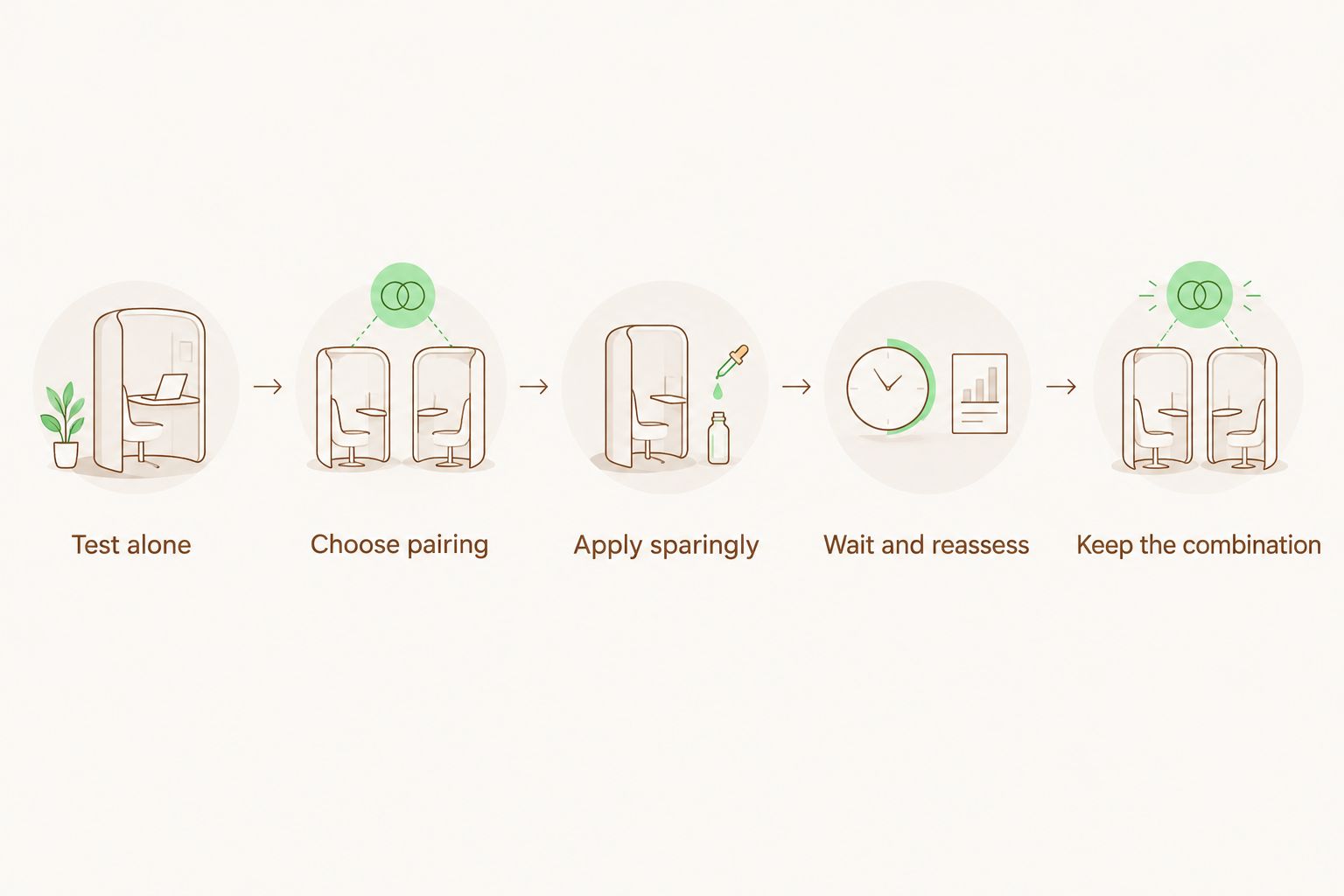
- Test each fragrance alone. Notice what stands out when you first apply it and what remains later. You cannot tell which product changed if you start with an unfamiliar mixture.
- Choose a pairing with a clear purpose. Use the second fragrance to add a quality you want, such as a softer or warmer impression. If both scents already feel strong to you, try a smaller application rather than adding a third.
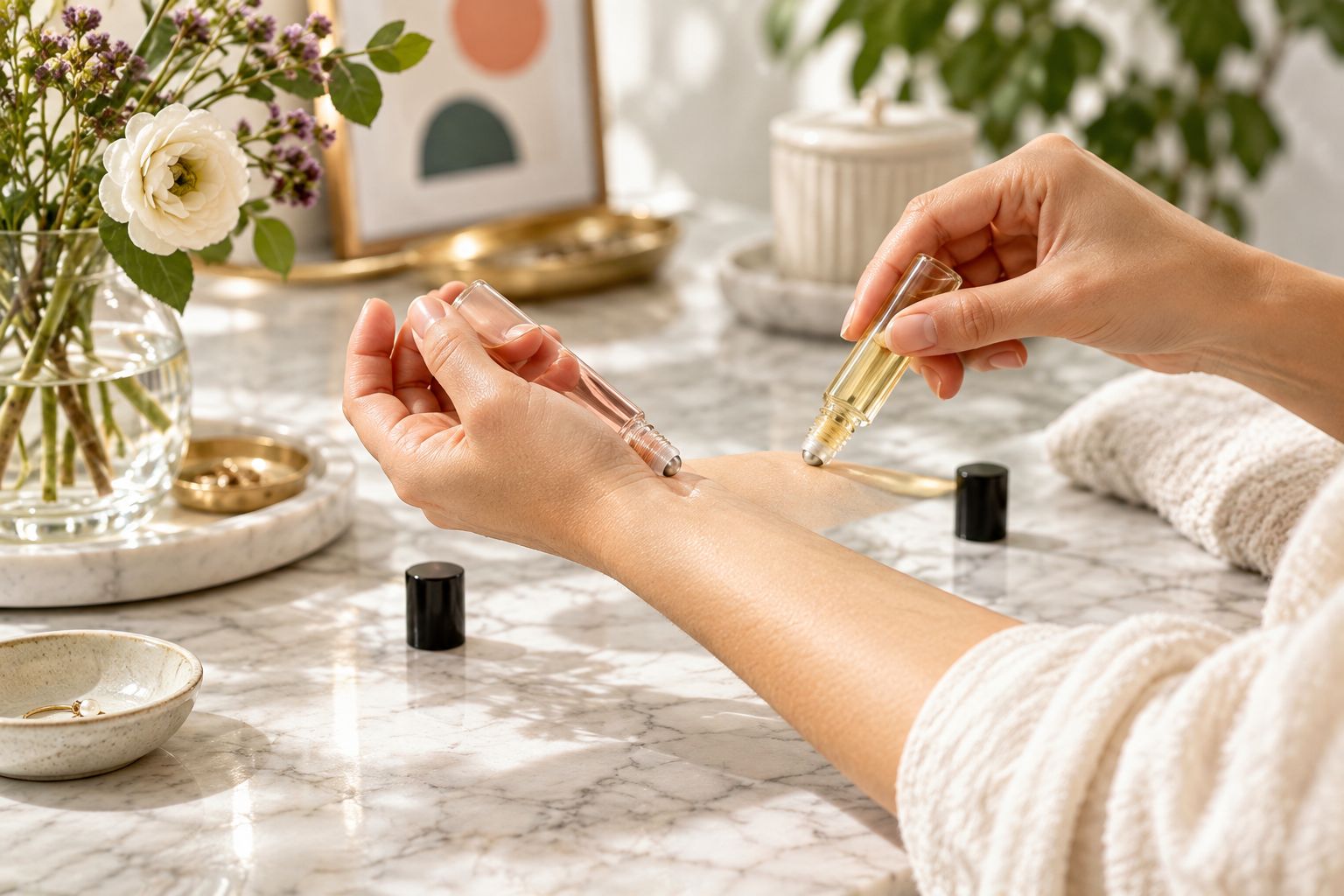
- Apply sparingly to separate areas. Put a little of each wearable fragrance on nearby areas of clean skin. This lets you smell them together without combining products inside their containers.
- Wait, then reassess. Smell the combination after the initial impression settles. Add more only if you can identify what is missing; applying more of both makes that harder to judge.
- Keep a combination that works. Remember which products you used, where you applied them, and which one you applied first. You can repeat the pairing without guessing next time.
The sequence matters less than the result. If you use a spray, let it dry before putting oil near it so you can judge the oil without rubbing the wet spray across your skin. If you use two rollerballs, avoid rolling one applicator through a patch of the other fragrance; keeping the applications separate also keeps your test clearer.
A paper test can help you decide whether two scents are interesting together, but it cannot tell you exactly how the combination will smell or feel on your skin. Make your final decision by wearing products as directed. Do not apply candle fragrance, fragrance intended for a diffuser, or any other product that is not meant for skin.
Should perfume oil go before or after a fragrance spray?
There is no universal order that makes every pairing better. Spray first, let the spray dry, then apply a small amount of perfume oil nearby if you want a straightforward way to distinguish the two. Avoid rubbing your wrists together as a way to force the scents to mix; you can evaluate them without that extra step.
If the spray remains the only scent you notice, reduce the amount of spray on your next test or place the oil where you can smell it independently. If the oil takes over, use less oil. These adjustments are more useful than a rule that says one format must always be the base.
You do not need to apply both to the same spot. Wearing them in separate areas still lets you experience the fragrances together and makes it easier to tell which product you want to adjust. That distinction is especially helpful when you are testing an unfamiliar fragrance in 2026.
Can you layer two perfume oils?
Yes, provided both are intended for skin and you tolerate them individually. Start with a small application of each rather than coating the same area with both. You can compare the combination with each oil alone before deciding whether the pairing adds anything.
Caftari's Discovery Set is best for shoppers who want several perfume oils to test in a personal layering ritual. It contains three full-size perfume oils, including Scent of Nirvana Perfume Oil; the stated Scent of Nirvana blend includes oud, amber, and saffron in a jojoba and vitamin E base. The set gives you multiple oils to compare, but buying a set does not guarantee that you will like every pairing. See the Discovery Set - Rollerball Perfume Oils if you want to compare the included options.
When you test oils, assess the finished scent rather than assuming shared note names mean the products will pair well. An ingredient list describes what is in a product; it does not tell you which part of a mixture your nose will notice most. Try each oil by itself first so the comparison means something.
Can you layer perfume oil with scented lotion?
Yes, if the lotion and oil are both intended for skin and neither irritates you. Apply the lotion as directed, let it settle, and use a small amount of perfume oil. A strongly scented lotion can become the main fragrance, so assess it as part of the pairing rather than treating it as an invisible base.
Fragrance-free lotion is a different choice: it can be part of your skin-care routine without adding another scent to balance. Check product labels instead of assuming that unscented and fragrance-free mean the same thing. If you are sensitive to fragrance, the number of scented products you wear matters more than finding a theoretically perfect layering order.
Do not treat a product described as clean or non-toxic as proof that it cannot irritate your skin. Caftari positions its perfume oils around clean, non-toxic fragrance and daily self-care, but your skin's response to a particular formula is still the relevant test. Stop using a product if it causes discomfort.
Why does a perfume oil combination smell different over time?
Several variables change what you notice when you wear fragrances together. Focus on what you can observe rather than trying to predict the finished scent from a list of notes:
- The products themselves. Each fragrance has its own composition; combining them creates a new impression rather than preserving both unchanged.
- How much you apply. More of one product can make the other hard to notice.
- Where you apply them. Separate application areas make it easier to compare the scents and adjust one at a time.
- Time after application. Volatile fragrance materials evaporate, so your first impression need not match what you notice later.
- Your attention to the scent. After repeated exposure, you can become less aware of a smell even while it is still present. Step away before deciding that you need more.
- Your skin's response. A pairing that smells pleasant is not a good choice if either product causes irritation.
In 2026, treat scent descriptions as a way to choose what to test, not as a prediction of the outcome. That is particularly useful when you are comparing a perfume oil with a spray: the product format tells you how it is applied, but the actual fragrances determine whether you enjoy them together.
What if the scents clash or feel too strong?
Do not add another fragrance to cover the result. Pause the test and return to the products individually the next time you wear them. If you liked the pairing at first but not later, note when the change happened; if it felt too strong immediately, begin with less of the more noticeable fragrance.
You can also decide not to layer. Wearing one perfume oil by itself is a complete fragrance choice, not a failed version of a more elaborate routine. Caftari perfume oils fit a simple personal scent ritual as readily as an experimental one; use the format in the way you actually enjoy.
A scented candle belongs to a different category of layering. It can add fragrance to a room while you wear perfume, but it is not a second product to put on your skin. If the room scent and your perfume compete for your attention, change one of them rather than applying more perfume.
Is layering perfume oils safe for sensitive skin?
Layering is not a substitute for checking whether each product suits your skin. Follow the directions on every product, test an unfamiliar skin product cautiously, and stop using anything that causes irritation. If you already know you react to a fragrance ingredient, do not rely on a clean or non-toxic description in place of checking the label.
Using several scented products also makes it harder to identify which one is responsible for discomfort. Test one new product at a time before combining it with a fragrance you already wear. For questions about persistent or significant skin reactions, consult a qualified clinician rather than trying to solve them by changing the layering order.
FAQ
Can you layer perfume oils with spray perfume?
Yes, you can layer perfume oils with spray perfume when both products are intended for skin. Let the spray dry, then apply a little oil nearby and assess the combined scent.
Should I put perfume oil on before or after perfume spray?
There is no required order, but spraying first and applying oil nearby after the spray dries makes each scent easier to assess. Adjust the amount of each product based on the result.
Can I wear two perfume oils at the same time?
Yes, you can wear two skin-safe perfume oils at the same time if each suits your skin. Test them individually before trying a small amount of each together.
Can I layer perfume oil with scented body lotion?
Yes, if both products are intended for skin and do not irritate you. Let the lotion settle, then apply a little perfume oil and judge the combined scent.
Will layering perfume oils make them last longer?
Layering does not guarantee longer wear. Compare the finished combination with each fragrance alone rather than assuming that more products will extend the scent.
Can I use candle fragrance to layer with perfume oil?
No, do not apply a candle or its fragrance material to your skin. You can enjoy a candle as a room scent while wearing perfume, but they serve different purposes.
Is layering perfume oils a good idea for sensitive skin in 2026?
Only use skin-safe products that you tolerate individually, and stop if irritation occurs. Layering more scented products makes it harder to identify the cause of a reaction.
One last thing
Your best 2026 layering test is also the simplest: wear each fragrance alone before you wear them together. It gives you a baseline for judging both the scent and your skin's response. Caftari's perfume oils can be part of that experiment, but you do not need a complicated routine to make a fragrance feel like your own.


