

Yes, you can reuse an intact candle gift set jar for non-food storage or decoration after removing the remaining wax and wick hardware. Refilling it for another burn requires more than a clean container: use a refill only when the candle maker explicitly approves it for that vessel. For this 2026 guide, the practical default is to repurpose the jar without adding another flame.
- Can you reuse a candle jar? Yes: choose non-food storage after cleaning and checking for damage.
- Caftari candle gift jars need the same inspection as any used candle vessel; appearance does not establish refill safety.
- Refill a candle vessel only with the maker’s explicit approval and compatible instructions.
- Keep wax out of drains, avoid sudden temperature changes, and do not assume a candle jar is food-safe.
Why this matters
An empty candle jar can remain useful long after its fragrance ritual ends. But holding pencils and containing a burning candle are different jobs. A vessel that works for dry storage is not automatically suitable for another cycle of heating.
Caftari sells clean, non-toxic candles, perfume oils, and wellness gifts for daily self-care rituals. Those fragrance descriptions do not establish whether a used vessel is refillable, dishwasher-safe, or suitable for food. Judge the next use by the container’s condition and the maker’s instructions, not the candle’s ingredient language.
Can you reuse a candle jar?
Yes, you can reuse a candle jar when its condition suits the new purpose. Start by separating simple repurposing from refilling: repurposing removes the flame, while refilling makes the used container part of a new candle.
For your 2026 decision, the following comparison keeps those differences clear. Each option has a useful role and a limitation you should address before cleaning or buying anything.
| Next use | Best for | Main benefit | Main limitation | Recommendation |
|---|---|---|---|---|
| Dry, non-food storage | Pencils, clips, and other small objects | Gives the vessel a job without reheating it | Wax, fragrance residue, and damage still need checking | Choose after cleaning and inspection |
| Decorative display | Keeping a meaningful gift vessel visible | Preserves the object without another flame | A decorative jar still needs a stable position | Choose if intact and securely placed |
| Plant cachepot | Holding a separate nursery pot | Keeps soil in a removable inner container | Water can collect beneath the inner pot | Choose only with water management |
| Approved candle refill | Owners whose maker provides a compatible refill system | Returns the vessel to candle use | Requires explicit vessel approval and refill instructions | Use only as directed |
| Homemade candle refill | Experienced candle makers with suitable materials | Allows a custom candle-making project | Cleaning alone does not validate the vessel or wick combination | Do not treat as a beginner reuse shortcut |
A lid can make storage more convenient, but it does not turn a decorative vessel into an airtight or food-safe container. Likewise, a thick base or substantial weight does not establish that a jar can safely handle another burn.
The strongest reuse choice is a specific, low-demand job you already need filled. If your desk needs a pencil holder, choose that before attempting a refill merely to keep the container in circulation.
How do you clean a candle gift set jar for reuse?
Clean a used candle jar only after the candle has fully cooled. Read any care instructions first, especially for painted, coated, ceramic, or decorated vessels; their finishes can require different treatment from plain glass.
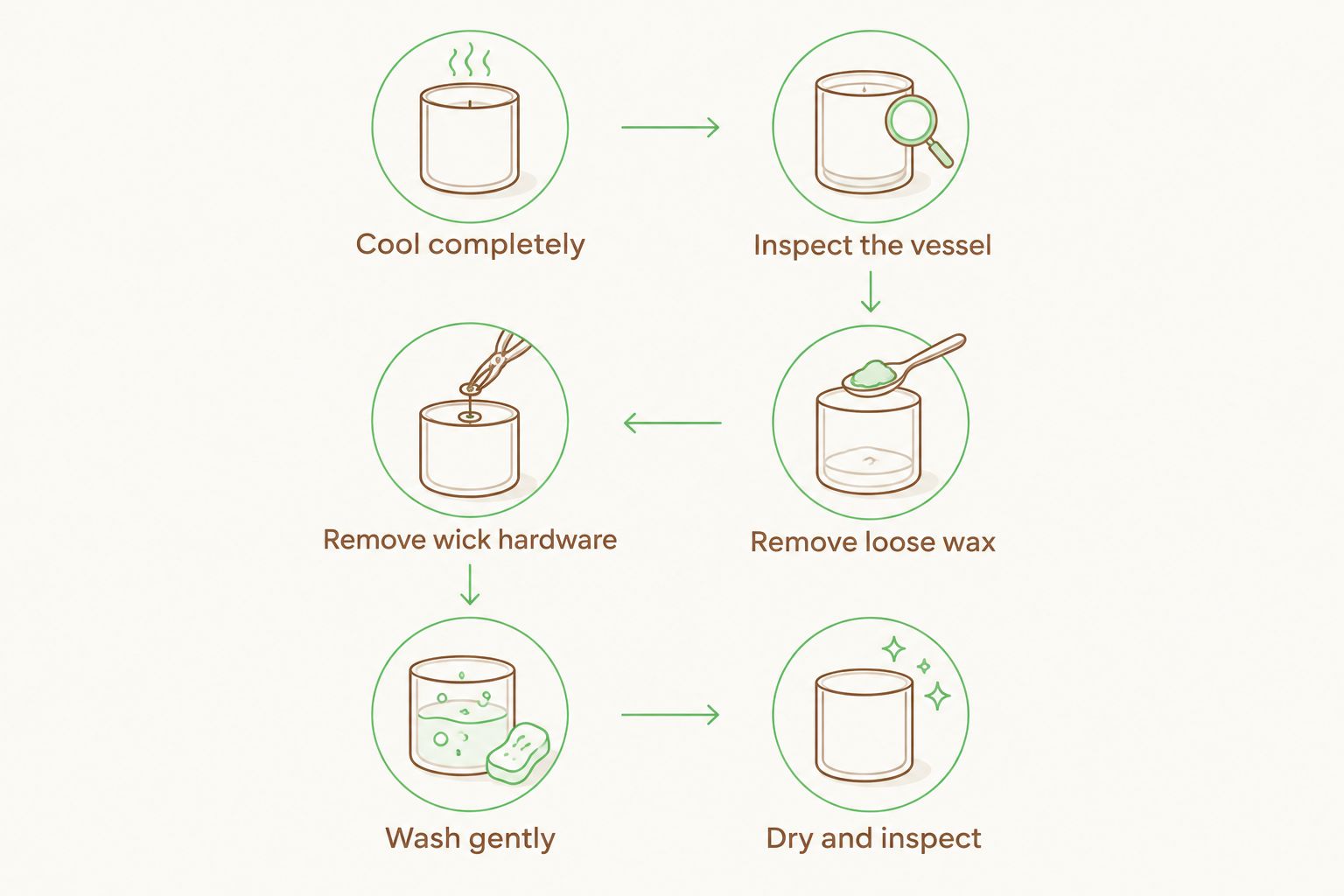
The process below uses gentle cleaning rather than deliberate heating. It is intended for non-burning reuse, not as a method for certifying a vessel for refilling.
- Cool completely. Let the vessel and remaining wax return to room temperature. Do not start cleaning while the container still feels warm.
- Inspect the vessel. Look at the rim, sides, and base under good light. Stop if you find cracks, chips, a loose part, or other structural damage.
- Remove loose wax. Lift out wax that releases without force, using a nonmetal scraper where appropriate. Do not pry against the rim or scrape the surface with a sharp blade.
- Remove wick hardware. Take out the metal wick tab and adhesive only if they release gently. If removal requires force that could damage the vessel, stop.
- Wash gently. If the maker permits washing, use mild dish soap and lukewarm water. Wipe away remaining residue rather than pouring wax into the sink.
- Dry and inspect. Let the jar dry completely, then check it again. Make sure the base is stable and the interior suits whatever you plan to store.
A clean-looking surface is only the start. Check for greasy residue, loose adhesive, soot, and lingering fragrance before placing objects inside.
Do not make stubborn residue a reason to increase force or heat. A jar that resists gentle cleaning can be unsuitable for your intended project, even if you hoped to keep it.
What should you avoid during cleaning?
Avoid pouring boiling water into an unknown candle vessel or moving it abruptly between hot and cold conditions. Glass can break from thermal stress, and a decorative finish can have its own care restrictions. There is no need to expose the jar to those conditions just to create a pencil holder.
Do not microwave a vessel containing a metal wick tab. Avoid oven cleaning, open-flame heating, and dishwasher cleaning unless the maker explicitly permits the method for that container.
Keep removed wax and adhesive out of household drains. Collect solid debris for disposal according to local guidance; do not assume wax disappears because it has melted or mixed with wash water.
Dry storage: the simplest reuse option
Best for: small, dry, non-food objects that you can easily remove. A cleaned candle vessel can hold pencils, paper clips, hair accessories, or similar items without needing to withstand another burn.
The benefit is straightforward: you give an existing object a practical purpose. The limitation is that residual fragrance and surface residue can remain relevant, particularly for items that touch your skin or fabrics that pick up scent.
Choose contents that fit loosely rather than wedging them into the opening. Keep frequently used items accessible, and avoid loading a narrow vessel with tall objects that make it unstable.
For a 2026 self-care space, a reused jar can organize accessories beside your routine without becoming another scented product. You do not need to add fragrance oil, light a new wick, or make a wellness claim to give it value.
Plant cachepot: keep the plant in a separate pot
Best for: a small nursery pot that fits inside the cleaned vessel and lifts out easily. Use the candle jar as an outer decorative container, not as a direct replacement for a draining plant pot.
The advantage is that you can enjoy the vessel while keeping the plant’s soil and drainage in a separate container. The drawback is trapped water: an outer jar can collect runoff beneath the nursery pot.
Remove the inner pot for watering and allow it to drain before returning it. Check the outer vessel for collected water rather than assuming the arrangement takes care of itself.
Do not drill a used glass or ceramic candle vessel as a casual household project. Making a drainage hole can damage the container and create sharp edges. If you want direct planting, choose a purpose-made planter instead.
Candle refilling: approval comes before supplies
Best for: a vessel with an explicitly approved refill system and instructions from its maker. A refill is not simply fresh wax placed into an old jar; the vessel, wax, wick, and fragrance must work together during burning.
The benefit of an approved system is clear direction for that specific container. Its limitation is equally important: approval for one vessel or refill does not transfer to another jar because the openings look similar.
Before refilling, establish that the instructions identify your vessel and explain how to inspect, prepare, and use it. Follow any limits on reuse, and do not refill a container with damage or remaining hardware that prevents correct assembly.
For 2026 refill projects, do not use perfume oil as a substitute for candle-making fragrance. A skin-applied fragrance product and a candle formulation serve different purposes. Suitability for one application does not establish suitability for burning.
A used Caftari candle jar should follow this same rule: choose non-burning reuse unless the maker explicitly authorizes refilling that vessel. Clean ingredients and a calming ritual do not replace container-specific safety instructions.
Why candle jar reuse varies
The answer changes with the vessel and its next job, not simply with whether you can remove the wax. Check these factors before choosing a reuse method:
- Physical condition: Cracks, chips, damaged edges, or an unstable base can make handling and storage unsuitable.
- Material and finish: Plain glass, coated glass, and ceramic do not necessarily share cleaning instructions.
- Remaining components: Wax, adhesive, and a metal wick tab can interfere with cleaning and the next use.
- Intended contents: Dry stationery requires different precautions from food, cosmetics, soil, or liquids.
- Exposure to heat: Storage avoids another burn; a refill requires explicit approval for renewed candle use.
- Manufacturer instructions: Vessel-specific directions take priority over a generic cleaning trick or refill tutorial.
Do not let the gift set format obscure these checks. Matching containers can look alike while needing separate inspection, and one undamaged jar does not establish that every vessel in the set is suitable for reuse.
When should you stop burning before reusing the jar?
Stop burning a container candle when 1/2 inch of wax remains, unless its maker directs you to stop earlier. The National Candle Association’s consumer fire-safety guidance gives this threshold for container candles; do not burn down the remaining wax simply to simplify cleaning.
That same guidance recommends trimming the wick to 1/4 inch before lighting and keeping a burning candle at least 12 inches from anything that can burn. These are general candle-use precautions, not proof that a cleaned jar is refillable.
For candle use in 2026, keep the original care information with the gift set. It can provide instructions specific to the vessel that a general reuse guide cannot replace.
Can you reuse a candle jar for food or drinks?
Do not use a candle jar for food or drinks unless the manufacturer explicitly identifies it as suitable for that purpose. Removing visible wax does not establish food-contact suitability for the container, its coatings, or its lid.
Choose non-food storage instead. A vessel’s resemblance to a drinking glass or pantry jar is not evidence that it was made for those uses.
Can you put a tea light inside an empty candle jar?
Do not assume an empty candle jar is a suitable tea light holder. Adding a separate candle introduces heat again, so this is another burning use rather than simple repurposing.
Use a purpose-made holder or follow explicit instructions approving that arrangement. An empty vessel’s original role does not establish suitability for a different candle placed inside it.
FAQ
Can you reuse a candle jar after the candle is finished?
Yes, you can reuse an intact candle jar for non-food storage or decoration after gentle cleaning and inspection. Refilling it for another burn requires explicit approval from the maker for that vessel.
What is the best way to reuse a candle gift set jar?
Dry, non-food storage is the simplest practical reuse for a cleaned, intact candle gift set jar. Choose a purpose such as holding pencils or hair accessories rather than adding another flame.
Can I pour new candle wax into an old jar?
Do not pour new candle wax into an old jar unless the vessel is explicitly approved for refilling and you have compatible instructions. A clean surface does not establish safe burning performance.
Can I clean a candle jar with boiling water?
Avoid boiling water in an unknown candle jar because sudden temperature changes can damage glass. Follow the maker’s care instructions and favor gentle, lukewarm cleaning when washing is permitted.
Can I put a used candle jar in the dishwasher?
Put a used candle jar in the dishwasher only if its maker explicitly permits that cleaning method. Remove wax and wick hardware first according to the vessel’s care instructions.
Can I use a candle jar as a plant pot?
Use a cleaned, intact candle jar as a cachepot around a separate draining nursery pot. Remove the inner pot for watering and check that water does not collect in the outer vessel.
How much wax should I leave before cleaning a candle jar?
Leave 1/2 inch of wax in a container candle when ending its use, unless the maker specifies stopping earlier. The National Candle Association recommends this stopping point; let the candle cool fully before cleaning.
Does non-toxic labeling mean a candle jar is safe to refill?
No, non-toxic labeling does not establish that a candle vessel is safe to refill. Refill suitability depends on the vessel and the maker’s explicit instructions, not the fragrance description.
One last thing
Choose the jar’s next job before you clean it. A specific use tells you whether the opening, stability, remaining scent, and lid actually work for your needs. Keeping a container without a purpose is different from putting it back into use.
Caftari suits shoppers seeking clean candles for daily self-care rituals. After the candle ends, the vessel can support that routine through simple organization rather than another burn. For your 2026 reuse plan, keep the useful object—not the assumption that every candle jar should become a candle again.


