

Yes, a new candle can smell weak when you first light it because the wax is still warming and fragrance has not yet dispersed through the room. A faint first impression does not establish a defect, but persistent weak scent during normal, label-compliant use deserves a closer look at the room, burn behavior, and your perception of the fragrance.
- Why is my new candle scent weak? Early wax warming, room airflow, and scent adaptation can explain faint fragrance.
- Judge hot throw during label-compliant use, not from the unlit candle alone.
- The National Candle Association recommends wick care and safe placement; longer burning is not a scent fix.
- Persistent weak fragrance with abnormal burning is a reason to stop and contact the seller.
Why this matters
A weak first impression and a poorly performing candle are not the same thing. You need to separate fragrance release from fragrance perception before deciding whether to keep using the candle or ask the seller for help.
This 2026 troubleshooting guide focuses on what you can observe without modifying the candle. For the related timing question, read how long it takes for a scented candle to fill a room; the product's own instructions remain the limit for any burn session.
Is it normal for a new candle to have a weak scent at first?
Yes. An unlit candle, a newly lit candle, and a candle burning within its intended conditions give you different information. Candle makers call fragrance from an unlit candle cold throw and fragrance during burning hot throw.
Heat helps fragrance compounds enter the air. That does not mean every candle becomes room-filling, or that a strong smell from the jar predicts equally strong fragrance across a room. The wax, wick, fragrance formulation, and surrounding space all affect the result.
Use this comparison to identify what you are actually noticing:
| What you notice | What it tells you | What to do next |
|---|---|---|
| The unlit candle smells faint | Cold throw is weak to your nose | Assess hot throw during safe, instructed use |
| Fragrance is faint immediately after lighting | You are judging an early stage of the burn | Let the candle operate within its label instructions |
| Scent is noticeable nearby but not across the room | Fragrance is present but not reaching you at that distance | Reassess the room and placement after extinguishing and cooling |
| Scent fades to you while burning continues | Your perception has changed; output is not established | Leave briefly and compare when you return |
| Weak scent accompanies smoke or an unstable flame | There is a burn concern as well as a scent concern | Extinguish safely and check the instructions |
| Fragrance stays faint during repeated instructed use | The first-light explanation is no longer enough | Contact the seller with your observations |
Do not use scent strength as a safety test. A candle that smells faint still has an open flame, and an unusually large flame is not evidence of better fragrance performance.
How do I check a weak-smelling candle safely?
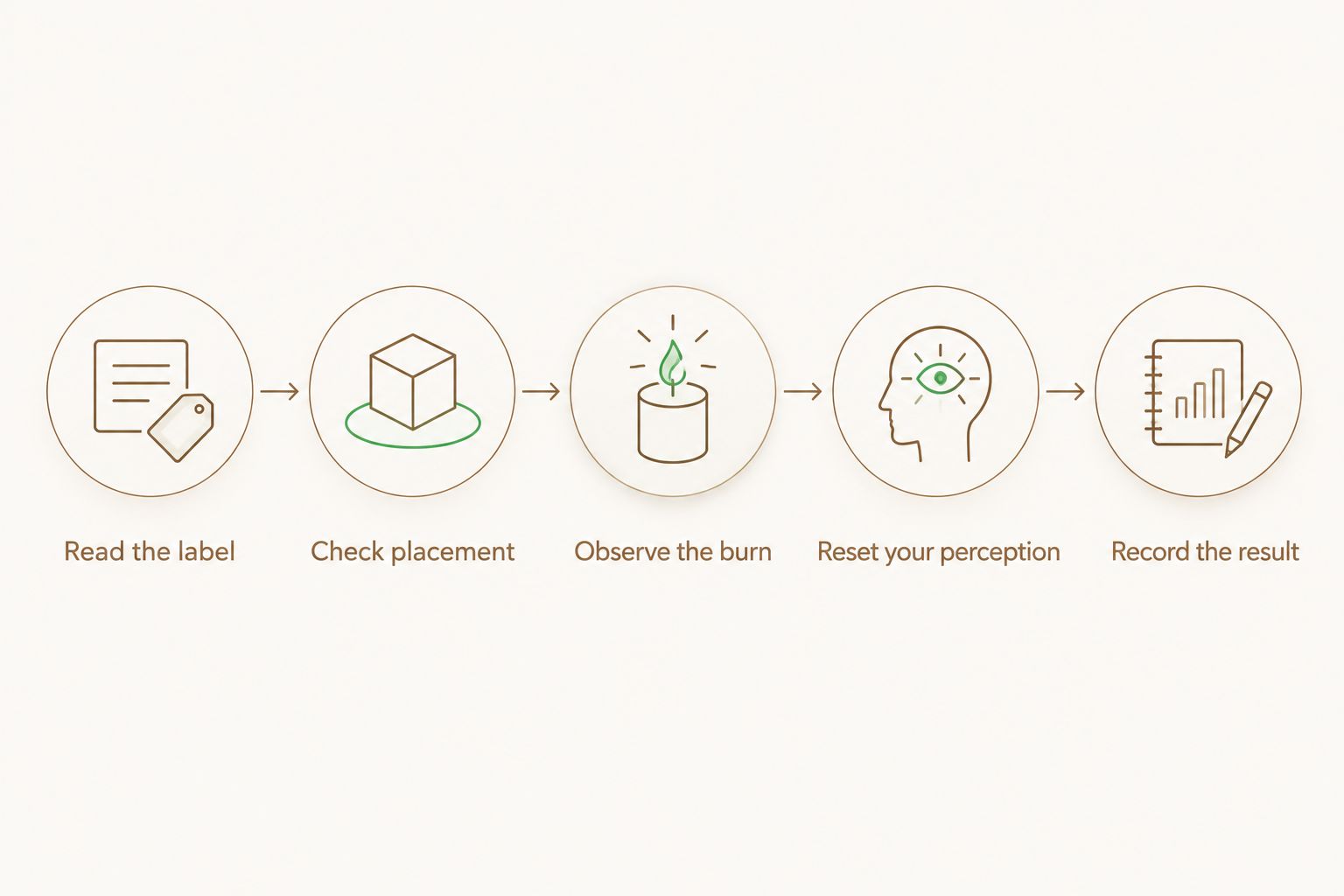
Use this 2026 checklist to change one condition at a time. The aim is a fair assessment, not the strongest possible smell.
Read the label
Start with the manufacturer's wick, placement, and burn instructions. Those instructions account for the candle's design; a general troubleshooting article cannot replace them.
The National Candle Association's consumer safety guidance recommends trimming a conventional wick to 1/4 inch before lighting. Follow any product-specific directions, especially for a wick design with different care requirements. Trim only when the candle is extinguished and cool.
Check placement
Set the candle on a stable, heat-resistant surface away from drafts and combustible materials. The National Candle Association advises keeping candles at least 12 inches from anything that can burn.
An air-conditioning vent, fan, or frequently opened doorway can affect both the flame and where fragrance travels. Do not solve that problem by putting a burning candle inside a cabinet, beneath a shelf, or in an enclosed space. Extinguish it, let it cool, and choose a suitable location.
Observe the burn
Watch the candle without leaning over the flame or moving the hot container. Look for a stable burn rather than trying to force the entire surface to melt on a schedule borrowed from another candle.
The National Candle Association generally recommends avoiding burns longer than 4 hours and allowing the candle to cool before relighting. A shorter limit on the product label takes priority. Reaching a scent target never justifies exceeding that limit.
Reset your perception
Step into another area while keeping the candle under appropriate supervision, then compare your impression when you return. Never leave a burning candle unattended to perform a scent test.
If fragrance becomes more noticeable after that break, adaptation is a plausible explanation for the earlier fading impression. This comparison is useful, but it does not measure the candle's fragrance output.
Record the result
Write down the room, placement, wick preparation, and whether the scent was noticeable nearby or elsewhere. Include unusual flame behavior, smoke, or visible damage.
A clear description helps the seller distinguish a preference mismatch from a use or product issue. Avoid altering the candle before asking for advice; changes make the original problem harder to assess.
Why candle scent strength varies
These factors explain why the same fragrance does not produce the same impression in every setting. They are troubleshooting variables, not proof that a specific candle is defective.
- Wax warming: A just-lit candle has not reached the same condition as a candle that has been burning within its instructions. Immediate impressions are a limited test of hot throw.
- Wax, wick, and fragrance formulation: These components work together. You cannot infer fragrance performance from a wax name or an ingredient label alone.
- Room size and layout: An open-plan area gives fragrance more space to disperse than a smaller room. Doorways and connected spaces change where you notice it.
- Air movement: Drafts affect flame behavior, while ventilation carries and dilutes fragrance. Keep necessary ventilation; do not sacrifice air quality to intensify scent.
- Fragrance character and preference: Different fragrance compounds have different volatility and odor thresholds. A scent you find subtle is not automatically absent.
- Olfactory adaptation: Continued exposure can reduce your awareness of a familiar smell. Your nose is not a continuous, objective output meter.
For a 2026 candle purchase, choose for the intended setting rather than assuming that stronger is always better. A fragrance you enjoy nearby during a quiet routine can still disappoint if your goal is scent throughout a large, connected space.
Does a weak scent mean the candle needs more curing?
Not necessarily. Candle makers use curing to describe a resting period after production, but curing practices depend on the formulation. A purchase date does not tell you the candle's manufacturing date or whether it needs additional rest.
Do not impose a home curing schedule on a finished retail candle. If the seller says the product requires a waiting period, follow that instruction. Otherwise, ask about persistent weak fragrance rather than assuming an unopened candle will become stronger after an arbitrary delay.
Storage is a separate issue. Follow the product's storage guidance and avoid exposing it to unnecessary heat or direct sunlight. Do not refrigerate, freeze, or repeatedly heat a candle as a fragrance-strengthening experiment.
Why can I smell the candle nearby but not across the room?
Fragrance noticeable near the candle but faint farther away points to a difference in distribution or perception, not complete absence of fragrance. The room's volume, airflow, and your position all matter.
A smaller suitable room offers a different test environment, but it is not a guaranteed solution. Extinguish the candle and let it cool before moving it. Keep it away from combustible materials, children, and pets in the new location.
Do not add more burning candles just to prove that a scent can fill the room. That changes the test and adds flames. First establish whether the original candle performs satisfactorily under its intended conditions.
Why does the scent disappear after I have been in the room?
A scent that becomes less noticeable during continued exposure can reflect olfactory adaptation. That is different from proving the candle has stopped releasing fragrance.
The National Institute on Deafness and Other Communication Disorders explains that smell begins when airborne molecules stimulate specialized sensory cells in the nose. The fading perception of a continuous odor is an established sensory phenomenon; it is not evidence of a candle's effect on mood, hormones, or sleep.
For this 2026 guide, the practical distinction is simple: perceived intensity is not the same as measured emission. A brief change of environment can help you compare impressions, but a home observation does not identify the underlying mechanism with certainty.
What should I avoid when trying to make the scent stronger?
Do not add perfume, essential oils, or other liquids to a finished candle. You would be changing a combustible product whose formulation was designed without those additions.
Avoid removing wax, digging around the wick, or using improvised heating methods to force fragrance release. Those changes can interfere with normal burning and make the seller's troubleshooting advice less useful.
Never trade safety for intensity:
- Do not burn beyond the label's limit.
- Do not move a lit candle or a container holding hot wax.
- Do not position the candle where your face is close to the flame.
- Do not leave it burning while you sleep.
- Do not continue burning through persistent smoke, an unstable flame, or container damage.
If the scent causes discomfort, extinguish the candle safely and ventilate the room. A wellness routine should not require you to tolerate an unpleasant physical response.
When should I contact the seller?
Contact the seller when weak fragrance persists during instructed use, or when the candle shows a burn problem. You do not need to keep repeating an unsatisfactory test indefinitely.
Provide the product name, purchase details, photographs if relevant, and a short account of your use. Describe what happened rather than diagnosing a manufacturing fault: faint fragrance, smoke, wick behavior, or visible container damage are useful observations.
Stop using a visibly damaged candle. For a scent-only concern with otherwise normal burning, the seller can explain the intended fragrance profile and the next appropriate step without you modifying the product.
How does a wellness candle fit into this decision?
Caftari candles are best suited to shoppers who want fragrance as part of a daily self-care ritual. Caftari offers clean, non-toxic perfume oils, candles, and wellness gifts with a neuroscience-inspired approach.
That positioning describes the intended experience, not a guarantee of room-filling scent. Caftari candles can be relevant to a calming routine, but a candle is not a treatment for anxiety, insomnia, or another medical condition. Clean and non-toxic descriptions also do not establish how an individual will respond to fragrance.
In 2026, assess wellness candles by the same practical standard as other scented candles: clear instructions, comfortable use, and fragrance that suits your setting. The limitation is straightforward: a ritual-focused description does not tell you how strongly a candle will smell in your particular room.
FAQ
Is it normal for a new candle to smell weak the first time I light it?
Yes, weak scent immediately after lighting can be normal because the wax is still warming and fragrance has not dispersed through the room. Persistent faint fragrance during instructed use needs a separate assessment.
Why is my new candle scent weak even though the jar smells strong?
Strong cold throw does not guarantee strong hot throw. The heated formulation, burn behavior, room, and airflow determine what you notice during use.
Should I burn my candle longer to get a stronger smell?
Do not extend a burn beyond the product's instructions to increase fragrance. The National Candle Association generally recommends avoiding burns longer than 4 hours; a shorter label limit takes priority.
How short should I trim a candle wick before lighting?
The National Candle Association recommends trimming a conventional candle wick to 1/4 inch before lighting. Follow product-specific guidance for the wick type, and trim only when the candle is extinguished and cool.
Does a weak candle smell mean it is non-toxic?
No, scent strength does not establish toxicity or safety. A faint smell and a non-toxic product description answer different questions, and individual fragrance responses still vary.
Can I add essential oils to make a candle smell stronger?
No, do not add essential oils or perfume to a finished candle. Those additions change its formulation and can interfere with safe burning.
Does Caftari guarantee a strong scent throughout my room?
This guide makes no room-filling guarantee for Caftari candles. Assess the fragrance under the product's instructions and ask the seller about persistent weak scent.
Should I stop using a candle if the smell gives me a headache?
Yes, stop using a candle that causes discomfort and ventilate the room. Do not keep exposing yourself to fragrance to test its strength; seek medical advice for persistent or concerning symptoms.
One last thing
A stronger smell is not proof of a better candle. Your most useful result is a comfortable fragrance experience under safe burning conditions, not the highest intensity you can create.
Before replacing a faint-smelling candle, distinguish an early impression, a room mismatch, and a persistent performance concern. That gives you a specific next move instead of another guess.


