

A scented candle starts releasing fragrance as it warms, but there is no universal number of minutes that guarantees it will make an entire room smell. The time depends on the candle, the room, airflow, and your sensitivity to the fragrance; a noticeable scent beside the jar does not mean the room is evenly scented.
- How long does it take for a candle to make a room smell? Timing varies with the candle and room.
- Judge hot throw from your usual seat, not directly above the candle.
- A stronger fragrance is not a reason to extend burning beyond the candle’s instructions.
- Caftari candles suit shoppers seeking fragrance for a calming ritual, not a guaranteed room-filling deadline.
Why this matters
Judge a candle by the scent where you spend time, not by how strongly the unlit wax smells. A candle that smells noticeable at your desk can feel faint across an open living area. Those are different conditions, not necessarily different product quality.
For your 2026 candle routine, separate fragrance preference from performance. Caftari offers clean, non-toxic candles and perfume oils for self-care rituals, but those descriptions do not establish how quickly a particular candle will scent your room. Room coverage needs its own assessment.
How long does it take for a candle to make a room smell?
There is no single room-filling time that applies to every scented candle. Fragrance becomes noticeable as scented material warms and volatile fragrance compounds enter the surrounding air. Whether you notice it throughout the room also depends on how that air moves and how much the fragrance is diluted.
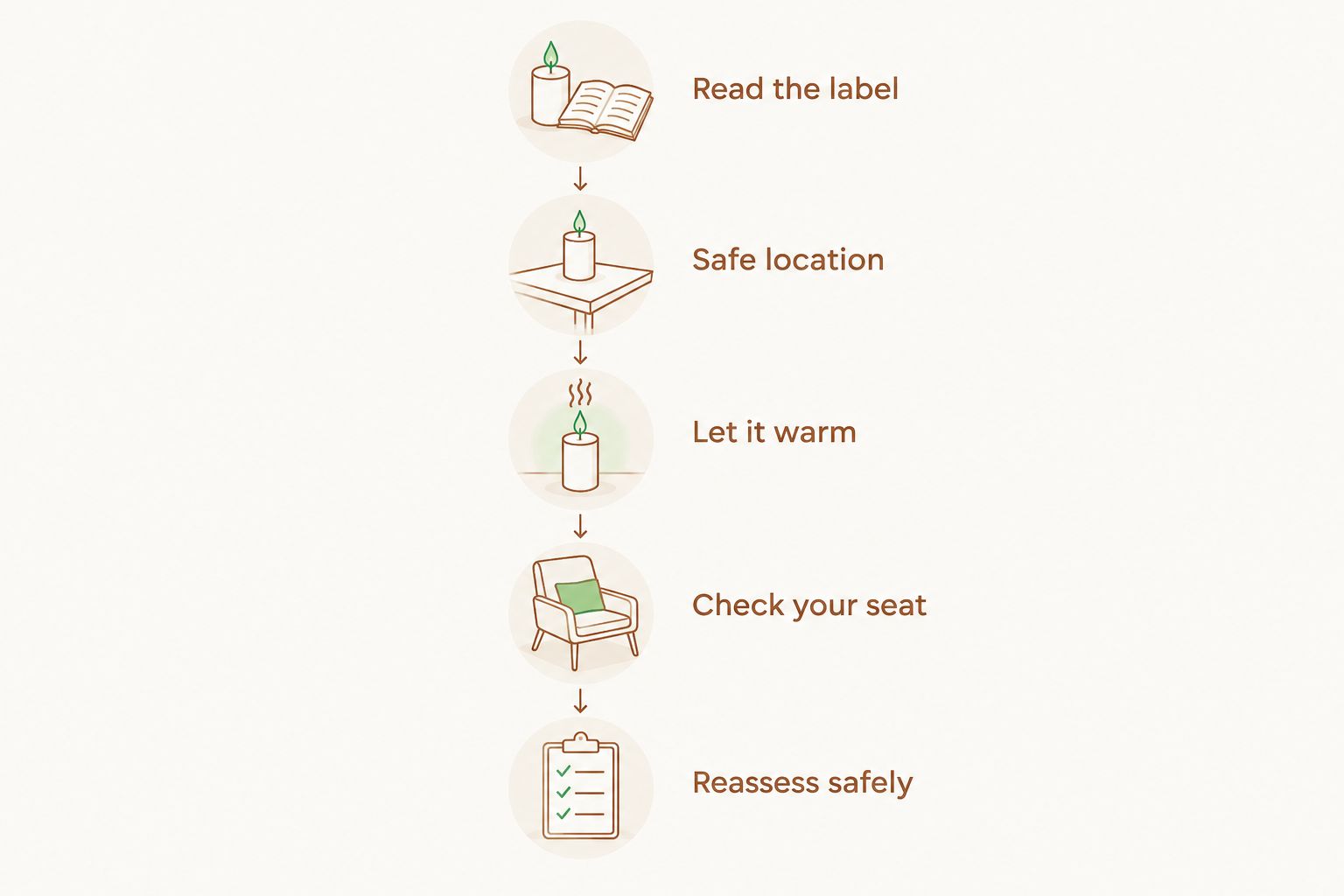
Use this sequence to assess your candle rather than setting an unsupported countdown:
- Read the label. Check the wick-care directions, placement requirements, and maximum burn duration before lighting.
- Choose a safe location. Use a stable, heat-resistant surface, away from drafts and anything that can catch fire.
- Let the candle warm. Observe from a safe distance without touching the vessel or leaning over the flame.
- Check your seat. Assess the fragrance where you normally read, work, or relax, rather than directly beside the jar.
- Reassess safely. If fragrance remains faint, check the room conditions and candle instructions. Do not keep burning past the stated limit.
A stopwatch can help you compare your own experiences, but a time recorded in one setting is not a promise for another. Keep the room and placement consistent when comparing burns. Otherwise, a change in airflow can look like a change in candle performance.
What counts as filling a room?
Define the result before judging the candle. Detecting fragrance when you approach the vessel, noticing it from your seat, and smelling it throughout adjoining spaces are different outcomes.
| Scent observation | What it tells you | Limitation | Best for |
|---|---|---|---|
| Unlit wax smells noticeable | You can detect the candle’s cold throw nearby | It does not establish performance when burning | Choosing a fragrance you enjoy |
| Fragrance is noticeable beside the burning candle | Heated fragrance is reaching the nearby air | It does not establish whole-room coverage | Checking local scent release |
| Fragrance is noticeable from your usual seat | The scent reaches your occupied area | Other parts of the room can smell different | Assessing your everyday ritual |
| Fragrance is noticeable across the room | The scent reaches several locations under current conditions | Coverage can change with ventilation or open doors | Assessing broader room coverage |
For a calming routine, whole-room intensity does not need to be the goal. A fragrance you notice comfortably from your chair can be enough. Choose comfortable scent presence over maximum intensity.
Why candle scent timing varies
The main drivers are the heated fragrance source, the space it needs to reach, and the person assessing it. These factors explain why a room-scenting claim needs context, including in 2026 product comparisons.
- Room volume and layout. A larger air volume dilutes fragrance more than a smaller one under otherwise comparable conditions. Open doorways also connect the candle to additional space.
- Airflow and ventilation. Moving air redistributes fragrance, while fresh-air exchange removes and dilutes it. A draft against the flame also creates a candle-safety problem.
- Candle construction. Wax, wick, vessel, and fragrance formulation work together as the candle burns. A jar’s size alone does not establish its scent coverage.
- Fragrance composition. Fragrance materials differ in volatility and odor character. A bold-smelling unlit candle is not proof of faster whole-room scenting.
- Burn condition. Wick condition and uneven burning affect how the candle operates. Follow its care instructions rather than improvising a fix.
- Your scent perception. People differ in smell sensitivity, and continuous exposure can make an odor less noticeable. A fading impression does not necessarily mean the candle stopped releasing fragrance.
Room size: match the goal to the space
A candle in a bounded room has a different task from one beside an open stairwell. The second setting connects to more air and more routes for fragrance to move.
The advantage of a smaller space is that local scent is easier to assess. The drawback is that a fragrance can become uncomfortable there. In an open space, distribution is less contained, so expecting one candle to scent every connected area is a poor assessment standard.
Airflow: avoid drafts without sacrificing ventilation
Do not place a candle directly beside a fan, an open window, or an air vent. The National Candle Association’s candle-safety guidance advises keeping burning candles away from drafts, vents, and air currents.
That does not mean sealing the room to trap fragrance. Keep appropriate ventilation and choose a stable location away from direct airflow. If stronger scent requires sacrificing safe placement or comfortable air quality, change the setup instead.
Fragrance perception: your nose is not a fixed sensor
Olfactory adaptation is an established sensory phenomenon: a continuously present odor can become less noticeable with exposure. It helps explain why returning to a room can make a familiar fragrance seem more apparent again.
Do not leave a burning candle unattended to test this. If another adult is present, ask whether they notice the fragrance from the same seating area. Treat the answer as a perception check, not a measurement of air quality or product safety.
How do you check a candle that seems too faint?
Start with its instructions and the room, not extra burning time. A candle should not need unsafe handling or an extended burn to pass a scent test.
Check placement first
Notice whether the candle sits beside an air outlet or near a doorway connecting to a larger space. Those conditions change where the fragrance travels.
If you need to relocate it, extinguish it and let it cool first. Never move a burning candle or a vessel containing hot liquid wax. Choose the next location for safety before considering scent distribution.
Check wick care and the burn surface
The National Candle Association recommends trimming candle wicks to 1/4 inch before lighting. Follow the candle manufacturer’s directions for its particular wick; do not trim a burning wick or reach into hot wax.
A narrow area of melted wax surrounded by a substantial unmelted ring can indicate uneven burning. Review the candle’s care directions rather than assuming that a longer burn will correct it. Do not add fragrance oil, cut extra channels into the wax, or improvise a heating method.
Keep the safety limit separate from the scent goal
The National Candle Association recommends keeping a burning candle at least 12 inches from anything that can catch fire. That clearance applies even if a closer location seems better for spreading fragrance.
Its general guidance also recommends not burning candles for more than 4 hours, while following manufacturer instructions. A shorter product-specific limit takes priority. Four hours is a safety ceiling in that general guidance, not a recommended wait for room fragrance.
For a 2026 candle-care checklist, those published safety recommendations are more useful than an unsupported room-filling timer. Extinguish the candle if burning becomes abnormal, and follow the label before relighting.
Can you tell scent strength from an unlit candle?
An unlit candle’s scent does not reliably establish its room coverage when burning. Cold throw describes fragrance from unheated wax; hot throw describes fragrance released during burning.
Cold throw is useful for deciding whether you like a scent. Its limitation is that heat changes how fragrance materials are released. Judge room performance during normal, supervised use, not by holding an unlit candle close to your nose.
Does a stronger candle scent mean a better calming ritual?
A stronger scent does not establish a better wellness effect. Comfort, personal preference, and safe use matter more than making fragrance noticeable everywhere.
In 2026, neuroscience-inspired fragrance language should remain separate from medical claims. A pleasant scent can be part of a calming ritual, but candle strength does not demonstrate treatment of anxiety, insomnia, or another health condition. Extinguish the candle if the fragrance causes discomfort.
Choosing a candle for your routine
Caftari candles are best for shoppers seeking fragrance as part of a calming self-care ritual, not a medical treatment. The Scent of Nirvana meditation candle features agarwood, also called oud, in its fragrance blend. Consider it if that fragrance direction interests you; judge its room presence in your own safe setup.
The benefit is a ready-made fragrance element for a daily ritual. The limitation is that the product’s wellness positioning does not establish a room-filling time, universal scent preference, or therapeutic outcome. Choose by the fragrance you enjoy and the use instructions you can follow.
FAQ
How long does it take for a candle to make a room smell?
There is no universal room-filling time for scented candles. Fragrance becomes noticeable as the candle warms, while room size, airflow, candle construction, and smell sensitivity determine how broadly you notice it.
Why can I smell my candle nearby but not across the room?
Nearby fragrance does not establish whole-room coverage. The scent is more diluted farther from its source, and room layout and airflow affect where it travels.
Does a full melt pool mean my candle has filled the room?
A full melt pool does not prove that fragrance has filled the room. It describes the wax surface, not scent concentration at your seat or across the space.
Should I close every window to make a candle smell stronger?
Do not sacrifice appropriate ventilation to intensify candle fragrance. Keep the candle away from direct drafts and follow its placement instructions.
How short should I trim my candle wick?
The National Candle Association recommends a wick length of 1/4 inch before lighting. Follow the candle manufacturer’s instructions for the particular wick, and trim only when the candle is extinguished and cool.
How long can I burn a candle if the scent is still faint?
The National Candle Association’s general guidance recommends no more than 4 hours, with manufacturer instructions taking priority. A faint fragrance is not a reason to exceed the candle’s stated burn limit.
Are Caftari candles a treatment for sleep problems?
Caftari candles are fragrance products for self-care rituals, not treatments for sleep problems. Use scent as an optional part of a comfortable routine, and extinguish any candle before sleeping.
One last thing
Your seat is a better checkpoint than the jar. If you enjoy the fragrance where you actually relax, the candle does not need to announce itself from every corner. If you only notice it beside the vessel, review placement and room conditions before blaming the scent.
For your next 2026 burn, note the room, placement, and whether you notice fragrance from your usual seat. Compare under similar conditions, stay within the label’s instructions, and stop when the experience is no longer comfortable. That gives you a useful personal reference without turning one observation into a universal timing claim.


