

Yes, you can travel with perfume oil on a plane in carry-on or checked baggage, provided you follow the applicable liquid and toiletry rules. For U.S. airport security in 2026, a carry-on container must hold no more than 3.4 fluid ounces (100 mL) and fit inside your quart-size liquids bag. A rollerball is still a liquid, and a secure cap matters just as much as the bottle size for protecting your belongings.
- Can you travel with perfume oil on a plane? Yes: TSA treats perfume oil as a carry-on liquid.
- Carry-on perfume oil containers must be 3.4 fluid ounces (100 mL) or smaller and fit your quart-size bag.
- Checked perfume follows FAA toiletry limits; larger baggage does not mean unlimited liquid allowance.
- Caftari perfume oils suit shoppers seeking fragrance for self-care rituals; bottle capacity still determines carry-on eligibility.
Why this matters: Airport screening rules, baggage safety rules, and practical packing solve different problems. A bottle can meet the liquid limit and still leak if its closure is damaged. Whether you choose Caftari perfume oils or another fragrance, inspect the actual container rather than relying on a travel-friendly description.
Is it safe to travel with perfume oil on a plane?
Yes—ordinary personal-use perfume oil is permitted when its packaging and quantity meet the relevant rules. The Transportation Security Administration lists perfume as permitted in both carry-on and checked bags. Its carry-on liquids rule applies to perfume oil regardless of whether you apply it with a rollerball, dropper, or spray.
For U.S. travel planning in 2026, distinguish TSA checkpoint screening from Federal Aviation Administration baggage safety requirements. TSA controls what passes through U.S. security checkpoints; FAA guidance covers restricted materials carried aboard aircraft, including the toiletry exception for perfumes.
| Packing option | Main requirement | Best for | Advantage | Limitation |
|---|---|---|---|---|
| Carry-on baggage | Each liquid container must be 100 mL or smaller and fit in your quart-size liquids bag | Keeping a small personal fragrance with you | You retain access to the bottle during your trip | Perfume shares limited bag space with other liquids |
| Checked baggage | Perfume must meet applicable FAA toiletry quantity and packaging rules | Bottles too large for the standard carry-on allowance | The TSA carry-on container limit does not apply | You cannot access it during the flight, and it needs protection from baggage handling |
The comparison concerns ordinary perfume packed for personal use. Do not assume that a bottle of concentrated fragrance-making material qualifies for the same treatment as a finished cosmetic perfume.
Carry-on perfume oil: 100 mL maximum per container
The TSA liquids rule allows containers of 3.4 fluid ounces (100 mL) or less, placed together in a single quart-size, clear, resealable bag. Each passenger is allowed one such bag. Perfume oil belongs in that bag alongside other liquids, gels, creams, and aerosols subject to the rule.
The container's capacity controls eligibility—not the amount left inside it. A nearly empty bottle labeled above the limit does not qualify simply because its remaining contents measure less than 100 mL. Choose a compliant container before you leave home.
Keep the capacity easy to identify
An original bottle with a readable capacity marking makes its size easier to establish. If you transfer perfume oil to another container, use a bottle designed for cosmetic liquids and check its stated capacity. Do not judge capacity from appearance alone.
A protective pouch does not replace the required liquids bag. Likewise, a small handbag or personal item does not create a separate liquid allowance: the same passenger-level rule applies to liquids carried through the checkpoint.
Best for carry-on: a clearly sized bottle with an intact closure that fits comfortably beside your other toiletries. Leave enough room to close the bag rather than forcing its seal around crowded containers.
Checked perfume oil: 500 mL maximum per container
FAA PackSafe guidance for medicinal and toiletry articles, including perfumes, sets a maximum of 500 mL or 0.5 kg per individual article. The combined allowance is 2 L or 2 kg per person for articles covered by that exception. These are aircraft baggage safety limits, not an invitation to fill a suitcase with fragrance.
For ordinary liquid perfume, the volume limits are the useful reference. Count other toiletries covered by the same FAA allowance when assessing your total; the allowance is not reserved exclusively for perfume oil.
In 2026, placing a bottle in checked baggage removes the standard TSA carry-on size restriction, but it does not remove FAA restrictions. Airline requirements and rules outside the United States also need checking for your itinerary.
Best for checked baggage: a larger personal-use perfume bottle that complies with the toiletry allowance and is securely packed. The trade-off is access and handling: you cannot retrieve it midflight, and the bottle needs protection from impacts and leaks.
Why perfume oil travel requirements vary
The rules depend on your journey and packaging, not on whether the fragrance sounds gentle or wellness-focused. Check these factors before deciding where the bottle belongs:
- Baggage type: Carry-on perfume passes through the checkpoint liquid rules; checked perfume follows applicable baggage safety restrictions.
- Container capacity: A partially used oversized bottle remains an oversized container for standard carry-on screening.
- Departure airport: TSA rules govern U.S. checkpoints. Another country's airport security authority sets its own screening requirements.
- Connecting flights: A transfer that requires another security check exposes your liquids to that checkpoint's rules.
- Product classification: Finished personal-use perfume and raw fragrance ingredients are not interchangeable categories for transport purposes.
- Combined toiletries: FAA quantity limits apply across qualifying medicinal and toiletry articles, not separately to each fragrance collection.
For a 2026 itinerary, check the security authority for every airport where you expect to clear screening. Check your airline's restricted-baggage guidance separately. A rule accepted at your first airport does not establish what happens at a later checkpoint.
How should you pack perfume oil before a flight?
Use a simple sequence: check the bottle, secure the closure, contain leaks, and protect the glass. These steps address compliance and the practical problem of keeping oil away from clothing, electronics, and travel documents.
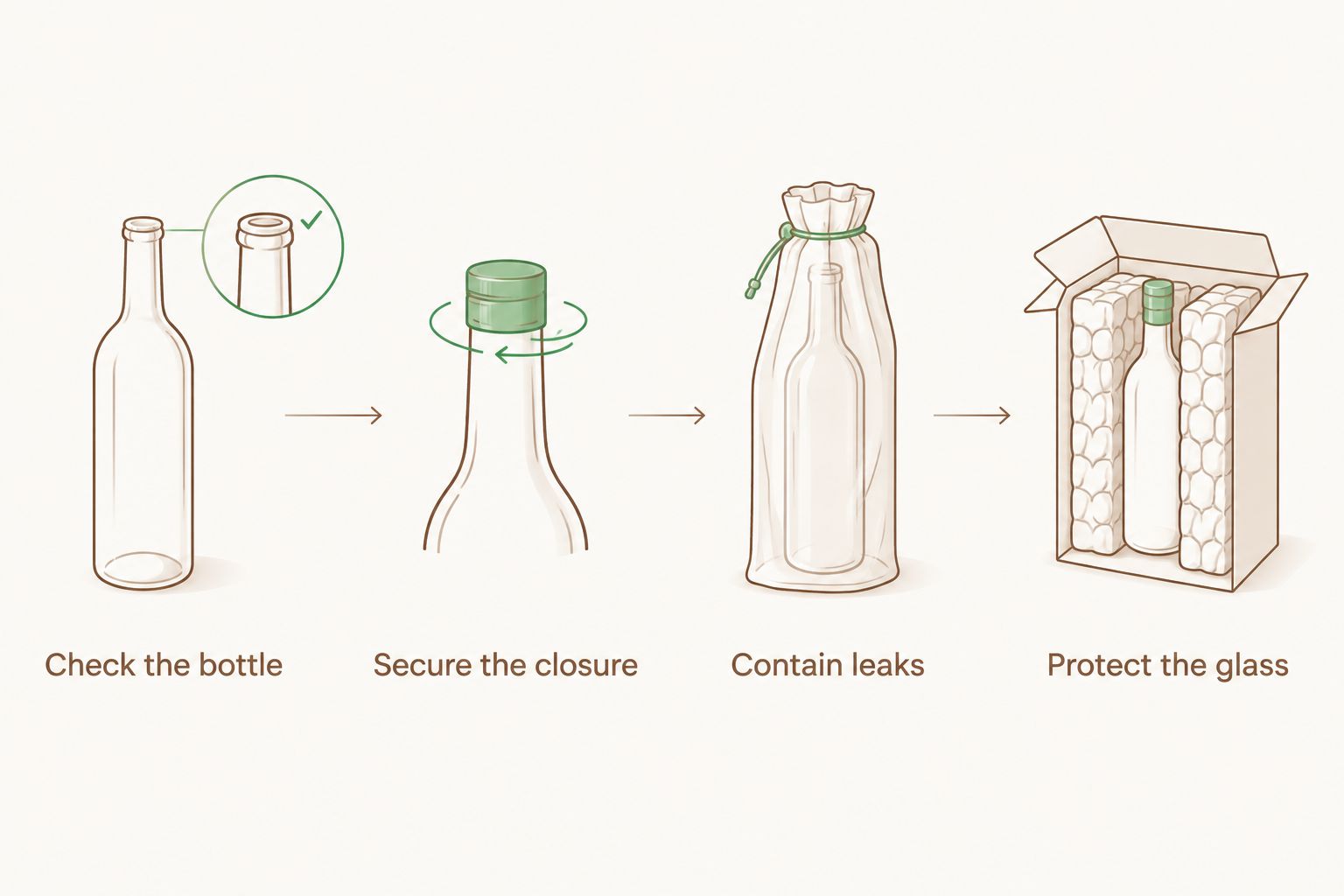
1. Check the bottle
Read the capacity marking and inspect the bottle for cracks, damaged threads, or oil around the applicator. For carry-on travel, verify that the container does not exceed 100 mL. If you cannot establish its capacity, choose a clearly marked alternative.
2. Secure the closure
Close the bottle according to its design and wipe away residue before packing. A rollerball's outer cap still matters; the ball itself is not a substitute for a secure closure. Do not pack a bottle that already leaks when handled normally.
3. Contain leaks
Use a sealed secondary pouch to keep any escaped oil away from other belongings. In carry-on baggage, the perfume still needs to fit within the required liquids bag. Secondary containment is a packing precaution, not an exemption from screening requirements.
4. Protect the glass
Cushion a glass bottle and position it away from hard objects that can strike it. In checked baggage, place the protected bottle within the packed contents rather than loose against the suitcase shell. Keep it separate from documents that oil could damage.
No packing method guarantees that a bottle will never leak. A compliant size gets the bottle through the size check; an intact closure and protective packing address the rest.
Does alcohol-free perfume oil avoid the liquids rule?
No. Alcohol-free perfume oil is still a liquid for airport screening. TSA's carry-on liquid restriction does not depend on whether a perfume contains ethanol, a carrier oil, or another liquid base.
Likewise, labels such as clean, natural, or non-toxic do not create a security exemption. They describe a product's positioning or formulation, not its permitted baggage category. Check the container capacity and the applicable transport rules independently of those claims.
Do not apply drinking-alcohol baggage allowances to perfume oil. Personal-use perfume falls under relevant toiletry guidance; beverage rules answer a different question. If a product carries unusual transport warnings, ask the airline about that specific formulation rather than treating it as an ordinary cosmetic.
Can you take rollerball perfume oil through security?
Yes. A rollerball perfume oil container of 100 mL or less can go in your carry-on liquids bag, subject to screening. The applicator changes how you dispense the fragrance, not how airport security classifies its liquid contents.
Caftari's Discovery Set - Rollerball Perfume Oils includes three full-size perfume oils, and its supplied description identifies Scent of Nirvana Perfume Oil as a 10 mL roll-on. That bottle capacity is below the TSA carry-on maximum. Check the markings on every bottle you pack rather than extending that specification to other products.
Caftari perfume oils are best for shoppers seeking fragrance as part of a daily self-care ritual. For travel, the rollerball format offers direct application without spraying; its limitation is that it still occupies liquids-bag space and needs a secure cap. A wellness-oriented fragrance is not a treatment for anxiety, insomnia, or any other medical condition.
A gift set's presentation box does not replace compliant liquids packing. If you carry several bottles, each container must meet the size rule and all must fit alongside your other permitted liquids.
Can you use perfume oil during the flight?
Permission to carry perfume does not mean that applying it is appropriate in every shared space. A rollerball avoids a spray cloud, but its fragrance can still be noticeable to nearby passengers. Save application for after landing if you want the most considerate option.
If you do apply fragrance, follow the product's directions and keep it away from shared surfaces. Do not use more because aircraft air feels dry, and do not treat scent as a solution for travel-related health symptoms.
For your 2026 travel routine, separate personal preference from health claims. A familiar fragrance can be part of a calming ritual, but packing it safely does not establish a medical benefit. Comfort also includes respecting passengers who prefer fragrance-free surroundings.
What should you check for an international flight?
Start with the airport security authority at your departure point, then check any transfer airport where you will clear security again. Rules and screening procedures are not identical everywhere. Do not assume that newer scanning equipment automatically changes the permitted liquid quantity.
Review your operating airline's dangerous-goods guidance as well. Airport security permission and airline acceptance are separate checks, especially for an unusual formulation or a quantity beyond ordinary personal use.
For international travel in 2026, retain readable product labeling and check destination customs guidance when relevant. Gifts, multiple bottles, or commercial quantities raise questions that a standard carry-on liquids rule does not answer. Keep a personal fragrance purchase separate from assumptions about importing products for resale.
FAQ
Can you travel with perfume oil on a plane in 2026?
Yes, perfume oil is permitted in carry-on and checked baggage when it meets applicable liquid and toiletry rules. For U.S. carry-on screening, each container must be 3.4 fluid ounces (100 mL) or smaller and fit in your quart-size liquids bag.
Does perfume oil count as a liquid at airport security?
Yes, perfume oil counts as a liquid at airport security. An oil base, alcohol-free formula, or rollerball applicator does not exempt it from TSA liquid requirements.
Can I bring a half-empty perfume bottle larger than 100 mL?
No, a container larger than 100 mL does not meet the standard TSA carry-on liquids rule even when partly empty. Use a compliant smaller container or pack the bottle in checked baggage if it meets the applicable toiletry restrictions.
Do I have to put rollerball perfume in my liquids bag?
Yes, rollerball perfume oil belongs in your carry-on liquids bag at U.S. checkpoints. Its container must be 100 mL or smaller, and the bag must close with your other liquids inside.
How much perfume can I pack in checked baggage?
FAA toiletry guidance limits each qualifying article to 500 mL or 0.5 kg and the combined total to 2 L or 2 kg per person. That combined allowance includes other articles covered by the same exception, not just perfume.
Is Caftari perfume oil automatically approved for flying?
No fragrance brand has a blanket exemption from airport rules. Check the capacity and closure of your Caftari perfume oil bottle, pack it under the applicable liquid rules, and follow checkpoint instructions.
Can I keep perfume oil in my purse during security?
Perfume oil in a purse still follows the same carry-on liquids rule. Put the compliant bottle in your quart-size liquids bag and follow the checkpoint's instructions for presenting that bag.
Is checked baggage safer than carry-on for a glass perfume bottle?
Neither baggage choice guarantees protection from breakage or leaks. Carry-on keeps a compliant small bottle accessible, while checked baggage accommodates larger permitted bottles but requires careful cushioning and secondary containment.
One last thing
Check the bottle's capacity, not how full it looks. This is the easiest detail to miss when you reach for a familiar perfume before leaving for the airport. A nearly empty oversized container is still oversized under the standard carry-on rule.
Before your 2026 departure, pack your complete liquids bag at home and close it. That final check reveals whether your perfume actually fits beside your skincare and other toiletries—before the checkpoint becomes the place where you have to choose what stays behind.


