

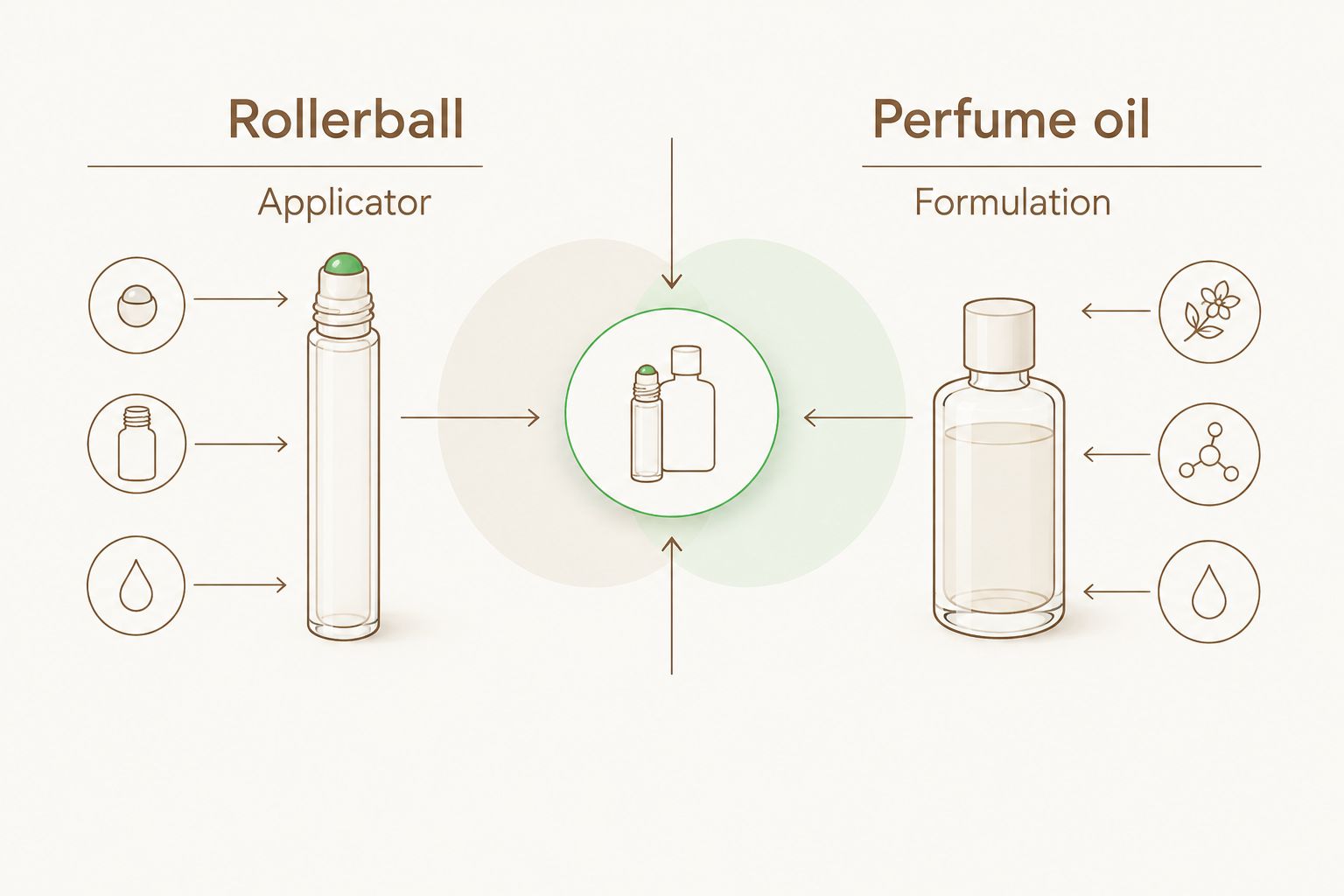
No. A rollerball is an applicator; perfume oil is a fragrance formulation. A rollerball can contain perfume oil, but the word rollerball alone does not tell you whether the liquid is oil-based. In 2026, check the product description and ingredients rather than treating the package name as a formula label.
- Is rollerball perfume the same as perfume oil? No: rollerball describes the applicator; perfume oil describes the formulation.
- Caftari rollerballs are best for shoppers who want a portable, jojoba-based fragrance ritual.
- Check the ingredients before assuming every roll-on is oil-based or every perfume oil comes in a rollerball.
- A scent can be part of a calming routine without treating a medical condition.
Is rollerball perfume the same as perfume oil?
A rollerball perfume and a perfume oil can be the same product, but the terms are not interchangeable. One tells you how the fragrance reaches your skin; the other tells you about the liquid. If you are comparing products in 2026, make the formulation—not the applicator—your first check.
| Term on the package | What it tells you | What it does not tell you | Best for |
|---|---|---|---|
| Rollerball perfume | A rolling applicator dispenses the fragrance. | Whether the liquid is oil-based. | Applying fragrance to a small area without spraying. |
| Perfume oil | The fragrance is presented in an oil-based formulation. | Whether it comes with a rollerball, dropper, or another applicator. | Shoppers who specifically want an oil-based format. |
| Rollerball perfume oil | The product combines an oil-based formulation with a rolling applicator. | Whether its scent, ingredients, or skin feel suit you. | Shoppers who want both an oil base and targeted application. |
The distinction helps you avoid buying by container alone. A photograph of a roll-on bottle cannot confirm its carrier ingredients, and a label that says perfume oil does not, by itself, establish how the product is applied.
Why this matters
A rollerball answers a practical question: How will I apply it? Perfume oil answers a formulation question: What kind of fragrance am I applying? Those are separate choices, particularly if you prefer a specific skin feel or want to avoid a spray in your daily routine.
If a rollerball is already part of your routine, the next question is how to care for it. This guide to replacing rollerball perfume covers that decision; replacement timing does not tell you whether a new rollerball contains perfume oil.
How can you tell whether a rollerball contains perfume oil?
Use the product's formulation details, not the bottle shape. Work through these checks in order:
- Read the full product name. Rollerball perfume oil names both the applicator and the formulation. Rollerball perfume names the applicator but leaves the liquid's base to the product description and ingredients.
- Look for the carrier. If the description identifies jojoba as a base, you have a concrete reason to call that formulation oil-based. Do not infer the base from scent notes such as rose, jasmine, or sandalwood; those describe how the fragrance is presented, not necessarily the complete formula.
- Check the ingredient information. The ingredients help you assess what will touch your skin. If you need to avoid a particular ingredient, check the current product information rather than relying on a general label such as clean.
- Confirm the applicator. A roll-on can make targeted application convenient, but the mechanism does not change the formulation inside. Likewise, an oil formulation does not require a rolling applicator.
- Separate scent preference from format preference. Decide whether you like the fragrance notes and whether you want the oil-and-rollerball combination. A pleasant scent is not evidence that a formula suits your skin.
These checks matter even when two products look alike. The word perfume on a label does not settle whether a product is oil-based, and the words perfume oil do not guarantee that every fragrance uses the same carrier or ingredients. In 2026, read the current listing for the specific item you plan to use.
What does the applicator change?
A rollerball brings the fragrance into contact with the spot where you apply it. That makes it useful when you want to place scent on a small area rather than distribute it through a spray. Its limitation is equally clear: the applicator tells you nothing about the liquid's carrier or whether an ingredient works for your skin.
Think of the applicator as part of the routine, not a shortcut for assessing the formula. If you like a deliberate pause when applying fragrance, a roll-on gives you a simple, repeatable action. It does not make an ingredient non-irritating, turn a fragrance into a treatment, or establish that the scent will last longer than a different format.
A spray and a rollerball also feel different to use. A spray disperses liquid through a nozzle; a rollerball transfers it by contact. Neither method is automatically better. Choose the one that matches where you want fragrance, then evaluate the actual formulation separately.
What does the oil formulation change?
An oil-based perfume uses an oil carrier for the fragrance. That is a formulation detail with practical implications: you can assess the carrier alongside the scent ingredients when deciding what to put on your skin. It does not establish that a product is suitable for everyone or that its scent will perform a certain way.
Caftari's rollerball descriptions identify jojoba and vitamin E in the base. That supports a specific conclusion about those Caftari perfume oils: they are examples of rollerballs that also contain an oil-based fragrance formulation. It does not support a conclusion about every rollerball sold elsewhere.
The carrier and the scent also answer different questions. If you are choosing between rose and sandalwood or jasmine and soft musks, you are choosing a fragrance profile. If you are checking for jojoba, you are examining the formulation. Keep both decisions visible rather than letting an appealing scent description stand in for an ingredient check.
The term non-toxic is not a substitute for that check. Caftari positions its fragrances as clean and non-toxic, but those words do not establish that any fragrance is free from the ingredient you personally need to avoid. Read the current ingredient information and stop using a product that causes an unwanted skin reaction.
Which Caftari rollerball fits your scent preference?
Caftari rollerball perfume oils are best for shoppers who want a jojoba-based fragrance they can apply as part of a daily ritual, not a product that promises a health outcome. Choose by scent notes first. The information provided for these products identifies each rollerball as a 10 ml roll-on in a jojoba and vitamin E base.
| Caftari option | Described scent notes | Best for | Limitation |
|---|---|---|---|
| Scent of Nirvana Rollerball | Oudh and patchouli | Someone drawn to those notes in a roll-on format. | Its scent profile will not suit someone looking for a floral fragrance. |
| Dolce Far Niente Rollerball | Rose and sandalwood | Someone who wants a floral note paired with sandalwood. | The description alone cannot tell you how it will smell on your skin. |
| Nidra Rollerball | Jasmine and soft musks | Someone who prefers those notes in an evening scent ritual. | A calming ritual is not a treatment for insomnia or a sleep disorder. |
Each of these Caftari rollerballs illustrates the answer to the original question: a product can be a rollerball and a perfume oil at once. Their shared 10 ml format and described base do not make the scents interchangeable. If the note combination does not appeal to you, a suitable applicator is not a reason to choose it.
For Scent of Nirvana, the clear advantage is targeted application of an oudh-and-patchouli fragrance. Its drawback is preference-dependent: those notes are not a match for every wearer. Dolce Far Niente offers rose and sandalwood in the same type of roll-on; its drawback is that a written description cannot replace smelling it. Nidra gives you jasmine and soft musks for a wind-down routine, but the fragrance should remain a sensory choice rather than a claim about sleep.


Why do rollerball perfumes vary?
The applicator is only one part of the product. These factors explain why two bottles called rollerball perfume do not necessarily offer the same experience:
- Carrier: A product description that identifies a jojoba base gives you formulation information; the word rollerball on its own does not.
- Scent notes: Oudh and patchouli, rose and sandalwood, and jasmine and soft musks describe different scent choices, even when each comes in a roll-on.
- Ingredient preferences: A clean or non-toxic positioning does not replace checking the specific ingredients against your own needs.
- Application style: A rollerball is for direct, targeted application. If you prefer a spray, the applicator itself may be the wrong fit regardless of the fragrance.
- Purpose in your routine: You might use scent as a cue to pause or wind down. That personal ritual is different from a claim that a perfume changes sleep or treats anxiety.
In 2026, the most useful comparison is between complete product descriptions, not between packaging terms. First establish what is in the bottle. Then decide whether you like the scent and the way it applies.
Can a perfume oil come without a rollerball?
Yes. Perfume oil describes the formulation, so it does not specify a rollerball applicator. Check the individual listing for how a particular perfume oil is dispensed; do not assume the word oil means roll-on.
That distinction is useful when you are browsing by scent. Finding an oil-based fragrance with notes you like settles only part of the decision. You still need to check whether its applicator fits the way you want to use it during the day.
Is every rollerball perfume alcohol-free?
No. Rollerball describes how you apply the perfume, not whether alcohol appears in the formulation. Check the current ingredients if avoiding alcohol matters to you; bottle shape is not evidence.
The same rule applies to other ingredient preferences. A targeted applicator does not verify a clean formula, and an oil-based description does not tell you every ingredient in a fragrance mixture. Read the specific product information before making that judgment.
Does perfume oil last longer than rollerball perfume?
That comparison mixes a formulation with an applicator, so it cannot produce a reliable winner. A rollerball perfume might itself be a perfume oil. To compare how fragrances wear, you need to compare the actual products rather than their format labels.
In particular, do not treat the Caftari rollerballs' shared 10 ml size as a longevity claim. Volume tells you how much product the container holds, not how long the scent remains noticeable after application. Scent choice, application habits, and the individual formula are separate considerations.
FAQ
Is rollerball perfume the same as perfume oil in 2026?
No. Rollerball names the applicator; perfume oil names an oil-based formulation. One product can be both, so check its description and ingredients.
Can a rollerball contain perfume oil?
Yes. Caftari describes its rollerball fragrances with a jojoba and vitamin E base, making them examples of oil-based perfume in a roll-on format.
Does rollerball mean a perfume is alcohol-free?
No. A rolling applicator does not identify the liquid's ingredients. Check the current ingredient information if alcohol is a concern.
Can I buy perfume oil without a rollerball?
Yes. The term perfume oil describes the formulation, not the dispenser. Check the specific product listing to confirm how it is applied.
Which Caftari rollerball should I choose for a calming ritual?
Choose by the scent notes you enjoy: Scent of Nirvana lists oudh and patchouli, Dolce Far Niente lists rose and sandalwood, and Nidra lists jasmine and soft musks. A calming ritual is a personal use of fragrance, not a medical treatment.
Is a rollerball better than a spray for targeted application?
Yes, if you want to place fragrance directly on a small area rather than disperse it through a nozzle. That preference does not establish which formulation or scent is better for you.
Does a 10 ml rollerball tell me how long its scent lasts?
No. The 10 ml figure identifies the amount of product described for Caftari's rollerballs, not how long the fragrance remains noticeable after you apply it.
One last thing
A product name can answer two different shopping questions without using two bottles. In 2026, a Caftari rollerball perfume oil means you can identify both the roll-on applicator and the oil-based format; you still need to choose the scent and check its ingredients. Buy for the formulation and fragrance you want, not for the shape of the bottle.


