

Yes, it is generally safe to apply perfume oil directly to skin when the specific product is intended for skin use and you tolerate its ingredients. Use it on intact skin, follow the label, and stop if you notice itching, burning, or a rash. An undiluted essential oil or a fragrance oil intended for candles is not automatically safe to wear.
- Is it safe to apply perfume oil directly to skin? Yes, when the product is made for skin and you tolerate it.
- Caftari’s Scent of Nirvana Perfume Oil is best for shoppers who want a portable roll-on, not an allergy guarantee.
- In 2026, check the intended use, ingredients, and your skin’s response before making perfume oil a daily ritual.
- Clean and non-toxic descriptions do not rule out fragrance sensitivity.
Why this matters
Perfume oils, essential oils, and fragrance oils can all smell appealing, but their intended uses differ. A formula designed for a roll-on belongs in a different decision category from an oil sold for a candle or diffuser. The label, not the word “oil,” tells you whether a product is meant to touch skin.
For a skin-applied format, Caftari’s Scent of Nirvana rollerball is a portable, 10 ml roll-on perfume oil described with a jojoba and vitamin E base. That description identifies its format; it does not establish that every shopper will tolerate it. Read the current product label before use, especially if you know you react to fragrance or other cosmetic ingredients.
The U.S. Food and Drug Administration’s guidance on fragrances in cosmetics identifies allergic reactions as a concern for some people. The American Academy of Dermatology also recommends testing a new skin-care product on a small area before adding it to your routine. Those are the relevant checks in 2026—not whether a fragrance is described as natural, clean, or non-toxic.
Is it safe to apply perfume oil directly to skin?
Yes, if the perfume oil is intended for direct skin application and your skin tolerates it. Follow the directions for that product rather than applying any scented oil as though all formulations were interchangeable. If your skin is already irritated or broken, leave that area alone.
| What you have | Intended-use check | Best for | Advantage | Limitation |
|---|---|---|---|---|
| Skin-use perfume oil or roll-on | Confirm that its label directs application to skin | Someone who wants fragrance applied directly to skin | The application method matches the product’s intended use | Fragrance or another ingredient can still irritate your skin |
| Essential oil | Check whether the label permits skin use and gives dilution directions | Someone willing to follow product-specific preparation instructions | Can be used as an ingredient when formulated appropriately | Undiluted application is not a safe default |
| Candle or diffuser fragrance oil | Check its stated purpose; do not treat a home-fragrance label as skin-use directions | Scenting a space as directed | Suits its labeled use | Not a substitute for a skin-use perfume |
This comparison does not rank ingredients by how natural they sound. It separates products by what their makers direct you to do with them. In 2026, that is a more useful first screen than a broad claim that one type of fragrance is always safe or unsafe.
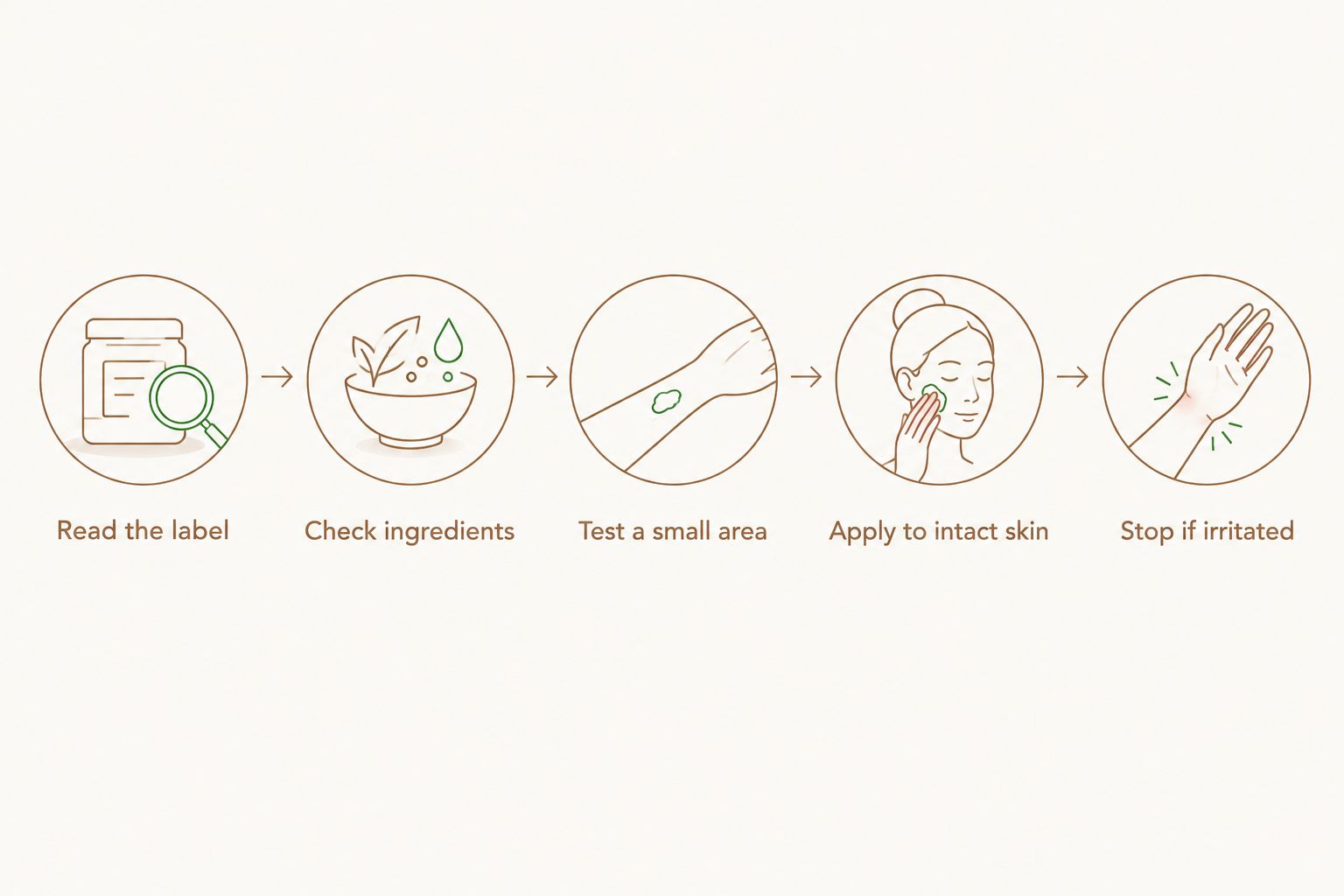
A sensible way to try a new perfume oil
- Read the label. Confirm that the product is intended to be applied to skin. Check its use directions and warnings rather than relying on the product name alone.
- Check ingredients. Look for substances you already know you react to. If an ingredient listing does not answer a question you have, ask the seller before applying the product.
- Test a small area. The American Academy of Dermatology advises applying a new skin-care product to a small test spot twice daily for 7 to 10 days and watching for a reaction. Follow the product’s directions if they call for a different approach.
- Apply to intact skin. Keep the oil away from broken or visibly irritated areas. Apply only as directed; using more does not make a reaction less likely.
- Stop if irritated. Wash off the product and discontinue use if the area becomes uncomfortable or develops a rash. Ask a dermatologist about a persistent or recurring reaction.
The small-area check is useful, but it is not a promise that you will never react later. Skin responses are individual, and a product you previously tolerated can become uncomfortable. If you are unsure whether a reaction is related to a fragrance, a dermatologist can help assess it.
Does a roll-on change the safety answer?
A roll-on changes how you dispense perfume oil; it does not remove the possibility of irritation. It also puts the applicator in contact with skin, so follow the product’s care directions and avoid using it over an irritated area. If you share fragrance with someone else, remember that their skin response tells you nothing certain about yours.
Caftari’s Scent of Nirvana Perfume Oil is best for shoppers who want a portable roll-on, not an allergy guarantee. Its described jojoba and vitamin E base gives you concrete ingredients to check against your own sensitivities. Its limitation is the same as any fragranced skin product: neither the format nor the brand’s clean, non-toxic positioning can predict individual tolerance.
Why skin tolerance varies
No single label claim can account for every person’s skin. These are the checks that change the answer to the 2026 question of whether you should apply a particular perfume oil:
- Intended use: A perfume oil labeled for skin and a fragrance oil intended for a candle serve different purposes. Do not substitute one for the other.
- Ingredient sensitivity: Fragrance ingredients and other components of a formula can cause a reaction in someone who is sensitive to them. Read the full label available for the product.
- Skin condition: Broken or already irritated skin is a poor place to test a new scented product. Wait until the area is no longer irritated.
- Amount and frequency: Follow the stated use directions. Repeated application to an area that feels uncomfortable is a reason to stop, not to keep testing it.
- Other products on the area: If you apply several new products at once, it becomes harder to identify which one coincided with a reaction. Introduce them separately.
- Sun exposure: Some essential oils, including certain citrus oils, can cause a skin reaction when followed by sun exposure. The National Center for Complementary and Integrative Health discusses this risk in its aromatherapy guidance; check the directions for any oil you intend to wear outdoors.
These factors explain why two people can use the same skin-use perfume oil and have different experiences. They do not turn a home test into a medical diagnosis. If reactions recur, a dermatologist can help you investigate the cause instead of guessing from scent notes or marketing terms.
Does “clean” or “non-toxic” mean safe for every skin type?
No. Clean and non-toxic are not guarantees that a fragranced product will suit every person’s skin. They describe a product’s positioning, not the result of an individual allergy assessment. Use the ingredient list, intended-use directions, and your own response to make the decision.
“Natural” is not a substitute for those checks, either. A plant-derived fragrance ingredient can still be a problem for someone who reacts to it. Likewise, a familiar-sounding carrier ingredient does not establish that the complete formula is right for you.
This distinction matters when you are choosing a scent for a daily self-care ritual. Caftari frames its perfume oils as clean, neuroscience-inspired fragrance products; that framing does not make them treatments for anxiety, insomnia, or any other condition. You can value the sensory routine without assigning the product a medical effect or overlooking a skin reaction.
Can you apply essential oil the same way as perfume oil?
No, not by default. A skin-use perfume oil is a finished product intended for application according to its label. An essential oil is an ingredient that requires its own use directions; do not assume it is ready to roll onto skin straight from the bottle.
The National Center for Complementary and Integrative Health advises caution with essential oils applied to skin because reactions can occur. If you are making your own blend, do not use a guess about dilution as a safety standard. Follow credible formulation guidance and the ingredient maker’s directions, or choose a finished product labeled for skin use.
Nor should you assume that any oil used to scent a room can become a perfume with the addition of a carrier oil. A product’s intended use, composition, and directions still matter. In 2026, the simplest rule remains the most practical: use a fragrance only for the purpose stated on its label.
Where should perfume oil go on your skin?
Apply it to intact skin in the locations permitted by its label, using the amount the directions specify. Avoid broken or irritated areas, and do not apply it close to your eyes or to other sensitive areas unless the product explicitly directs that use. Stop if the application site becomes uncomfortable.
There is no safety requirement to put perfume oil on a particular pulse point. Placement is a personal preference within the product’s directions, not evidence that the fragrance will provide a wellness benefit. If you plan to layer scents, test each product on its own first so you can recognize which one your skin does not tolerate.
A calm fragrance ritual can be as simple as choosing a scent you enjoy and using it as directed. That keeps the decision tied to the product in your hand rather than to a claim about what fragrance must do for your body.
Related questions
Can perfume oil cause a rash even if it is made for skin?
Yes. A skin-use label does not rule out irritation or an allergic reaction to fragrance or another ingredient. Stop using the oil if a rash develops, and seek a dermatologist’s advice if the reaction persists or keeps returning.
Should you put perfume oil on irritated skin?
No. Wait until the area is no longer irritated, and follow the product’s skin-use directions. Applying fragrance to uncomfortable skin adds another variable when you need to identify what is bothering it.
Is a perfume oil safe just because it contains jojoba oil?
No. Jojoba in a base does not establish that every ingredient in the finished perfume will suit your skin. Caftari identifies jojoba and vitamin E in its Scent of Nirvana Perfume Oil description; check the complete product label and your response to the whole formula.
FAQ
Is it safe to apply perfume oil directly to skin in 2026?
Yes, when the specific perfume oil is intended for skin use and you tolerate its ingredients. Follow its label, apply to intact skin, and stop if irritation occurs.
Do you need to dilute a roll-on perfume oil before use?
Follow the directions on that roll-on rather than assuming it needs dilution. A finished skin-use perfume oil and an undiluted essential oil are different products.
Can you apply candle fragrance oil to your wrists?
Do not treat a fragrance oil intended for candles as a skin-use perfume. Use a product whose label directs application to skin instead.
Can clean perfume oil irritate sensitive skin?
Yes. Clean positioning does not prevent an individual reaction to fragrance or another ingredient. Check the label and test a new product on a small area first.
How do you test a new perfume oil on your skin?
Check that it is meant for skin, then test it on a small area before routine use. The American Academy of Dermatology advises testing a new skin-care product twice daily for 7 to 10 days while watching for a reaction.
What should you do if perfume oil makes your skin itch?
Stop using the perfume oil and wash it off. Ask a dermatologist about itching that persists or returns with fragrance use.
Is a rollerball perfume oil safer than an essential oil?
A roll-on sold for skin use gives you directions for wearing that finished product; it is not automatically suitable for everyone. An essential oil requires its own skin-use and dilution checks.
One last thing
Check intended use before you check scent notes. In 2026, the useful distinction is still whether the bottle is a finished perfume for skin or an oil meant for another purpose. Once that is clear, your ingredient sensitivities and the product’s directions determine the next step.


