

Yes, perfume oil can cause an allergic reaction, including an itchy, delayed rash called allergic contact dermatitis. An oil-based formula, natural ingredients, or a clean label does not rule out fragrance allergy. Stop using a perfume oil that causes symptoms; breathing difficulty or swelling of your lips, tongue, or throat requires emergency care.
- Can perfume oil cause an allergic reaction? Yes; fragrance allergy can occur with natural or synthetic ingredients.
- Caftari perfume oils support a fragrance ritual, not a guarantee against allergic contact dermatitis.
- Stop applying a perfume oil that causes itching, burning, swelling, or a rash.
- Dermatologist patch testing investigates delayed contact allergy; a home spot test cannot rule it out.
Can perfume oil cause an allergic reaction?
Perfume oil can trigger allergy, irritation, or other fragrance-related symptoms, and these are not interchangeable. The fragrance ingredients matter more than whether the bottle contains an oil or an alcohol-based spray. You cannot identify the cause from the product format alone.
For shoppers exploring Caftari, the same distinction applies: a wellness-focused fragrance is still a scented product. Choose it for the ritual and scent, not as evidence that your skin cannot react.
DermNet's clinical reference on allergic contact dermatitis describes a delayed reaction that typically appears 24–72 hours after exposure. That delay explains why a perfume oil can seem comfortable when you first apply it but leave an itchy patch later.
| Reaction pattern | What you might notice | What the pattern tells you | Next step |
|---|---|---|---|
| Allergic contact dermatitis | Itching, inflamed skin, scaling, or small blisters after exposure | A delayed immune reaction is possible; appearance alone does not confirm it | Stop the product and seek assessment for persistent or recurring symptoms |
| Irritant contact dermatitis | Burning, stinging, dryness, or inflamed skin | The skin barrier can be irritated without an allergy | Stop the product and avoid further irritation |
| Contact urticaria | Raised, itchy welts appearing soon after contact | This differs from delayed contact dermatitis | Stop exposure and seek medical advice; systemic symptoms need urgent care |
| Scent-related discomfort | Headache, nausea, coughing, or discomfort without a skin rash | Symptoms alone do not establish a skin allergy | Leave the exposure and discuss recurring symptoms with a clinician |
These patterns help you describe what happened. They do not replace a diagnosis, and more than one pattern can occur together.
Why this matters
A calming fragrance ritual should not require tolerating an uncomfortable skin reaction. Fragrance preference and skin tolerance are separate questions: you can enjoy a scent and still react to an ingredient in its formula.
Caftari describes its perfume oils as clean, non-toxic, and neuroscience-inspired. Those descriptions explain the brand's positioning, but they are not a personal allergy assessment. Caftari perfume oils are best for shoppers seeking a scented self-care ritual, not shoppers seeking guaranteed freedom from fragrance allergy.
For a 2026 purchase, separate the experience you want from the safety question you need answered. Pleasant scent, an oil base, and wellness language do not establish whether a formula contains your particular allergen.
The practical benefit of perfume oil is a localized application ritual. Its limitation is direct skin exposure to a fragranced formula. If you have a confirmed fragrance allergy, choosing a different application format is not a substitute for identifying and avoiding the relevant ingredients.
What does an allergic reaction to perfume oil look like?
Allergic contact dermatitis often causes an itchy, inflamed patch where the perfume touched your skin. The area can become dry, scaly, swollen, or blistered, and a reaction can extend beyond the original application site.
Inflammation does not always look bright red. On darker skin, changes can appear darker, purple-toned, or less visually obvious, so pay attention to itching, texture, swelling, and discomfort as well as color.
The 24–72 hours after exposure pattern is a useful clue, not a diagnostic stopwatch. A rash appearing outside that window still deserves attention, especially if it returns when you use the same product.
A wrist rash also does not prove that perfume caused it. Soap, a watch strap, jewelry, and other products can affect the same area. Describe every exposure to your clinician instead of assuming the most noticeable scent is responsible.
Can perfume oil cause an allergic reaction after years of use?
Yes, previous tolerance does not guarantee future tolerance. Allergic contact dermatitis develops after sensitization, so a product you once used comfortably can later cause a reaction.
Do not repeatedly apply the oil to check whether the rash returns. Keep the bottle and ingredient information available for your appointment, but stop using it on your skin.
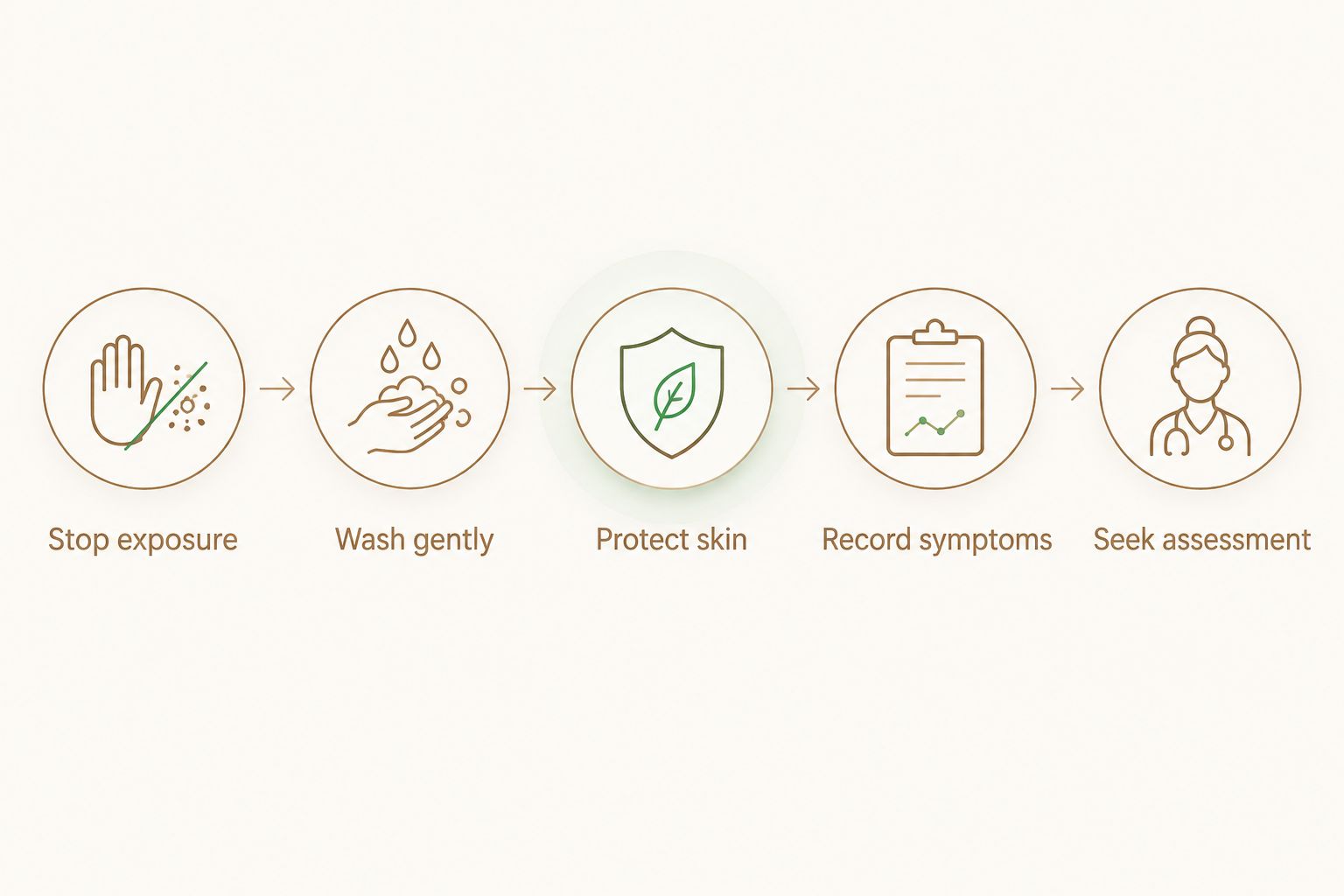
What should you do if perfume oil causes a reaction?
Stop exposure first; investigate the ingredient later. You do not need to prove that a reaction is allergic before deciding not to apply a product that makes your skin uncomfortable.
- Stop exposure. Do not reapply the perfume oil, layer another fragrance over it, or test it on a different body area.
- Wash gently. Remove remaining product with lukewarm water and a gentle cleanser you already tolerate. Avoid scrubbing, exfoliating acids, or using alcohol to remove the scent.
- Protect skin. Leave the area fragrance-free and avoid unnecessary products. A simple moisturizer you already tolerate can help dry skin; stop it if it stings or worsens symptoms.
- Record symptoms. Photograph the affected area and note the application site, symptom timing, and other products used there. Save the ingredient list and packaging.
- Seek assessment. Contact a clinician for persistent, spreading, blistering, painful, or recurring symptoms. Seek emergency help for breathing difficulty, faintness, or swelling of the lips, tongue, or throat.
Avoid choosing a medicated cream solely from an online description of a rash. The appropriate treatment depends on the diagnosis, location, severity, and your medical history.
If you need medical advice, take the actual product information rather than only the advertised scent notes. A note such as amber describes a scent impression; it is not a complete ingredient inventory.
Why reactions to perfume oil vary
People do not react to every fragranced product in the same way. Established dermatology guidance identifies several relevant differences; none lets you predict personal tolerance from a product name.
- The ingredient involved. Fragrance substances, botanical extracts, and other formula ingredients can cause contact allergy in susceptible people. The carrier oil is not automatically the cause or automatically exempt.
- Previous sensitization. Someone already allergic to an ingredient can react when exposed to it again. Past use without symptoms does not permanently exclude sensitization.
- Skin condition. Damaged or inflamed skin is more vulnerable to irritation. Applying fragrance to eczema, broken skin, or freshly irritated skin adds an avoidable exposure.
- Exposure pattern. The amount applied, frequency of use, and duration of contact affect exposure. Layering products also makes it harder to identify the source of a reaction.
- Ingredient changes during storage. Some fragrance chemicals, including limonene and linalool, form more sensitizing oxidation products when exposed to air. This does not prove that any particular bottle has caused an allergy.
For storage considerations, see the guide to whether perfume oil can go bad or expire. Expiration and allergy are different questions: a fresh product can contain an allergen, and an older bottle is not automatically the explanation for a rash.
Do clean, natural, or non-toxic perfume oils prevent allergy?
No. Clean, natural, and non-toxic descriptions do not establish that a perfume oil is allergen-free or suitable for every person with sensitive skin.
The U.S. Food and Drug Administration explains that even products marketed as hypoallergenic can cause allergic reactions. Its consumer guidance also distinguishes cosmetic marketing claims from evidence of individual tolerance.
Natural essential oils contain chemical compounds, just as synthetic fragrances do. Botanical origin does not remove the possibility of sensitization, and synthetic origin does not, by itself, establish that an ingredient will cause allergy.
For your 2026 fragrance choices, match the ingredient information to your known allergies rather than ranking safety by natural versus synthetic. If you do not know the responsible ingredient, a dermatologist can help investigate instead of having you cycle through scented products.
A fragrance-free routine avoids intentional fragrance exposure, but it still requires attention to other ingredients you personally react to. Unscented is not necessarily the same as fragrance-free; a product can contain ingredients used to mask an odor.
Can a home patch test tell you whether perfume oil is safe?
A home spot test cannot rule out perfume oil allergy. A small application that causes no symptoms does not guarantee that repeated use, a different application site, or later exposure will remain comfortable.
The phrase patch test is often used loosely in beauty advice. Medical patch testing is a controlled investigation of delayed contact allergy, not simply trying a new perfume on your wrist.
DermNet describes medical patch testing with allergens typically left in place for 48 hours, with a later reading commonly performed at 96 hours. The clinician interprets the reactions alongside your history and can decide whether further testing is needed.
These are clinical testing timings, not instructions to leave perfume oil under a bandage at home. Covering an unknown product against your skin can increase exposure and irritation.
If you have previously reacted to perfume, do not use home testing to decide whether to challenge your skin again. Ask your clinician how to assess the product and whether your own cosmetics should be included in the investigation.
How should you choose perfume oil if your skin is sensitive?
Sensitive skin is a symptom description, not an allergy diagnosis. Start with your history: whether you have reacted before, what the reaction looked like, and whether a clinician identified an allergen.
For a 2026 shopping decision, use these criteria before considering scent preference:
- Read the current ingredient information and directions, not only the fragrance notes.
- Compare the ingredients with any allergen names supplied by your dermatologist.
- Ask the manufacturer about relevant ingredients when the label is not sufficient for your allergy assessment.
- Avoid applying fragrance to actively irritated or broken skin.
- Introduce products separately rather than changing several parts of your routine together.
An ingredient list that uses a collective fragrance term might not give you enough detail to exclude a specific allergen. Lack of detail is not evidence that the allergen is present, but it is also not confirmation that it is absent.
If you have confirmed fragrance allergy, prioritize your clinician's avoidance advice over recommendations for sensitive-skin perfumes. No scented product earns a universal safe-for-allergy label from its format or marketing language.
Evidence behind this 2026 guide
The medical distinctions here follow established clinical and regulatory guidance, not claims about a particular perfume formula. The references used for this 2026 guide are:
- DermNet, Allergic contact dermatitis: delayed reaction timing, sensitization, symptoms, and clinical assessment.
- DermNet, Patch tests: the purpose of diagnostic patch testing and typical application and reading timings.
- DermNet, Contact allergy to hydroperoxides of limonene and linalool: sensitizing oxidation products of these fragrance chemicals.
- U.S. Food and Drug Administration, Allergens in Cosmetics: cosmetic allergens, labeling considerations, and the limits of hypoallergenic claims.
- American Academy of Dermatology, contact dermatitis guidance: identifying triggers, avoiding exposure, and seeking dermatologic assessment.
These sources explain general mechanisms and care principles. They do not certify an individual perfume oil as suitable for your skin, and this article does not replace medical assessment.
FAQ
Can perfume oil cause an allergic reaction even if it is alcohol-free?
Yes, alcohol-free perfume oil can cause an allergic reaction to fragrance or another ingredient. Removing alcohol does not remove every possible allergen.
How long after applying perfume oil can an allergic rash appear?
Allergic contact dermatitis typically appears 24–72 hours after exposure, according to DermNet. Timing is a clue, not proof of the diagnosis.
Does burning mean I am allergic to perfume oil?
Burning does not prove perfume oil allergy; it can occur with irritation. Stop applying the product and seek medical advice if symptoms persist, spread, or become severe.
Are natural perfume oils better for fragrance allergies?
Natural perfume oils are not automatically better for fragrance allergies. Botanical ingredients can contain allergens, so your identified triggers matter more than ingredient origin.
Can I keep using perfume oil if the rash is small?
Stop using perfume oil that causes a rash, even if the affected area is small. Repeated application adds exposure and makes it harder to let the skin recover.
Will applying perfume oil to clothes prevent an allergic reaction?
Applying perfume oil to clothes does not guarantee prevention of an allergic reaction. Fabric can contact skin, scent exposure remains, and the oil can stain; follow the product directions and your clinician's advice.
When should I get emergency help after a perfume reaction?
Get emergency help for breathing difficulty, faintness, or swelling of the lips, tongue, or throat after exposure. Do not wait to see whether these symptoms settle.
One last thing
The scent name is not the allergen name. Keep a photograph of the full ingredient information alongside a photograph of the rash; that combination gives your clinician more useful information than describing the perfume as woody, floral, or calming.
A successful fragrance ritual is one you tolerate comfortably. If the skin objects, pause the ritual rather than trying to push through it.


