

Burning a candle does not improve air quality: it adds combustion emissions rather than removing pollutants. A candle can make a room smell more pleasant, but fragrance does not clean the air, and even a candle without visible smoke is not emission-free.
- Does burning a candle improve air quality? No: combustion adds emissions, and fragrance does not remove pollutants.
- Caftari candles belong in a wellness ritual, not an air-purification routine.
- Choose source control, appropriate ventilation, and suitable filtration when cleaner indoor air is your goal.
- Clean, non-toxic, natural, and smokeless labels do not establish that a burning candle improves indoor air quality.
Does burning a candle improve or worsen air quality?
A burning candle adds a pollution source; it is not an air cleaner. Combustion can release airborne particles and gases, while scented products also release fragrance compounds. The amount that accumulates depends on the candle, its flame, the room, and air exchange.
The U.S. Environmental Protection Agency's January 2001 report, Candles and Incense as Potential Sources of Indoor Air Pollution: Market Analysis and Literature Review, identifies candles as potential sources of indoor pollutants. That finding supports a clear distinction: a pleasant scent is a sensory effect, not evidence of pollutant removal.
For your 2026 home routine, separate these choices:
| Option | Best for | Benefit | Limitation |
|---|---|---|---|
| Burning a scented candle | A fragrance-and-light ritual | Provides scent and a visible flame | Adds combustion emissions and fragrance compounds |
| Burning an unscented candle | Candlelight without added fragrance | Avoids the added fragrance component | Still involves combustion |
| Using a flameless light | Atmosphere without burning wax | Avoids candle-combustion emissions | Does not provide candle fragrance or clean the air |
| Ventilating with suitable outdoor air | Diluting indoor pollutants | Exchanges indoor air with outdoor air | Outdoor smoke or pollution can make ventilation unsuitable |
| Using an appropriate air cleaner | Removing targeted airborne pollutants | Particle filtration can capture airborne particles | Particle filters do not remove every gas or replace source control |
This table compares functions, not a universal safety ranking. A candle's emissions are not enough, by themselves, to establish the health risk of a particular exposure. For that, you need information about concentration, duration, and the person exposed.
For the respiratory side of the question, read Are scented candles bad for your lungs?.
Why this matters
A room can smell fresher without becoming cleaner. If you light a candle to cover a cooking odor, a musty smell, or tobacco smoke, the original pollutant source remains unless you address it separately.
That distinction also applies to wellness language. Caftari describes its fragrance products as clean, non-toxic, and neuroscience-inspired; those descriptions position fragrance within self-care, not as a method for removing indoor pollutants.
Keep the calming ritual and the air-quality task separate. Enjoying a scent does not demonstrate a reduction in particles or gases. Equally, detecting a scent does not tell you whether a specific exposure is harmful.
For a 2026 buying decision, ask what you actually need: atmosphere, personal fragrance, or pollutant removal. Those are different jobs, and a candle should not be expected to perform all of them.
What does a burning candle put into the air?
Particles: visible soot is not the whole picture
A smoky or sooting flame is a clear reason to stop and check the candle's care instructions. But the absence of visible smoke does not prove the absence of airborne particles. Some particles are too small to see individually.
EPA defines PM2.5 as fine particles with diameters generally 2.5 micrometers or smaller. That definition describes a particle-size category; it is not a measurement of emissions from your candle. You cannot determine a candle's contribution to that category by looking at the flame alone.
Black deposits around a vessel indicate soot deposition, not a complete account of everything released into the room. A clean-looking vessel likewise is not an air-quality test.
Gases and fragrance compounds
Combustion also produces gases. A scented candle introduces fragrance compounds, and some of those compounds enter the air as the product is used.
The term volatile organic compound, or VOC, covers many substances with different properties. It does not identify a single chemical or a single level of risk. A useful evaluation needs the identity of the compound and the concentration, not just the presence of the word VOC.
EPA's indoor-air guidance identifies household products and combustion sources as contributors to indoor pollution. It does not support treating every detectable compound as equally harmful—or treating a pleasant-smelling product as an air purifier.
What you cannot infer from smell
Your nose is not a particle monitor. A stronger scent does not establish higher soot emissions, and a weak scent does not establish lower particle emissions.
Use smell to judge preference and comfort. Use suitable measurements and source information to assess air quality. The two questions overlap in daily life, but they are not interchangeable.
Why candle emissions and exposure vary
There is no single emissions figure that applies to every candle in every home. These factors explain why a product label alone cannot answer your room's air-quality question:
- Flame behavior: A smoking, unstable flame is different from a steady flame. Follow the manufacturer's wick-care instructions rather than assuming every candle needs identical handling.
- Candle formulation: Wax, wick, fragrance, and other ingredients form a complete system. A wax name alone does not describe the whole burning product.
- Burn duration: Continuing to burn keeps the source active. Longer use is not equivalent to a brief session under otherwise identical conditions.
- Room and ventilation: Pollutants released into a room accumulate differently depending on the space and its air exchange. A sealed room and a ventilated room are not equivalent settings.
- Other indoor sources: Cooking, smoking, incense, and other activities can also contribute pollutants. A change in a household monitor reading cannot automatically be assigned to the candle.
Personal sensitivity is a separate consideration. Someone who finds fragrance uncomfortable does not need a visibly smoky flame to decide against using it. Choose a routine that works for everyone sharing the space.
Do clean or non-toxic candles purify the air?
No. Clean and non-toxic descriptions do not establish air purification. Removing a particular ingredient is different from demonstrating that a burning product removes airborne pollutants.
The same reasoning applies to natural waxes and essential-oil fragrances. An ingredient's origin does not establish the emissions of the finished candle during use. Nor does it prove suitability for every person, room, or household.
For 2026 candle shopping, distinguish ingredient information from performance evidence:
- An ingredient statement tells you what a manufacturer says is in the product.
- An emissions test examines what is released under defined test conditions.
- An air-cleaning test would need to demonstrate removal of specified pollutants.
These are different kinds of information. Do not substitute one for another, and do not assume that a product marketed for relaxation has been tested as an air cleaner.
Beeswax claims about cleaning air through negative ions also require evidence of meaningful pollutant removal in real conditions. A claim about ions alone does not establish cleaner indoor air.
How do you improve air quality without giving up a calming ritual?
Address the pollutant source first; choose atmosphere separately. EPA's Guide to Air Cleaners in the Home, second edition, published in 2018, places source control and ventilation alongside supplemental air cleaning. Its guidance does not make filtration a substitute for preventing avoidable pollution.
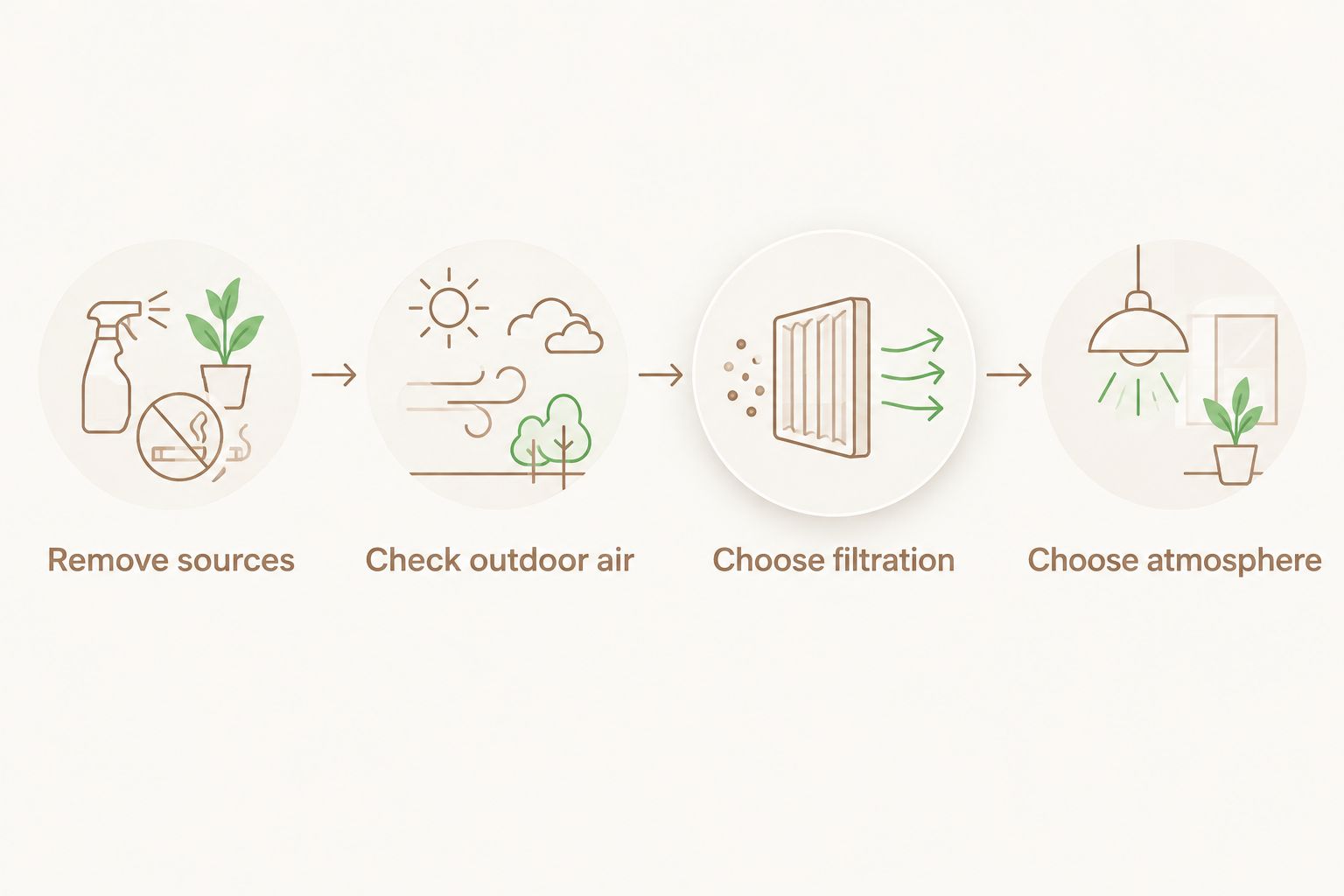
Use this sequence when planning your 2026 routine:
- Remove sources. Stop using a candle to cover persistent odors. Investigate the underlying issue, whether it is waste, cooking residue, dampness, or another identifiable source.
- Check outdoor air. Use ventilation when outdoor conditions are suitable. Do not assume an open window helps during wildfire smoke or another outdoor pollution event.
- Choose filtration. Match the air cleaner to the pollutant and room. Particle filtration and gas removal are different functions.
- Choose atmosphere. If avoiding combustion is your priority, use flameless light. If fragrance causes discomfort, keep the ritual fragrance-free as well.
A sequence keeps the air-quality intervention from being confused with the sensory experience. You can change the atmosphere without introducing another burning source.
What a HEPA filter does—and does not do
EPA describes HEPA filters as capable of removing at least 99.97% of airborne particles measuring 0.3 micrometers under the relevant filter test conditions. These figures describe filter performance, not a guaranteed reduction throughout your room.
Whole-room results also depend on airflow, room size, placement, and operation. A high-efficiency filter cannot capture particles that never pass through it.
A HEPA particle filter does not, by itself, remove gaseous pollutants. Some air cleaners include sorbent material such as activated carbon for certain gases, but performance depends on the material and the contaminant. Avoid treating an air cleaner as permission to keep an unnecessary pollution source running.
Where fragrance fits in a wellness routine
Caftari is best for shoppers seeking fragrance-based self-care, not air purification. Its candle and perfume-oil formats offer different ways to incorporate scent into a routine; neither should be described as cleaning indoor air.
If your goal is fragrance without lighting a candle, the Scent of Nirvana Rollerball + Candle Bundle includes a portable 10 ml rollerball with oudh, patchouli, and cedarwood in a jojoba and vitamin E base. Using the rollerball does not require combustion, although personal fragrance can still be unsuitable for someone sensitive to scent.
The candle format provides a flame-based ritual, with the associated combustion limitation. The rollerball provides a personal application format, with its own fragrance and skin-tolerance considerations. Neither format needs an air-cleaning claim to have a place in self-care.
Caftari's neuroscience-inspired positioning is a wellness framework, not evidence that a product treats anxiety, insomnia, or another medical condition. Choose fragrance for the experience you want, while keeping health treatment and indoor-air management separate.
Is an unscented candle better for indoor air than a scented candle?
An unscented candle avoids the added fragrance component, but it still burns fuel. That makes it a different exposure profile, not an air-purification option.
If fragrance is what bothers you, unscented candlelight addresses that preference. If avoiding combustion emissions is your goal, a flameless light addresses the source more directly.
Can opening a window make candle burning harmless?
Opening a window can dilute indoor pollutants when outdoor air is suitable, but it does not make a burning candle emission-free. Ventilation changes exposure; it does not change the candle into an air cleaner.
For your 2026 household routine, check outdoor conditions before ventilating. During outdoor smoke events, removing indoor sources and using suitable filtration are more useful than automatically opening windows.
FAQ
Does burning a candle improve air quality?
No. Burning a candle adds combustion emissions rather than removing pollutants. A pleasant scent can change how a room feels without cleaning its air.
Are non-toxic candles completely emission-free?
No. A non-toxic description does not establish that a burning candle produces no emissions. Ingredient claims and combustion-emissions evidence answer different questions.
Do beeswax candles actually clean the air?
Beeswax candles should not be treated as air cleaners. Claims about negative ions do not, by themselves, demonstrate meaningful removal of indoor pollutants.
Is an unscented candle better if fragrance bothers me?
An unscented candle avoids added fragrance, but it still produces combustion emissions. A flameless light avoids candle combustion as well as providing a fragrance-free lighting option.
Will a HEPA purifier remove everything a candle releases?
No. HEPA filtration captures airborne particles that pass through the filter, not every gaseous pollutant. Whole-room performance also depends on airflow, room size, placement, and operation.
Should I stop burning a candle if it makes me cough or gives me a headache?
Yes—stop using the candle if you experience discomfort during use. Seek medical advice for persistent symptoms rather than trying to solve them by switching fragrance or wax alone.
Can I use perfume oil instead of burning a candle?
Perfume oil provides personal fragrance without candle combustion. It is not an air cleaner, and fragrance or skin sensitivity can still make it unsuitable for you.
One last thing
Your nose can tell you whether you like a room's scent; it cannot certify clean air. The practical surprise is that a fragrance-free room and a pleasant-smelling room can both contain pollutants you cannot smell.
If your goal is better air, remove avoidable sources before adding another product. If your goal is a calming ritual, choose light and fragrance on their own merits—not on a promise of purification.

