

Burn a new container candle long enough for the melted wax to spread evenly across the surface, but never beyond the candle’s labeled burn limit. There is no single first-burn duration that fits every candle; the vessel, wax, and wick change how quickly the surface melts. For your 2026 candle-care routine, follow the label before any rule about reaching the edges.
- How long to burn a new candle the first time depends on its label and how evenly the wax melts.
- An even melt pool helps limit candle tunneling; never extend a burn beyond the labeled maximum.
- The National Candle Association recommends trimming conventional wicks to 1/4 inch before lighting.
- Caftari candles suit shoppers seeking fragrance for a calming ritual, not a treatment for sleep or anxiety.
How long should you burn a new candle the first time?
Use the manufacturer’s burn instructions as your limit and the wax surface as your progress check. For a container candle, an even pool of melted wax is a useful first-burn goal. It is not permission to keep burning indefinitely.
The National Candle Association’s Candle Safety guidance generally recommends burning candles for no longer than 4 hours and letting them cool for at least 2 hours before relighting. Those are general safety recommendations, not a promise that every new candle needs a 4-hour first burn. A shorter limit on your candle’s label takes priority.
Fragrance strength is a separate question. If you are waiting for the smell to become noticeable, read about how long a scented candle takes to fill a room rather than extending the session past its safe limit.
| What you see | What it means for the first burn | What to do |
|---|---|---|
| Melted wax spreading evenly | The candle is developing an even surface melt | Continue only within the labeled limit |
| A narrow melted center with solid wax around it | The surface has not melted evenly yet | Monitor it; do not exceed the limit to force the edges |
| A steady flame without visible smoke | No obvious flame disturbance | Keep supervising the candle |
| Persistent smoke or repeated, excessive flickering | The candle needs attention | Extinguish it and check its care instructions |
| The labeled maximum has been reached | The session is finished | Extinguish it, even if some edge wax remains |
These checks apply to container candles. Pillars, tapers, and other candle formats have different care requirements, so do not use a jar’s edge-to-edge melt goal for every candle you own.
Why this matters
A short session can leave a depression around the wick while wax remains along the vessel wall. Repeated burns can deepen that depression, commonly called tunneling. The result is uneven wax use, not a reason to ignore safety instructions.
The opposite mistake is chasing a perfectly liquid surface for too long. Continued burning keeps heating the candle and its container; an attractive melt pool does not establish that an extended session is safe.
For candle care in 2026, keep the priorities in this order: safe placement, a supervised flame, the labeled limit, then an even melt pool. Appearance comes last. A candle with some unmelted edge wax is preferable to a candle left burning beyond its instructions.
How do you prepare a candle for its first burn?
The first burn begins before you light the wick. Set up the candle where you can leave it undisturbed and watch it throughout the session.
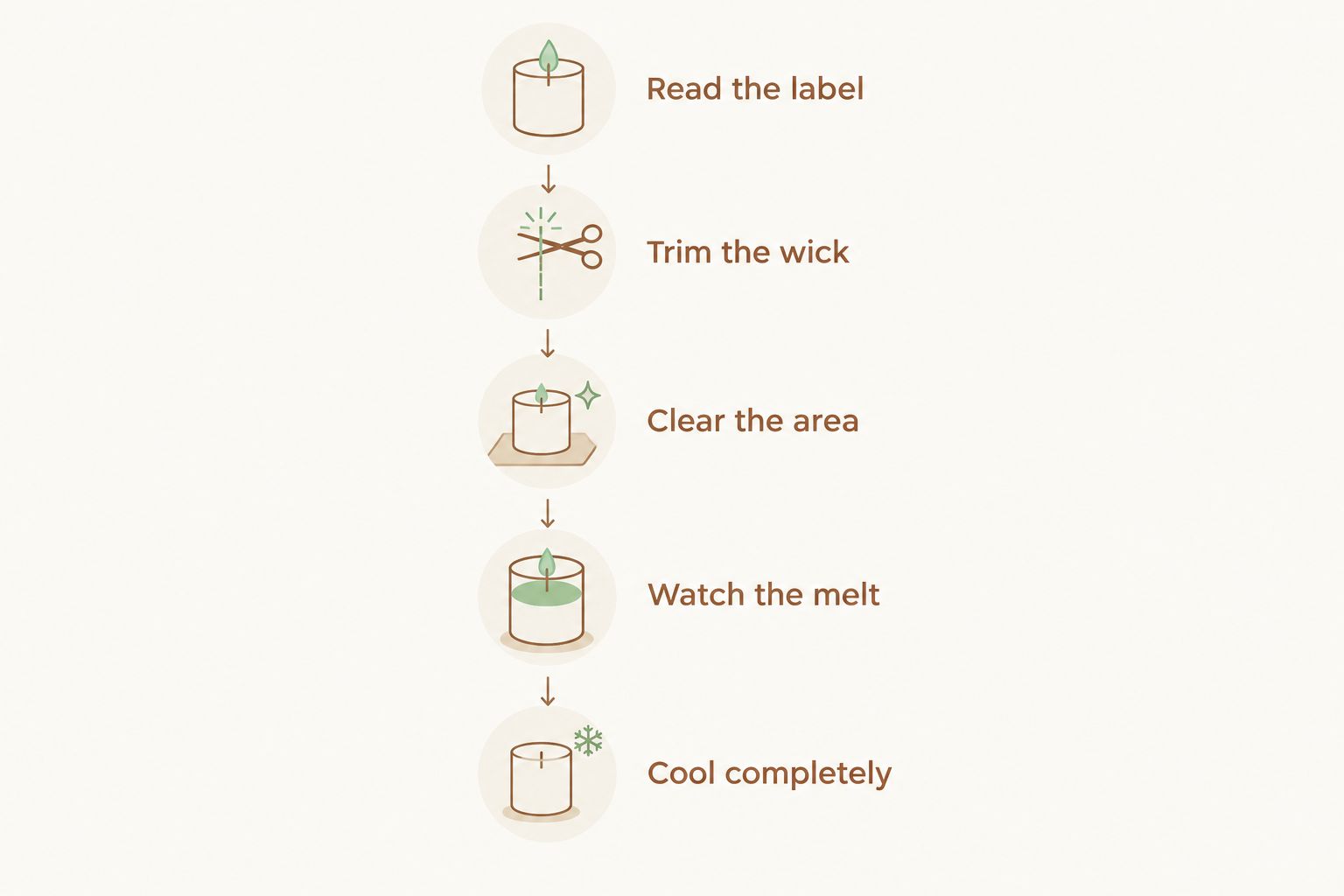
Read the label
Look for the maximum burn duration, wick-care instructions, placement warnings, and the point at which you should stop using the candle. Keep any care card that came with it. Product-specific instructions matter more than a general candle-care shortcut.
Do not transfer directions from another candle simply because the jars look similar. A different wax blend or wick arrangement can require different care, even when the vessels appear alike.
Trim the wick
The National Candle Association recommends trimming conventional wicks to 1/4 inch before burning. Remove the trimmed piece rather than leaving it in the wax. A long wick can contribute to a larger flame and soot.
Follow the maker’s directions for wooden or other specialized wicks. The general cotton-wick recommendation is not a substitute for instructions written for a different wick design.
Clear the area
Place the candle on a stable, heat-resistant surface. The National Candle Association recommends keeping burning candles at least 12 inches from anything that can catch fire, including curtains, books, and decorations.
Keep the candle away from drafts, children, and pets. Leave enough clear space that you will not need to reach across the flame or move the jar while it is hot.
Watch the melt
Light the candle according to its instructions, then observe both the flame and the wax surface. Look for steady melting rather than a particular scent intensity. Never leave the room with the candle burning unattended.
Cool completely
Extinguish the candle with a suitable snuffer, or use the method the manufacturer recommends. Confirm that the wick is no longer glowing. Leave the candle in place while the wax and vessel cool; do not carry a container of hot liquid wax.
Why first-burn time varies
The same timer setting does not produce the same melt pool in every candle. These physical differences explain why the candle’s own instructions are the right starting point.
- Vessel width: A wider surface puts more wax farther from the flame. Diameter affects how the melt pool spreads; height alone does not tell you the first-burn duration.
- Wax formulation: Different waxes and blends have different melting behavior. A wax name does not establish a universal safe session length.
- Wick design: Wick size and construction affect fuel delivery and flame behavior. Follow the care directions for the wick actually in the candle.
- Wick arrangement: Multiple wicks distribute heat differently from a single wick. Do not calculate a burn limit by multiplying or dividing by wick count.
- Room conditions: Drafts disturb the flame and can make melting uneven. Keep the candle in a suitable location rather than trying to compensate with a longer session.
Do not use “an hour per inch” as an automatic safety rule. A vessel measurement cannot account for all these differences, and it cannot override the manufacturer’s maximum.
In 2026, the useful information remains on the care label—not in a universal timer formula. Record the instructions somewhere convenient if you are likely to discard the packaging.
Should you wait until the wax reaches every edge?
Aim for an even surface melt when the candle’s instructions support it, but stop at the labeled maximum. Reaching the wall is a care goal, not the overriding safety test.
A thin rim of unmelted wax does not justify another unattended stretch of burning. Assess the candle again after it has cooled, then follow its directions on the next session. If the uneven melt persists, ask the manufacturer for product-specific advice.
Also distinguish a shallow rim from a deep tunnel. They are not the same observation, and neither tells you to improvise a hotter setup. Keep the vessel uncovered unless the manufacturer explicitly provides a safe accessory and instructions for its use.
What happens if you blow out a new candle too soon?
A short first burn can leave the melted area concentrated near the wick, but it does not automatically ruin the candle. Let it cool, then return to the labeled care routine for the next session.
Repeated short burns can reinforce uneven melting. The practical response is to choose a time when you can supervise the candle for its recommended session—not to add extra hours later as compensation.
For your 2026 routine, decide whether you have time before lighting. If you are about to leave, start cooking, or go to bed, save the candle for another occasion. Extinguishing early is always better than leaving a flame unattended.
Can you fix tunneling by burning the candle longer?
Do not extend a burn beyond the label to fix tunneling. Additional heat is not a general-purpose repair, particularly when you do not know why the candle is melting unevenly.
Start with the basics after the candle cools: check the wick, remove loose debris, and choose a draft-free location. Read any troubleshooting directions supplied by the manufacturer. Persistent problems belong with the maker rather than a generic online repair method.
Avoid pouring out hot wax, adding another wick, or wrapping the vessel in foil to concentrate heat. These changes alter the candle’s intended setup. A tidier wax surface is not worth creating an uncontrolled burn condition.
When should you extinguish the candle immediately?
End the session when something looks wrong, even if your timer has not finished. Persistent smoke, an unusually large flame, a damaged vessel, or a wick that has moved toward the container wall warrants stopping and checking the instructions.
Never use water to extinguish a candle. The National Candle Association warns that water can cause hot wax to splatter and can break a glass container. Do not move the vessel to a sink while it is burning or hot.
Keep the wax pool free of matches, wick trimmings, and other debris. If debris catches fire, treat it as a fire hazard rather than continuing the session to preserve an even melt pool.
For container candles, the National Candle Association recommends discontinuing use when 1/2 inch of wax remains; stop sooner if the manufacturer requires it. That end-of-life rule matters on later burns, even if the first session went perfectly.
How does a candle fit into a calming evening routine?
A candle can serve as a sensory cue for a quiet activity: reading, gentle stretching, or sitting without a screen. The ritual depends on your preferences and setting. It does not require a stronger fragrance or a longer burn.
Caftari candles suit shoppers seeking fragrance for a calming ritual, not a treatment for sleep or anxiety. Caftari’s Scent of Nirvana is one option for that setting; its own care instructions should determine how you burn it.
The benefit of choosing fragrance for a routine is personal enjoyment. The limitation is equally clear: clean or non-toxic positioning does not remove flame precautions, guarantee comfort for fragrance-sensitive people, or establish a medical effect. If the scent feels uncomfortable, extinguish the candle and ventilate the space.
Keep your 2026 evening ritual compatible with staying awake and attentive. Extinguish the candle before becoming drowsy, and never treat a burning candle as an overnight sleep aid.
FAQ
How long to burn a new candle the first time?
Burn a new container candle according to its label, aiming for an even surface melt without exceeding the stated maximum. The wax, vessel, and wick prevent one duration from fitting every candle.
Is a 4-hour first burn necessary for every candle?
No, a 4-hour first burn is not necessary for every candle. The National Candle Association’s general recommendation is to burn candles for no longer than 4 hours; a shorter manufacturer limit takes priority.
Should the wax melt all the way across on the first burn?
An even surface melt is a useful goal for a container candle, but the labeled burn limit comes first. Extinguish the candle at that limit even if some wax remains solid at the edges.
How short should I trim a new candle wick?
The National Candle Association recommends trimming conventional wicks to 1/4 inch before burning. Follow the manufacturer’s instructions for wooden or other specialized wicks, and remove loose trimmings from the wax.
Did I ruin my candle by blowing it out early?
An early first extinguishing does not automatically ruin your candle. Let it cool and follow the manufacturer’s recommended care on the next burn rather than adding extra time to compensate.
Can I leave a new candle burning while I sleep?
Never leave a candle burning while you sleep. Extinguish it before you become drowsy, and keep every burning candle under supervision.
Do non-toxic candles need different fire precautions?
Non-toxic candles still need standard fire precautions. Caftari candles and other fragrance candles require safe placement, supervision, and adherence to their own care labels.
How much wax should remain when I stop using a jar candle?
The National Candle Association recommends stopping use of a container candle when 1/2 inch of wax remains. Stop sooner if the manufacturer gives a more conservative instruction.
One last thing
Your timer is a reminder, not a supervisor. Set it when you light the candle, but continue watching the flame and extinguish it before leaving—even if the timer has time remaining.
Photograph the care label before discarding the packaging. That gives you the correct wick instructions, session limit, and stopping point when you next need them, without relying on a rule meant for another candle.

