

Budget the complete delivered cost per employee in 2026: the gift set, applicable taxes, delivery, and any separately quoted packaging or customization. Divide the approved total by the number of recipients, and keep any shared setup charges visible rather than treating the product subtotal as your entire budget. Choose a gift only after its delivered cost fits your employee-level ceiling.
- How much to budget for corporate gift sets depends on delivered cost, not the product subtotal.
- Caftari wellness gifts suit fragrance-interested recipients; scent preference still matters.
- Corporate gifting budgets should include quoted packaging, delivery, applicable taxes, and shared setup charges.
- Keep employee gift budgets consistent within the same recognition occasion.
How much should you budget for a corporate gift set per employee?
Your per-employee budget should cover everything required to put the chosen gift into that employee's hands. For a wellness gift such as the Caftari Signature Gift Set, evaluate the complete order rather than the product alone. Confirm what the current quote includes before requesting additional presentation or corporate branding.
Use this breakdown when approving your 2026 corporate gifting budget:
| Budget component | What to confirm | How to account for it |
|---|---|---|
| Gift set | Exact contents and selected quantity | Include the quoted product subtotal |
| Packaging | What is included and what is additional | Add only separately charged presentation costs |
| Customization | Branding, packaging, and any setup requirements | Separate shared charges from per-gift charges |
| Delivery | Destination list and delivery method | Use the quote for the actual destinations |
| Taxes and duties | Charges applicable to the order | Confirm treatment with procurement or finance |
| Order changes | Approval process for replacements or additions | Define how extra spending gets authorized |
Per-employee delivered cost = total approved gifting cost divided by recipient count. If your team also tracks internal administration, record that separately so the gift budget and staff workload remain distinguishable.
Do not treat a quote for a single delivery address as the budget for individually addressed employee gifts. Ask for the delivery arrangement you actually intend to use. The quote must match the plan.
Why this matters
A gift-set subtotal answers what you are buying, not what the program requires. Packaging decisions, recipient addresses, and the number of gifting occasions belong in the approval process because they determine the scope of the order.
The recipient experience matters just as much. A scented gift is personal, and a higher spending ceiling does not make fragrance suitable for every employee. Give recipients a discreet way to request an alternative without explaining a health condition or personal preference.
For wellness gifts, keep the message modest: appreciation and an invitation to a personal ritual. Do not promise better sleep, lower anxiety, or improved employee performance. A gift is not a health intervention.
Build your budget from the recognition occasion
Start by naming the reason for the gift. An onboarding welcome, a work anniversary, and a company-wide thank-you serve different purposes, so they need separate approval rules even when you use the same supplier.
Write a short brief before comparing sets. State who receives the gift, what the occasion recognizes, whether recipients choose an option, and where delivery takes place. This prevents a visually appealing product from becoming the budget's starting point.
Company-wide appreciation: prioritize consistent treatment
Best for: an occasion shared by the whole team. Use the same delivered-cost ceiling and selection process for employees covered by that occasion. Consistency does not require everyone to receive the same fragrance.
The advantage is a clear rule that employees and managers can understand. The limitation is that a uniform product can miss individual preferences. Keep the spending framework consistent while allowing an appropriate alternative.
Onboarding gifts: define eligibility before ordering
Best for: welcoming employees through an established onboarding process. Specify the event that authorizes the order, the person responsible for confirming the address, and the budget owner. A welcome gift should not depend on whether a manager remembers to request it.
The advantage is a repeatable approval process. The limitation is ongoing administration as employees join at different times. The guide to connecting corporate gifting to your HR onboarding workflow covers that operational question separately.
Work anniversaries: budget for the program, not one shipment
Best for: recognition tied to defined employment milestones. Document which milestones qualify and whether the gift selection changes between them. Use the same rule for employees reaching the same milestone.
The advantage is a recognition occasion with clear eligibility. The limitation is that a single order does not describe the annual commitment. Your 2026 forecast should use the expected eligible recipient list, then update it as that list changes.
| Occasion | Best for | Budget priority | Main limitation |
|---|---|---|---|
| Company-wide appreciation | Shared team recognition | Consistent delivered-cost ceiling | One fragrance does not suit everyone |
| Onboarding | New-employee welcome | Clear authorization and delivery ownership | Requires ongoing administration |
| Work anniversaries | Defined service milestones | Annual eligibility forecast | Recipient counts change |
These are planning categories, not spending tiers. Choose the occasion first, then obtain quotes against the same brief.
Why corporate gift-set budgets vary
The following decisions change what you are asking a supplier to quote. Resolve them before comparing proposals, rather than using an unspecified allowance for every employee.
- Gift contents: Confirm the exact items in the proposed set. Compare equivalent contents rather than names such as premium or deluxe.
- Packaging scope: Distinguish included packaging from separately requested presentation. Ask what the quoted package contains.
- Corporate customization: Specify the branding or packaging you want. Request a separate breakdown for shared setup and per-gift work.
- Delivery destinations: Decide between a consolidated shipment and individual delivery. Supply the intended destination information for quoting.
- Recipient count: Use the approved eligibility list. Ask for an updated quote when the scope changes; do not assume a quantity discount.
- Gifting frequency: Separate a one-time occasion from a recurring program. Forecast each approved event rather than treating the first order as the annual budget.
A supplier comparison is only useful when these decisions stay consistent. If one proposal includes personalization and another does not, the totals describe different orders.
Approve the budget before choosing extras
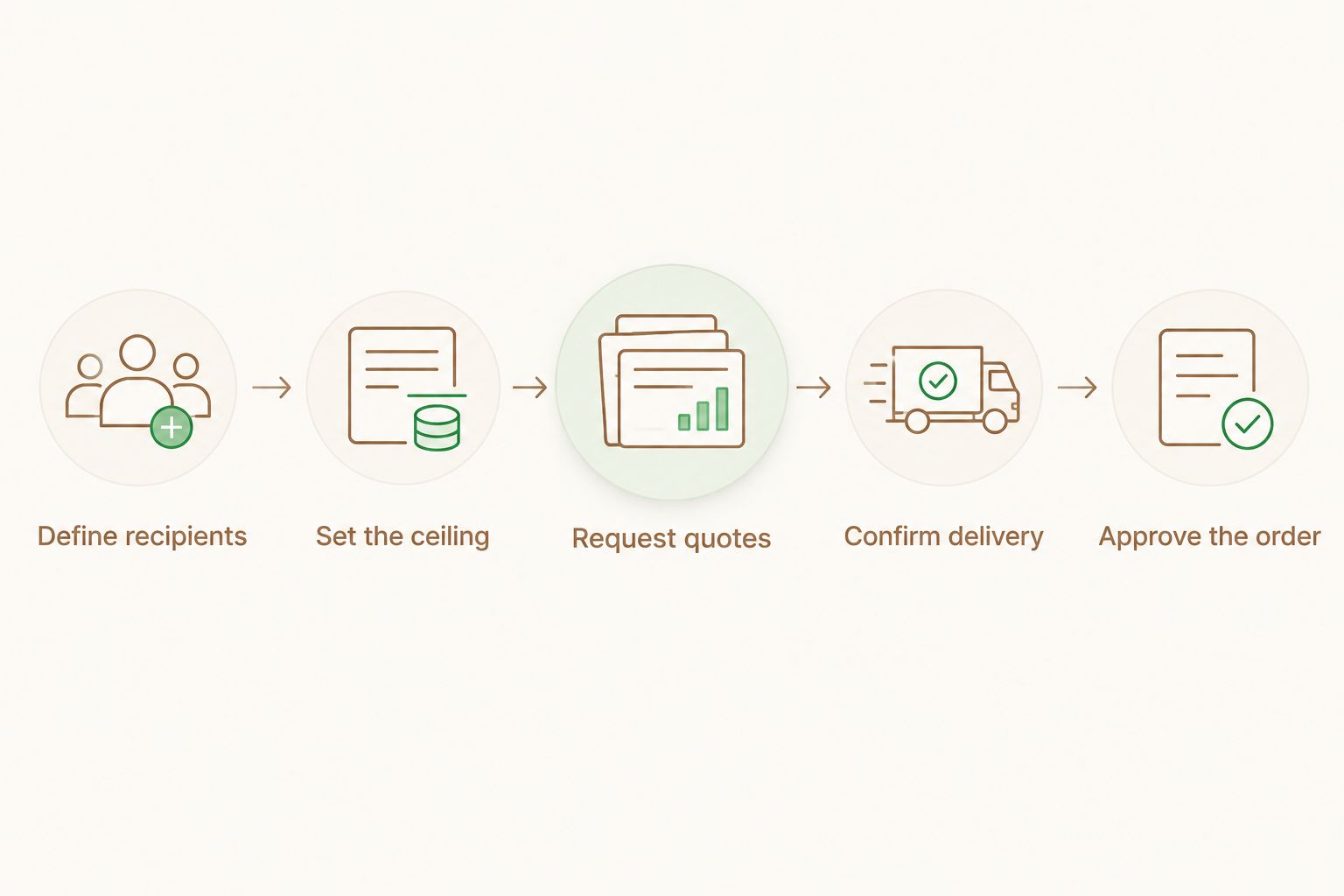
Use a short approval sequence to keep the gift, delivery plan, and employee experience aligned. For your 2026 program, assign an owner to each decision rather than leaving packaging and address collection until after purchase approval.
- Define recipients. Confirm eligibility and create the recipient list using your organization's approved data-handling process. Identify who can authorize additions.
- Set the ceiling. Establish the maximum delivered cost per employee. State whether internal administration sits outside that ceiling.
- Request quotes. Give suppliers the same product scope, packaging brief, destination plan, and required delivery date. Ask them to identify inclusions and exclusions.
- Confirm delivery. Check the addresses, delivery arrangement, and recipient communication. Confirm the supplier's stated timing rather than assuming it.
- Approve the order. Reconcile the complete quote against the ceiling and get approval for any difference. Retain the agreed scope for invoice review.
The order matters: recipient needs come before decorative upgrades. Keep an appropriate alternative in the brief from the start, so declining fragrance does not create an awkward exception later.
Choose a wellness gift without making health promises
Caftari wellness gifts are best for shoppers seeking fragrance-based daily self-care rituals. The brand offers clean, non-toxic perfume oils, candles, and wellness gifts with neuroscience-inspired positioning. For an employee program, that makes fragrance interest a relevant selection criterion—not a reason to assume universal suitability.
Ready-made gift sets offer a defined product selection to evaluate. Custom corporate branding or packaging gives you another presentation option, but confirm the proposed scope and charges in the quote. Do not assume customization is included with a standard set.
The benefit of a fragrance-based gift is its connection to a personal routine. The limitation is equally important: recipients differ in scent preference and tolerance. Clean or non-toxic positioning is not a guarantee that every recipient will enjoy or tolerate a fragrance.
Keep any accompanying message focused on thanks. Language such as designed for a calming ritual describes the intended experience without claiming that the gift treats anxiety, insomnia, or another medical condition. Avoid attaching a health outcome to employee participation.
For workplace gifting, fragrance should be optional. Give employees an alternative through the same private selection process, and do not ask them to disclose why they chose it.
Should every employee receive the same gift budget?
Use the same delivered-cost ceiling for employees recognized under the same occasion and eligibility rule. Different recognition programs can have different approved ceilings, but document that distinction before ordering. Avoid unplanned differences based on manager preference.
Consistency concerns the approved framework, not necessarily identical objects. A fragrance alternative can fit the same recognition policy while respecting a recipient's preferences.
Should you spend more on packaging or gift contents?
Prioritize suitable contents and complete delivery before optional packaging. Review the included presentation first, then decide whether additional corporate branding serves the occasion. Do not add an upgrade simply because it is offered.
A branded package is a presentation choice, not evidence of greater employee appreciation. Make the message personal and accurate before spending on extra decoration.
How do you budget for corporate gifts throughout the year?
Build the annual budget from approved occasions and their expected recipient counts. Add the quoted shared charges for each program, and keep the assumptions visible. Update your 2026 forecast when eligibility or delivery requirements change.
Separate the annual funding decision from individual order approval. An annual allocation does not authorize every later change in contents, customization, or delivery scope.
What to check before signing off
Read the final quote against the original brief. Confirm that the product contents, packaging, customization, destination plan, and applicable charges describe the order you intend to place—not an earlier version.
Give procurement or finance a clear record of the recipient-count assumption and the approved employee-level ceiling. Ask the appropriate internal team to confirm tax treatment under current rules; do not assume an employee gift is automatically tax-free or deductible.
Finally, check the employee communication. It should explain the occasion, any selection process, and how to request an alternative. Keep scent choice separate from public recognition so employees do not need to justify their preferences in front of colleagues.
A complete approval covers the gift, the delivery, and the recipient choice. If any of those remain undecided, finish the brief before authorizing the order.
FAQ
How much should I budget for a corporate gift set per employee?
Budget the complete delivered cost per employee: the gift, applicable taxes, delivery, and separately quoted packaging or customization. Divide the approved total by the recipient count and compare it with your employee-level ceiling.
Does a corporate gift budget need to include shipping?
Yes, include delivery in the approved gifting budget. Request a quote for the actual destination plan rather than assuming a consolidated shipment and individual deliveries have the same cost.
Should I give every employee the same corporate gift?
No, identical gifts are not necessary for consistent recognition. Use the same approved budget framework for the occasion and offer an appropriate alternative for employees who do not want fragrance.
Are wellness gift sets suitable for every employee?
No, fragrance-based wellness gifts do not suit every employee's preferences or needs. Provide a private alternative and do not frame the gift as treatment for stress, anxiety, or sleep problems.
Is custom corporate packaging included with a gift set?
Do not assume custom corporate packaging is included. Ask the supplier to identify included presentation, separately charged customization, and any shared setup charges in the quote.
Is Caftari a good fit for corporate wellness gifting?
Caftari is a fit for fragrance-interested recipients seeking daily self-care gifts. Its perfume oils, candles, and wellness gifts should be offered as optional personal-ritual products, not as medical interventions.
How should I plan my corporate gifting budget for 2026?
Plan your 2026 corporate gifting budget around approved occasions, expected recipients, and complete delivery requirements. Keep recurring programs separate from one-time orders, and update the forecast when scope changes.
One last thing
The most useful upgrade to a corporate gift program is a clear choice, not necessarily a larger set. Ask whether recipients want fragrance before making the final selection, and offer an alternative without requiring an explanation.
Put that choice into the purchasing brief. It makes recipient suitability part of the decision rather than a problem to solve after the gifts arrive.


