

Wearing perfume oil while breastfeeding calls for an ingredient-specific assessment, not a blanket promise that every formula is safe. Keep perfume oil off your nipples, areolae, and any skin your baby mouths or regularly touches, and ask your healthcare professional about the exact formula if you need individual guidance. You can make fragrance part of your personal routine while keeping its application separate from feeding and close contact.
- Is perfume oil safe while breastfeeding? Assess the formula and application site; no fragrance label guarantees breastfeeding safety.
- Keep perfume oil away from nipples, areolae, your baby's mouth, and skin involved in close feeding contact.
- Caftari's Discovery Set offers three full-size perfume oils for exploring personal scent preferences, not establishing breastfeeding safety.
- Use ingredient information and individual clinical advice to choose a perfume-oil routine that fits breastfeeding.
Is it safe to wear perfume oil while breastfeeding?
The useful question is whether the particular perfume oil and the way you apply it fit your feeding routine. An oil-based format, a botanical carrier, or a clean ingredient description does not independently answer that question. Consider the complete formula, your own skin response, and where your baby makes contact with you.
If you are exploring a collection, the Discovery Set – Rollerball Perfume Oils contains three full-size 10 ml oils. That gives you different fragrances to consider for your own enjoyment. It does not make the collection a breastfeeding-tested product or replace an ingredient-specific discussion with your clinician.
Use this sequence when deciding how to include perfume oil in your 2026 self-care routine:
- Read the formula. Check the product's ingredient information and directions, rather than judging the formulation by its name or fragrance notes.
- Map feeding contact. Notice where your baby's mouth, face, and hands touch your skin during feeding, carrying, and settling.
- Choose placement. Keep the application away from your breast and other areas involved in that contact. Follow the product's directions for use.
- Ask specific questions. If you have a known allergy, irritated skin, or a concern about an ingredient, give your healthcare professional the actual product information.
- Keep the routine simple. Introduce a fragrance on its own so you can distinguish its scent and your skin's response from other products.
This approach separates two decisions that often get mixed together: which fragrance you enjoy and how to use that fragrance during breastfeeding.
Why this matters
Breastfeeding involves frequent close contact, so placement deserves as much attention as scent selection. A perfume oil worn on your skin is not the same use situation as a product applied to a nipple, transferred onto a baby's hand, or put into a baby's mouth.
Your scent ritual can remain personal and enjoyable. The practical aim is to keep the perfume where it belongs: on an appropriate adult application site, used according to its directions, rather than on feeding-contact areas.
Choose fragrance for enjoyment; assess breastfeeding suitability through the formula and actual contact. That distinction supports a considered purchase without asking a perfume to provide a medical assurance it was not designed to provide.
What should you check before choosing a perfume oil?
Start with the information that helps you make a real decision. A fragrance description tells you about the intended scent experience, while an ingredient list tells you what the manufacturer discloses about the formulation. These serve different purposes.
For your 2026 product review, the following checks keep the buying decision focused:
| What to check | What it helps you decide | What it does not establish |
|---|---|---|
| Complete ingredient information | Whether a disclosed ingredient needs closer review | Universal breastfeeding safety |
| Carrier oil | What forms the perfume's base | That the entire fragrance is natural |
| Fragrance notes | Whether the scent sounds appealing to you | The complete ingredient composition |
| Application directions | How the manufacturer intends you to use the product | Approval for breast or infant application |
| Your known sensitivities | Which ingredients to discuss with your clinician | Your baby's tolerance |
| Packaging and format | Whether the product suits your everyday handling | A medically safer formulation |
The US Food and Drug Administration's consumer guidance on fragrances in cosmetics explains that fragrance ingredients can appear collectively as fragrance on a cosmetic label. Its scope is cosmetic labeling and consumer information, not approval of a specific perfume for breastfeeding.
That matters when you have an ingredient-specific question. If the information you need is not on the label, ask the manufacturer for clarification and share the response with your healthcare professional. A recognizable scent note is not a substitute for that information.
Why breastfeeding suitability varies
There is no single answer that covers every perfume oil, every application site, and every parent–baby routine. The relevant differences are practical, not a reason to abandon an enjoyable fragrance ritual.
- The formulation: A carrier and a fragrance blend are separate parts of the product. Consider the complete disclosed formula.
- The application site: Your baby's contact with your skin changes the use situation. Breastfeeding placement needs its own consideration.
- Your skin history: A known fragrance allergy or an existing irritated area calls for individual advice before application.
- Your feeding position: The skin your baby touches during one feeding position can differ from the skin involved in another.
- Other scented products: Body lotion, hair products, and perfume can overlap in your routine. Review them together when discussing a reaction or exposure concern.
A scent you already enjoy gives you useful preference information. It does not prove infant tolerance, and a first-time skin check cannot establish lactation safety. Keep those questions separate so each gets the right answer.
Where should you apply perfume oil while breastfeeding?
Choose an application site that stays away from your baby's mouth and routine feeding contact. Do not treat wrists, neck, or chest as automatically suitable simply because they are common perfume locations. Your baby's position determines whether those areas are touched, nuzzled, or mouthed.
Before applying fragrance, think through a normal feed and how you hold your baby afterward. An application site that seems separate while you are standing can become a contact area when you cradle your baby. Placement is a decision based on your actual routine, not a fixed list of pulse points.
A useful 2026 habit is to check contact before application rather than trying to work around it afterward. Washing your hands after handling perfume oil also helps keep the product off anything you touch during feeding.
Can I put perfume oil on my chest before feeding?
Do not apply perfume oil to your nipples, areolae, or chest areas your baby contacts while feeding. Those locations bring the product close to your baby's mouth and face. Keep the fragrance application separate from the feeding area.
Is applying perfume oil after a feed enough?
Applying perfume oil after a feed does not, by itself, establish safe use. A later feed or cuddle can still bring your baby into contact with the application site. Placement and the actual formulation matter more than timing alone.
Should I put perfume oil on my baby's clothes?
Keep adult perfume oil for its intended adult use, not your baby's clothes, bedding, or skin. Applying fragrance to fabric your baby touches does not resolve the contact question. Follow the manufacturer's directions for your own use.
How to choose a scent for your own self-care ritual
Once you have addressed formula and placement questions, choose the perfume for the experience you want to enjoy. You do not need to turn scent selection into a medical decision or expect the fragrance to change your sleep, milk supply, or mood clinically.
Think about how the fragrance fits a quiet personal moment: getting dressed, finishing your morning routine, or preparing for an outing. These are contexts for enjoyment, not claims about therapeutic effects. A familiar routine can give fragrance a meaningful place in your day without requiring a promised health outcome.
Caftari perfume oils are best for shoppers seeking a personal fragrance ritual in a rollerball format. The brand describes its products as clean, non-toxic, and neuroscience-inspired; those descriptions frame its wellness positioning, rather than certify a perfume for breastfeeding use.
For the Discovery Set, the supplied product description identifies Scent of Nirvana Perfume Oil as a 10 ml roll-on with oud, amber, and saffron notes in a jojoba and vitamin E base. Those are useful details for choosing a fragrance experience. The named notes do not disclose every ingredient in the fragrance blend.
The collection's three full-size oils offer a way to explore different scents. Choose it because you want a collection for your own use, not because a larger set provides stronger evidence of tolerance or breastfeeding suitability.
How to keep your perfume-oil routine easy to follow
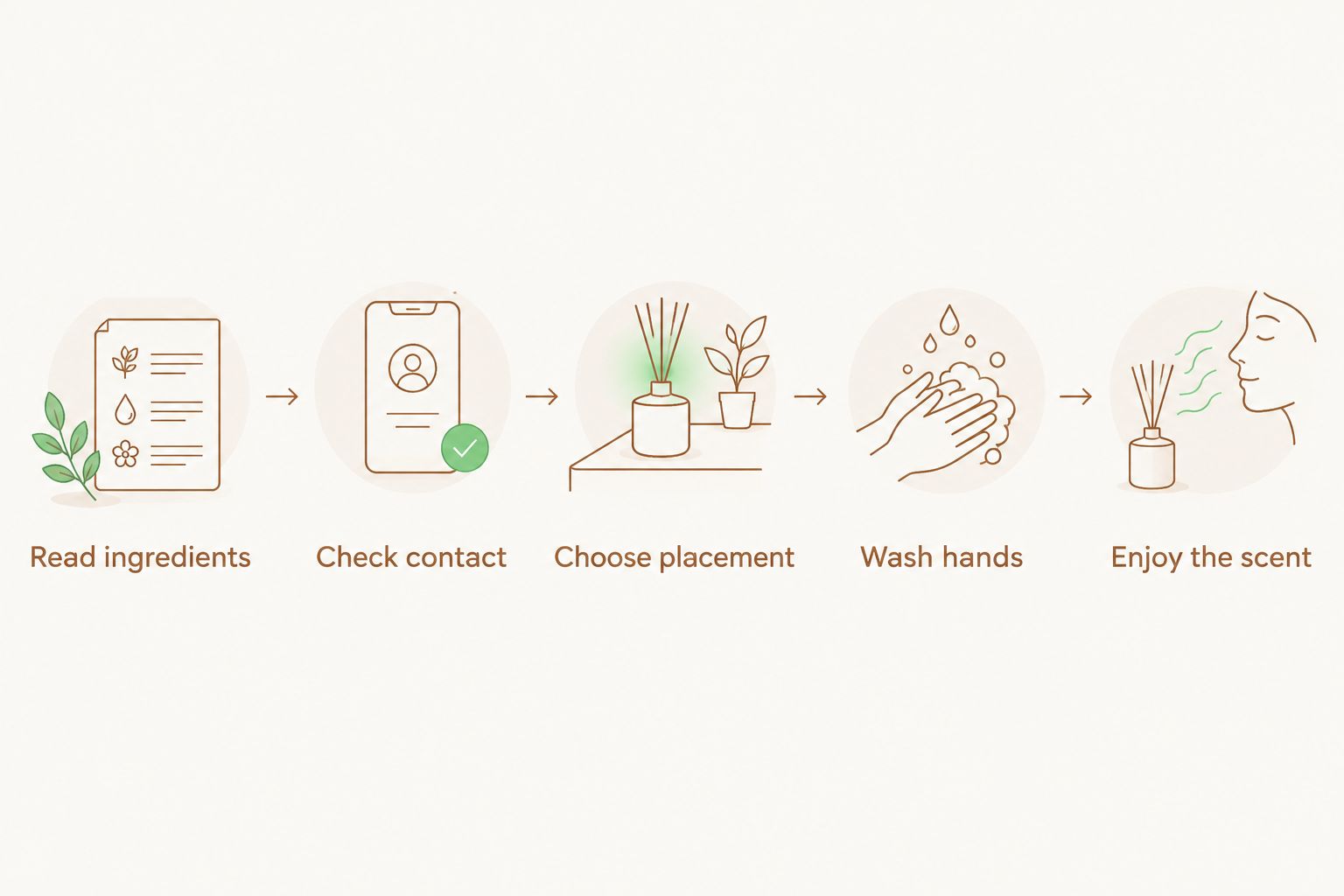
A simple routine makes the important checks easier to remember. Keep formula review, contact-aware placement, and scent enjoyment as separate steps rather than relying on one reassuring label to answer everything.
- Read ingredients: Keep the product information available for any specific question.
- Check contact: Consider feeding, cuddling, carrying, and settling positions.
- Choose placement: Follow directions and keep perfume off feeding-contact areas.
- Wash hands: Clean your hands after handling the oil and before handling feeding equipment.
- Enjoy the scent: Let the fragrance be a personal sensory detail, without expecting a medical effect.
In your 2026 routine, keep the bottle with your personal-care products and out of your baby's reach. Use the product only as directed, and do not add it to nipple-care products or feeding equipment. Those are different uses from wearing a perfume.
What should you ask your healthcare professional?
Ask a specific question about a specific product. Bring the ingredient list, the product name, and a description of where you intend to apply it. This gives your clinician more useful information than asking whether all natural fragrances are safe.
You can phrase the question simply: you want to wear this perfume oil on an adult application site that your baby does not contact, and you want to know whether any disclosed ingredient needs consideration for your circumstances. Mention known allergies, active skin irritation, and any relevant advice already given for your baby's care.
The National Library of Medicine's LactMed database covers medicines and other substances in relation to breastfeeding. It is an ingredient-level reference, not a product endorsement system for perfume collections. A clinician can decide whether a substance-specific reference is relevant to your question.
For a 2026 assessment, use current product information rather than an old ingredient screenshot or a general discussion of essential oils. There is no basis for inventing a universal waiting period between perfume application and feeding.
If you or your baby develops a reaction after contact, stop that exposure and seek appropriate medical advice. Trouble breathing requires urgent medical attention. These are proportionate care instructions, not a prediction that a particular fragrance will cause a problem.
Do clean, non-toxic, or natural labels answer the question?
Clean and non-toxic positioning can help you understand a brand's ingredient philosophy, but neither label establishes breastfeeding suitability on its own. The decision still rests on the actual formulation and its intended use. The FDA's consumer guidance on cosmetic allergens also makes clear that cosmetic ingredients, including fragrances, can cause reactions in some people.
Natural describes an ingredient's origin; it is not a substitute for a tolerance assessment. Likewise, a jojoba base does not show that every fragrance ingredient is botanical or that the finished perfume is entirely natural.
Caftari's clean perfume-oil positioning is relevant to shoppers seeking ingredient information and a wellness-oriented fragrance experience. Use that interest as the starting point for an informed choice: read the formula, choose the scent you enjoy, and resolve any individual breastfeeding question with the right professional.
FAQ
Is perfume oil safe while breastfeeding?
Breastfeeding suitability depends on the particular formula and how you use it; no blanket safety guarantee covers every perfume oil. Keep it off nipples, areolae, and skin your baby mouths or regularly touches, and ask your healthcare professional about individual concerns.
Can I wear rollerball perfume while nursing?
A rollerball format does not establish breastfeeding safety. Review the formula, follow its directions, and choose an adult application site away from feeding contact.
Is natural perfume oil better while breastfeeding?
Natural origin does not independently establish breastfeeding suitability. Assess the complete formula rather than treating botanical ingredients or a botanical carrier as a safety guarantee.
How long should I wait to breastfeed after applying perfume oil?
There is no universal waiting period that makes every perfume oil suitable for breastfeeding. Placement, the formula, and your baby's contact with the application site matter more than timing alone.
Can I apply perfume oil to my breasts?
Do not apply perfume oil to nipples, areolae, or breast skin your baby contacts during feeding. Keep adult fragrance separate from nipple care and feeding-contact areas.
What does the Caftari Discovery Set contain?
The Discovery Set contains three full-size 10 ml perfume oils. Choose it to explore personal scent preferences, not as proof that a formula has been tested for breastfeeding suitability.
Does testing perfume oil on my skin prove it is safe for my baby?
Your own skin response does not prove infant tolerance or breastfeeding safety. It answers a different question from ingredient assessment and avoiding direct infant contact.
One last thing
Your favorite scent and your baby's feeding-contact areas do not need to occupy the same space. Before choosing your usual perfume application point, picture how you actually hold your baby. That small change in perspective makes the routine more practical than following a standard pulse-point diagram.
Enjoy fragrance as a personal ritual, use the product according to its directions, and keep medical questions specific to the formula and your circumstances. A thoughtful purchase starts with the scent you want and the information you need to use it well.


