

Perfume oil can be a better fit for sensitive skin when its ingredients suit you and you prefer precise application, but oil is not automatically gentler than spray perfume. An alcohol-based spray and an oil-based fragrance differ in their carriers and application methods; either can contain fragrance ingredients your skin reacts to. Choose by the formula and your skin’s response, not by the bottle format alone.
- Perfume oil vs spray perfume sensitive skin: ingredients and individual tolerance matter more than format.
- Caftari perfume oils suit shoppers seeking roll-on fragrance for a considered daily self-care ritual.
- An oil carrier does not establish that the complete fragrance is natural or allergy-free.
- Compare scent preference separately from skin tolerance before choosing your everyday perfume.
For a practical starting point, the Discovery Set - Rollerball Perfume Oils contains three full-size oils. It gives you different fragrances to consider within the same roll-on format, rather than asking you to choose a format and a scent at once.
Is perfume oil better than spray perfume for sensitive skin?
Perfume oil is the better choice if you want precise, targeted application rather than a spray. A rollerball lets you place fragrance on a selected area. A spray distributes droplets through an atomizer, while the carrier and fragrance mixture determine what reaches your skin.
For your 2026 fragrance choice, separate the application experience from the ingredient question. You can prefer the feel and precision of an oil without treating that preference as proof that every oil formula will suit your skin.
| What you’re comparing | Perfume oil | Spray perfume |
|---|---|---|
| Typical carrier | An oil-based carrier; check the actual formula | Often alcohol-based; check the actual formula |
| Application | A rollerball or applicator places fragrance directly | An atomizer distributes fragrance droplets |
| Practical advantage | Precise placement and an easy-to-follow application habit | A misting format for shoppers who prefer spraying |
| Skin-tolerance question | Whether the carrier and fragrance ingredients suit you | Whether the carrier and fragrance ingredients suit you |
| Best for | Shoppers who want a deliberate roll-on ritual | Shoppers who prefer a misting application |
| What format cannot establish | Allergy-free status or proven sensitive-skin suitability | Allergy-free status or proven sensitive-skin suitability |
Neither format has a universal sensitive-skin advantage. The useful comparison is between actual formulas, not an imagined category where every oil is mild and every spray is harsh.
Why this matters
Sensitive skin describes an experience, not a single ingredient requirement. Stinging, dryness and an itchy rash do not necessarily have the same cause, so the phrase alone cannot identify your ideal perfume.
DermNet’s educational guidance on fragrance allergy distinguishes allergic contact dermatitis from other reactions to products. The American Academy of Dermatology’s contact-dermatitis guidance likewise explains that irritation and allergy are different processes. These sources explain skin reactions; they do not establish that a particular perfume oil is suitable for you.
The practical lesson is reassuringly specific: you do not need to settle the entire oil-versus-spray debate to make a thoughtful purchase. You need a fragrance you enjoy, clear ingredient information and an application routine that respects your skin’s history.
What changes when you choose an oil instead of a spray?
The carrier changes the experience
The carrier holds the fragrance materials and helps deliver them. Oil-based and alcohol-based formulas can feel different during application, but that difference is not a medical ranking.
Alcohol can sting irritated skin. An oil-based product offers a different application experience, yet its fragrance ingredients and other components still matter. If you have previously reacted to a named ingredient, that history is more useful than a broad preference for oils or sprays.
The applicator changes placement
A rollerball provides a visible, direct way to choose where fragrance goes. That makes the format useful when you want a simple ritual rather than a broad mist.
Precise placement also makes your routine easier to describe. If you discuss a reaction with a dermatologist, you can identify the product and application area instead of guessing which fragrance landed where.
The scent remains a separate choice
An oil carrier does not tell you whether the scent is woody, floral, sweet or fresh. Those qualities come from the fragrance composition, and your preferences deserve their own attention.
Read the stated scent notes before choosing. A scent you love and a formula you tolerate are separate selection criteria; a good everyday perfume needs both.
How should you choose a perfume oil in 2026?
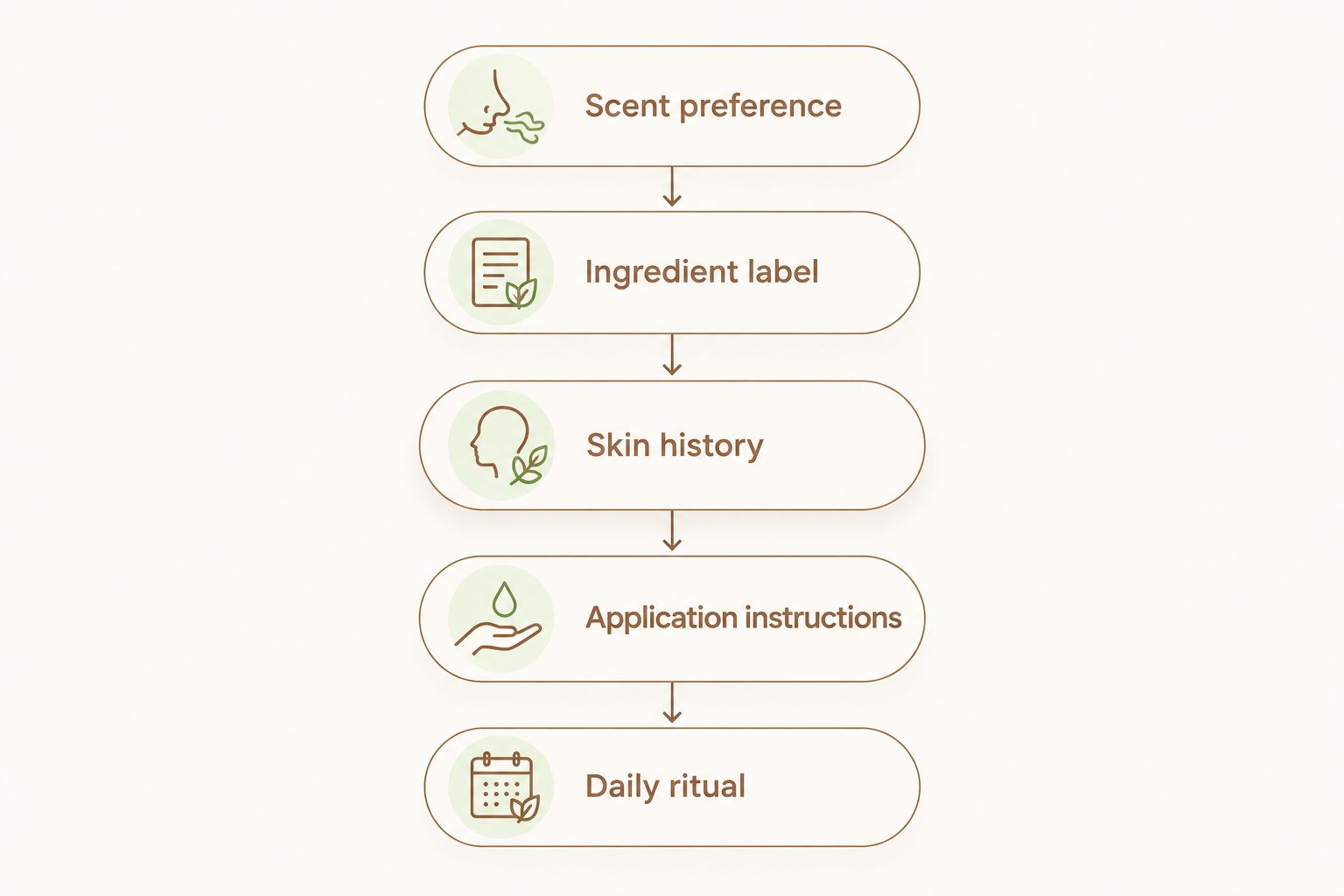
Use a short selection process that keeps the enjoyable part of fragrance shopping central. Begin with the scent you want to wear, then check the information that matters for your skin.
- Scent preference. Identify the fragrance direction you enjoy and read the product’s stated notes. Avoid interpreting a fragrance name as a complete ingredient description.
- Ingredient label. Review the listed carrier and other ingredients.
- Skin history. Consider ingredients and products you have already used comfortably. A previous diagnosed allergy deserves more attention than a general clean-beauty label.
- Application instructions. Follow the product’s directions and keep initial use simple. Avoid introducing several new scented products together when you want to understand your response.
- Daily ritual. Choose a format you will enjoy using consistently. A deliberate roll-on application can be part of getting ready or transitioning out of the workday.
For a 2026 purchase, use the information accompanying the product you are actually considering. Familiar packaging or an appealing ingredient story is not a substitute for reviewing the formula and directions.
If you have a diagnosed fragrance allergy, ask your dermatologist how to assess a proposed perfume before applying it. That is a targeted ingredient question, not a reason to assume every fragrance product is the same.
Which Caftari perfume oils fit this comparison?
Choose Caftari perfume oils over a spray if you want targeted roll-on application and a considered daily self-care ritual. The brand’s clean, non-toxic and neuroscience-inspired positioning describes its approach to fragrance; it does not replace individual ingredient review or establish medical benefits.
The collection includes named rollerball options and a full-size set. Choose between them by the scent information and purchase format, rather than assigning an unsupported sensitive-skin ranking.
| Option | Verified information relevant to choosing | Best for |
|---|---|---|
| Scent of Nirvana Rollerball | Described in the Discovery Set as a 10 ml roll-on with oud, amber and saffron in a jojoba and vitamin E base | Shoppers interested in the stated oud, amber and saffron profile |
| Nidra Rollerball | A named rollerball option; review its own description and ingredients before choosing | Shoppers exploring Nidra in a roll-on format |
| Dolce Far Niente Rollerball | A named rollerball option; use its own product information to assess the fragrance | Shoppers exploring Dolce Far Niente in a roll-on format |
| Discovery Set - Rollerball Perfume Oils | Three full-size 10 ml perfume oils | Shoppers who want several fragrances in full-size roll-on bottles |
Scent of Nirvana gives you a concrete starting point if its listed notes match your preferences. Jojoba and vitamin E describe its base; they do not establish that the complete fragrance is entirely natural or that everyone will tolerate it.
The Discovery Set is useful when variety is part of the purchase you want to make. Its full-size format is different from the Perfume Sample Set, which contains three 1 ml oils. Choose samples for initial scent exploration and the Discovery Set when you want full-size options.
Why skin tolerance varies between perfumes
The same format can contain very different formulas. These factors explain why choosing an oil is only one part of your decision:
- Fragrance composition. Two perfume oils can use different fragrance materials, even when they share a carrier.
- Carrier and other ingredients. Review the whole formula, not just the ingredient highlighted in the product description.
- Your reaction history. A known allergy to a particular substance changes what you need to check.
- Skin condition at application. Irritated or broken skin is not an appropriate place to introduce a new perfume.
- Application habits. Placement, repeated application and layering affect how you use the formula on your skin.
For your 2026 routine, treat these as a practical checklist rather than a list of reasons to worry. They help you ask better questions and choose a fragrance with more confidence.
Does alcohol-free perfume mean it is better for sensitive skin?
Alcohol-free perfume removes alcohol from the formula, not every possible source of a skin reaction. That distinction matters if alcohol has caused discomfort for you, but fragrance ingredients and the rest of the formula still need consideration.
Do not infer alcohol-free status from a rollerball bottle alone. Check the actual ingredient information, just as you would for a spray.
Are natural perfume oils always gentler?
Natural perfume oils are not automatically gentler because botanical fragrance materials can also cause contact allergy. The origin of an ingredient and your tolerance of it answer different questions.
A botanical carrier also does not establish that every fragrance component is natural. Read the description for what it explicitly says, without extending a claim about the base to the entire perfume.
How do you compare a fragrance’s scent and skin tolerance?
Compare scent preference first as an enjoyment question, then assess skin use according to the product’s instructions and your history. A fragrance can smell appealing without that observation telling you anything about skin tolerance.
Keep your initial routine simple enough to understand. If irritation develops, stop using the product on the affected area; persistent or significant symptoms deserve medical advice. A home trial cannot rule out a fragrance allergy or replace a dermatologist’s diagnostic patch testing.
How can perfume oil become part of a calming daily ritual?
Perfume oil is the better choice for a daily ritual if you prefer a deliberate, hands-on application to a quick mist. With Caftari’s rollerball perfume oils, you choose where to apply your fragrance and make that small gesture part of getting dressed or putting away work materials. The roll-on format gives your scent ritual a simple, repeatable action.
Caftari frames fragrance around neuroscience-inspired wellness and daily self-care. That is a useful setting for a thoughtful scent habit, not a claim that perfume treats anxiety, insomnia or another medical condition.
Keep the routine uncomplicated: choose your fragrance, follow its directions and enjoy the scent. You do not need an elaborate layering routine to make the moment feel considered.
FAQ
Is perfume oil better than spray perfume for sensitive skin in 2026?
Perfume oil is not automatically better for sensitive skin; the ingredients and your individual response matter more than the format. A rollerball offers precise placement, which can make your application routine easier to control.
Can I react to perfume oil even if it is alcohol-free?
Yes, alcohol-free perfume oil can still contain ingredients that cause irritation or contact allergy. Review the complete available ingredient information, particularly if you have a known allergy.
Does a jojoba base mean a perfume is completely natural?
No, a jojoba base identifies a carrier ingredient, not the origin of every fragrance component. Check the product’s explicit claims rather than extending the carrier description to the whole formula.
Which Caftari oil should I consider if I like oud and amber?
Scent of Nirvana is described with oud, amber and saffron in a jojoba and vitamin E base. Choose it for that stated scent profile, not because those notes establish sensitive-skin suitability.
What is the difference between the Perfume Sample Set and the Discovery Set?
The Perfume Sample Set contains three 1 ml oils, while the Discovery Set contains three full-size 10 ml oils. The sample format supports initial scent exploration; the full-size set gives you several fragrances to wear.
Can I apply perfume oil to irritated skin?
Do not apply a new perfume oil to irritated or broken skin. Follow the product’s directions and seek medical advice for persistent or significant skin symptoms.
Does testing perfume at home prove I am not allergic?
No, a home trial does not prove that you are not allergic to a perfume. Dermatologist-led patch testing is a diagnostic process distinct from trying a fragrance during everyday use.
One last thing
The most useful detail on a perfume page is not always the scent note you notice first. A note describes the fragrance experience; an ingredient listing helps you assess the formula. Keep both in view, and you can choose an enjoyable perfume oil without asking its format to answer every skin question.
For your next fragrance, start with a scent you genuinely want to wear and give the formula equal attention. That is a more useful buying rule than assuming oil always wins over spray.


