

You should not treat Caftari as confirmed vegan and cruelty-free based solely on its clean, non-toxic description. For a 2026 purchase, verify animal-derived ingredients and animal-testing policies separately: those are different questions, and neither is answered by a fragrance’s wellness positioning.
- Is Caftari vegan? Clean, non-toxic positioning alone does not establish vegan ingredients or cruelty-free testing.
- Vegan fragrance excludes animal-derived ingredients; cruelty-free claims address animal testing. Verify both separately.
- Check perfume oils, candles, and every gift-set component rather than extending one product’s claim across a collection.
- Choose fragrance for a calming ritual without treating ethical labels as guarantees against irritation.
Is Caftari vegan and cruelty-free?
The responsible answer is to verify both claims before buying, not infer them from clean or non-toxic language. A vegan claim concerns what a product contains. A cruelty-free claim concerns animal testing, with its precise scope depending on the policy or certification behind it.
Neither term is interchangeable with natural, plant-based, neuroscience-inspired, or suitable for a calming routine. Those descriptions address different characteristics.
| Claim | What it addresses | What it does not establish | What to check |
|---|---|---|---|
| Vegan | Whether ingredients are animal-derived | Animal-testing practices or skin tolerance | An explicit statement covering the finished formula |
| Cruelty-free | Animal-testing practices within a stated policy | Whether ingredients are animal-derived | Coverage of finished products, ingredients, and suppliers |
| Clean or non-toxic | The brand’s ingredient and safety positioning | Vegan ingredients or a no-animal-testing policy | The specific meaning and supporting product information |
| Neuroscience-inspired | The approach used to frame a fragrance experience | Ethical certification or treatment of a medical condition | Separate ingredient, testing, and wellness statements |
This distinction prevents two opposite mistakes: accepting an unsupported ethical claim and assuming that an unverified claim means a product fails your standards. Unverified is not the same as non-vegan or animal-tested. It means you need a clear answer before making that particular purchasing decision.
Why this matters
Caftari is best for shoppers seeking clean perfume oils and candles for calming self-care rituals; ethical requirements need separate verification. Its fragrance positioning gives you a reason to explore the range, but it does not replace ingredient-origin information or an animal-testing policy.
For your 2026 shopping checklist, keep personal preference, animal welfare, and product tolerance in separate columns. You can enjoy a scent while still asking precise questions about how it was made.
The same distinction matters when gifting. Someone who avoids animal-derived ingredients needs a different answer from someone whose main requirement is a documented no-animal-testing policy. If both matter to the recipient, satisfy both before choosing a gift.
What does vegan mean for perfume oils and candles?
A vegan fragrance product excludes animal-derived ingredients. That assessment concerns the actual formula, not whether the fragrance smells botanical or appears in a wellness collection.
Beeswax is an animal-derived candle ingredient. Lanolin comes from sheep’s wool and is another example of an animal-derived material. These are category examples, not claims about any ingredient in this brand’s products.
Ingredient names do not always tell you everything about their origin. Some materials can come from different sources, so a familiar-looking label is not always enough to establish vegan status. Ask for a finished-formula statement rather than trying to identify every possible source yourself.
A useful vegan statement should specify what it covers:
- The exact product you intend to buy.
- The complete formula, rather than a featured ingredient.
- Any separately formulated items included in a bundle.
- Packaging materials, if those are part of your personal requirements.
A plant-derived headline ingredient is not proof of an entirely vegan product. The advantage of an explicit finished-product statement is clarity; its limitation is that you still need to understand whether it applies to one item or the whole collection.
What does cruelty-free mean for fragrance?
Cruelty-free claims concern animal testing, but the wording and coverage matter. A statement about finished products alone does not answer every question about ingredients, suppliers, or testing commissioned by another party.
For U.S. shoppers in 2026, the FDA’s consumer guidance on cruelty-free and not-tested-on-animals labeling provides an important distinction: these terms have no legal definitions for cosmetic labeling. A label therefore needs context, rather than being treated as a complete explanation on its own.
When reading a policy, look for answers to these questions:
- Does the company test finished products on animals?
- Does it commission animal testing through another organization?
- Does its policy address ingredient testing?
- Does it explain expectations for suppliers?
- Does it identify the products and business activities covered?
Independent certification can provide an additional way to assess a claim. However, certification programs have their own standards and scope; a cruelty-free certification does not automatically establish vegan ingredients.
A clear policy is useful because it identifies the commitments being made. Its limitation is that broad language without defined coverage leaves important questions unresolved. Read the explanation behind a logo or short product-page claim, not just the headline.
Why vegan and cruelty-free verification varies
The verification process changes with the product and the breadth of the claim. These factors explain why one answer should not automatically be extended to every item you buy:
- Claim scope: A statement about one product is narrower than a statement covering a complete collection.
- Ingredient origin: A material’s name and its source are separate pieces of information.
- Product format: Perfume oils and candles require their own formula checks; one format does not establish the other’s status.
- Bundle contents: A gift set combines items, so the answer must cover each included formula.
- Policy coverage: Finished-product testing, ingredient testing, and supplier requirements are distinct parts of an animal-testing policy.
- Current documentation: Your purchase should be supported by information that applies to the product being sold now.
These are reasons to ask focused questions, not reasons to assume a problem. For a 2026 decision, the most useful evidence is a current statement with an identifiable product and a clearly defined claim.
How do you verify vegan and cruelty-free status before buying?
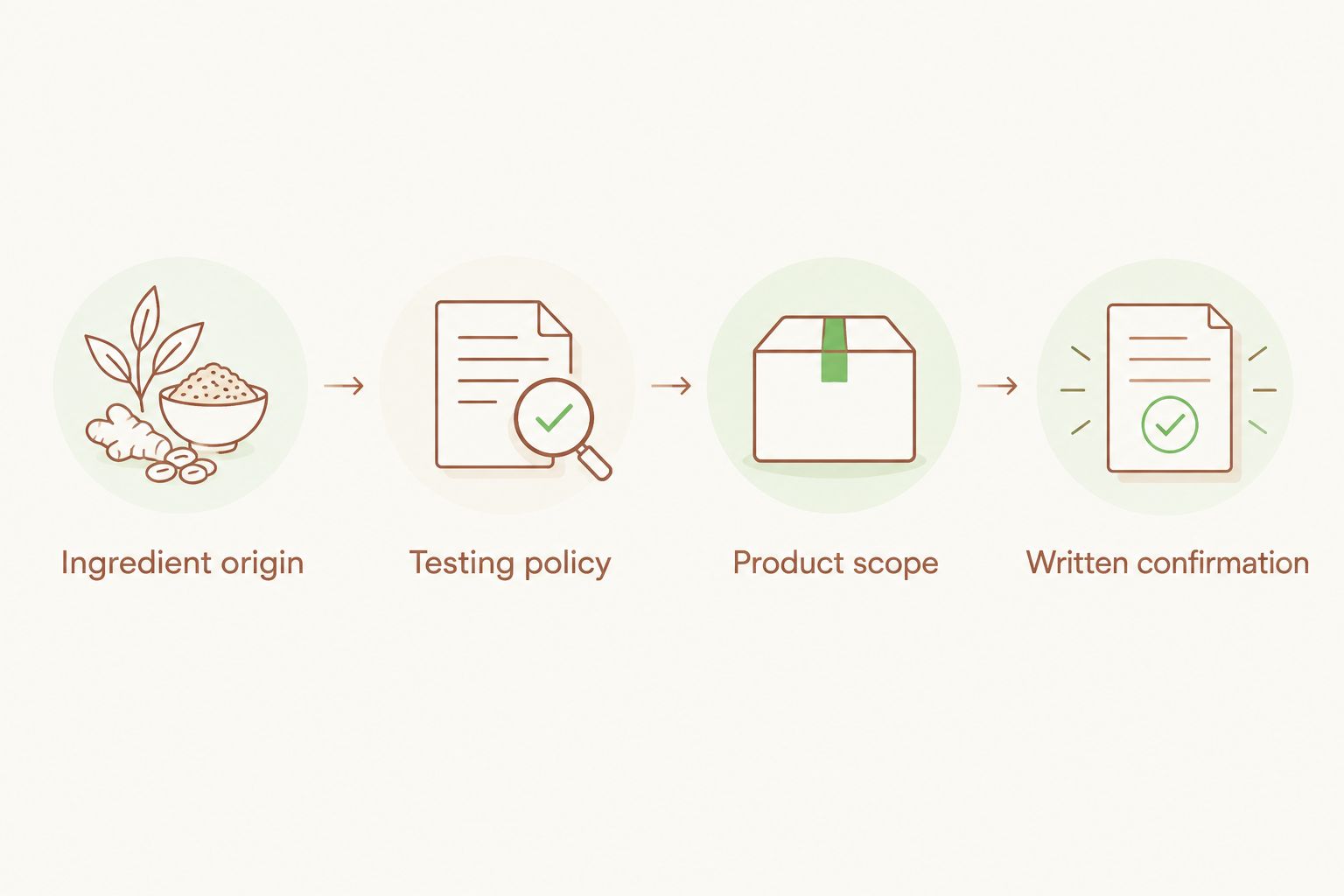
Use this sequence to keep the conversation specific. It works whether you are choosing a personal fragrance, a candle, or a gift containing several items.
- Ingredient origin: Ask whether the complete formula contains any animal-derived ingredients. Identify the exact product rather than asking only whether the brand is generally vegan.
- Testing policy: Ask whether the animal-testing policy covers finished products, ingredients, commissioned testing, and suppliers. Keep this separate from your ingredient question.
- Product scope: Confirm whether the answers apply to your selected item and any other products packaged with it. Do not extend a statement beyond its stated coverage.
- Written confirmation: Keep the current response or product statement with your purchase information. Written wording is easier to check than a remembered summary.
These steps turn a broad ethical question into a clear purchasing decision. They also reduce the risk of accepting an answer to a different question—for example, receiving a reassurance about clean ingredients when you asked about animal testing.
Your request does not need to be technical. Ask for confirmation that the named product contains no animal-derived ingredients, then ask for the policy covering animal testing. If a response addresses only one point, follow up on the other before treating both claims as established.
Choose based on the answer’s scope, not its reassuring tone. A short, precise statement is more useful than a lengthy description that never addresses your requirement.
What should you check in a perfume oil?
For a perfume oil, establish whether the vegan statement covers the carrier and the fragrance formula together. A statement about a featured botanical ingredient is narrower than a statement about the finished product.
Next, review the animal-testing policy independently. An oil-based format, a rollerball applicator, or a calming scent description does not answer that question.
If your skin is sensitive, treat tolerance as a separate concern. Vegan and cruelty-free labels do not guarantee that a fragrance will be comfortable on your skin, and clean positioning does not eliminate individual sensitivities.
For personal wear, the best choice meets both your ethical requirements and your tolerance needs. Follow the product’s application directions, and stop using it if irritation occurs. Ethical verification should not replace ordinary care when introducing a fragranced product into your routine.
What should you check in a scented candle?
For a candle, ask about the complete formula rather than only the main wax. A vegan statement should address the finished candle’s ingredients, including the fragrance and any additives.
Wax names can help you identify questions, but they cannot replace a full-product answer. Beeswax is animal-derived; identifying a different main wax does not, by itself, settle the origin of every other ingredient.
Cruelty-free verification remains separate. A candle’s wax type does not establish the company’s animal-testing practices, and a fragrance ingredient’s ethical status should not be assumed from its scent description.
Your intended setting also matters. A vegan candle is not automatically suitable for every shared space or every fragrance-sensitive person. Ask whether the recipient enjoys scented candles before making ethical suitability the only selection criterion. Respecting that preference is part of choosing a thoughtful gift.
How should you check a fragrance gift set?
A gift set needs item-by-item verification because its contents can include different formulas. An answer covering a perfume oil should not automatically be extended to a candle packaged alongside it.
If you are considering the Caftari Signature Gift Set, request confirmation covering every included item. The supplied product description identifies it as a gift set featuring the original three scents; that description does not itself establish vegan ingredients or cruelty-free testing.
Ready-made sets simplify presentation and selection. Their limitation for an ethics-led purchase is that you must establish the suitability of the complete assortment, not just the item you recognize.
For a 2026 gift, ask the recipient which requirements matter most: animal-derived ingredients, animal testing, fragrance tolerance, or all of these. Do not use attractive presentation as a substitute for suitability. A carefully checked gift respects the recipient’s standards without asking them to do the verification afterward.
Does non-toxic mean vegan?
Non-toxic does not mean vegan. The first term concerns safety positioning; the second concerns animal-derived ingredients. A product description needs an explicit vegan statement to address that ethical requirement.
The same applies to clean and natural wording. Those terms should not be converted into an animal-origin claim that the description does not make.
Does vegan mean cruelty-free?
Vegan does not automatically mean cruelty-free. A formula can exclude animal-derived ingredients without its ingredient list telling you anything about animal-testing practices.
Ask both questions, even when one answer is already clear. That keeps formula composition and testing policy from being treated as interchangeable evidence.
Can a vegan fragrance still irritate sensitive skin?
A vegan fragrance can still irritate sensitive skin. Vegan status describes ingredient origin, not a guarantee of individual tolerance.
For your 2026 routine, evaluate ethical claims and skin comfort separately. A scent designed for a calming ritual is not a treatment for anxiety, insomnia, or any other medical condition.
FAQ
Is Caftari vegan and cruelty-free?
Clean and non-toxic positioning alone does not confirm vegan or cruelty-free status. Obtain an explicit statement about animal-derived ingredients and a separate animal-testing policy covering the product you plan to buy.
What's the difference between vegan and cruelty-free perfume?
Vegan perfume excludes animal-derived ingredients; cruelty-free claims address animal testing. Neither claim automatically establishes the other.
Does a clean fragrance label mean there are no animal ingredients?
A clean fragrance label does not establish the absence of animal-derived ingredients. Check an explicit vegan statement covering the complete formula.
Can a candle be vegan if it contains beeswax?
A candle containing beeswax is not vegan because beeswax is animal-derived. Confirm the complete formula rather than relying only on the main wax description.
Do I need to check every item in a fragrance gift set?
Check every included item unless an explicit statement covers the entire set. Different products can have different formulas, so one item's status does not establish another's.
Is cruelty-free certification the same as vegan certification?
Cruelty-free certification is not the same as vegan certification. Review the certification's standards and scope to understand whether it addresses testing, ingredients, or both.
Are vegan perfume oils better for sensitive skin?
Vegan status does not establish better tolerance for sensitive skin. Ingredient origin and your response to fragrance are separate considerations.
One last thing
The most useful question is not simply whether a brand is vegan; it is whether the exact product meets your defined requirements. That small change makes the answer more actionable and prevents a collection-wide assumption from replacing product-specific evidence.
Save the ingredient-origin answer and the testing-policy answer separately. When you reorder, check that the information still applies to the product you are choosing. You will have a clearer basis for your decision than any combination of clean, natural, or wellness language can provide.


