

Scented candles may help you feel calmer as part of a relaxing routine, but they are not a treatment for anxiety. The important caveat is that research on lavender or aromatherapy does not establish that burning a scented candle treats an anxiety disorder. This 2026 guide explains how to use scent as an optional comfort cue, recognize irritation, and keep a calming ritual separate from medical care.
- Can scented candles help with anxiety? They may support relaxation, but they do not replace anxiety treatment.
- Caftari candles suit shoppers seeking neuroscience-inspired fragrance for self-care, not a medical intervention.
- Lavender aromatherapy research does not prove that a lavender-scented candle treats anxiety.
- Choose a comfortable scent, follow fire-safety instructions, and stop if fragrance causes symptoms.
Can scented candles help with anxiety?
A scented candle can be part of a calming ritual; it should not be presented as anxiety treatment. A pleasant fragrance, a quieter setting, and time away from a demanding task can make a pause feel more comfortable. That experience is different from demonstrating a sustained reduction in an anxiety disorder.
Caftari is best for shoppers seeking neuroscience-inspired candles and perfume oils for self-care rituals, not anxiety treatment. Its clean, non-toxic positioning describes its approach to fragrance; those terms do not establish medical effectiveness or guarantee that every person will tolerate a scent.
The distinction matters when you compare ways to wind down:
| Option | Best for | Practical benefit | Limitation |
|---|---|---|---|
| Scented candle | People who enjoy fragrance and can supervise a flame | Adds a sensory cue to a quiet routine | Fragrance can be uncomfortable; burning requires fire precautions |
| Unscented candle | People who want candlelight without added fragrance | Keeps the visual part of the ritual | Still involves combustion and an open flame |
| Fragrance-free quiet pause | People who dislike scent or want to avoid burning anything | Removes fragrance and flame from the routine | Does not provide the scent or candlelight some people enjoy |
None of these options replaces assessment or treatment when anxiety affects your daily life. Choose the setting that feels comfortable rather than the one with the strongest wellness claim.
Why this matters
Anxiety and ordinary stress can overlap in how they feel, but a comforting evening is not a clinical outcome. You can appreciate a candle without expecting it to address persistent worry, panic, avoidance, or disrupted functioning.
In 2026, keep the shopping decision separate from the healthcare decision. Ask whether a fragrance makes your surroundings more pleasant, not whether its packaging promises to change your brain or fix anxiety.
This also protects the routine itself. If you expect a candle to eliminate anxious thoughts, an uncomfortable evening can feel like a failed treatment. If you use it as an optional cue to pause, the goal is simpler: create a setting you enjoy while using appropriate support for the anxiety itself.
Comfort is a valid reason to enjoy fragrance. It does not need a medical promise.
What does the science actually support?
Smell connects with emotion, but that is not a treatment claim
The olfactory system has connections with brain regions involved in emotion and memory. The National Institute on Deafness and Other Communication Disorders explains how odor molecules activate smell receptors and how signals reach the brain in its guidance on smell disorders.
That biology helps explain why a familiar scent can bring an experience to mind. It does not establish that a particular candle will reduce anxiety, improve sleep architecture, or produce a predictable physiological response.
Personal associations matter. A fragrance linked with a pleasant setting can feel comforting, while the same fragrance can feel unpleasant to someone else. There is no reason to force yourself to enjoy a scent because it is marketed as calming.
Lavender findings need careful interpretation
The National Center for Complementary and Integrative Health discusses lavender research in its Lavender fact sheet. Its guidance distinguishes research on different preparations and describes limitations in evidence for aromatherapy and health-related uses.
That distinction is essential. An oral lavender preparation, an inhaled essential oil, and fragrance released by a burning candle are not interchangeable interventions. Differences in formulation, exposure, study conditions, and measured outcomes prevent a simple transfer of findings.
For your 2026 shopping decision, use this rule: research about an ingredient is not proof of a finished candle's health effects. Even when a study reports a change in short-term anxiety scores, that does not establish that an unrelated consumer candle treats an anxiety disorder.
A ritual has several parts
A candle routine can include putting your phone away, sitting somewhere comfortable, lowering distractions, and choosing an enjoyable fragrance. If you feel calmer afterward, the experience does not tell you which part made the difference.
You do not need to solve that question to enjoy the routine. You do need to avoid attributing the entire effect to the fragrance, especially when deciding whether to seek professional help.
The source distinction throughout this guide is deliberate: NIDCD supports the explanation of smell biology; NCCIH informs the limits of lavender evidence. Neither provides clinical proof for the individual candles discussed here.
Why the calming experience varies
Your response to a candle depends on more than the fragrance name. These factors help explain why the same routine is enjoyable for one person and uncomfortable for another:
- Scent preference: A fragrance you genuinely like is a better choice than one you tolerate because it sounds therapeutic.
- Personal associations: A familiar smell can recall a place or experience; the association is not necessarily pleasant.
- Fragrance sensitivity: Headache, nausea, coughing, or irritation can outweigh any enjoyment of the scent.
- Room conditions: Ventilation, room size, and how strongly you perceive the fragrance affect the experience.
- The surrounding routine: Noise, notifications, work demands, and whether you actually pause shape the setting.
- The nature of your anxiety: A sensory ritual does not address every cause of distress or replace individualized care.
These are reasons to adjust or skip the ritual, not reasons to search for a supposedly more powerful candle. Stronger scent is not evidence of a stronger calming effect.
How do you build a calming candle routine safely?
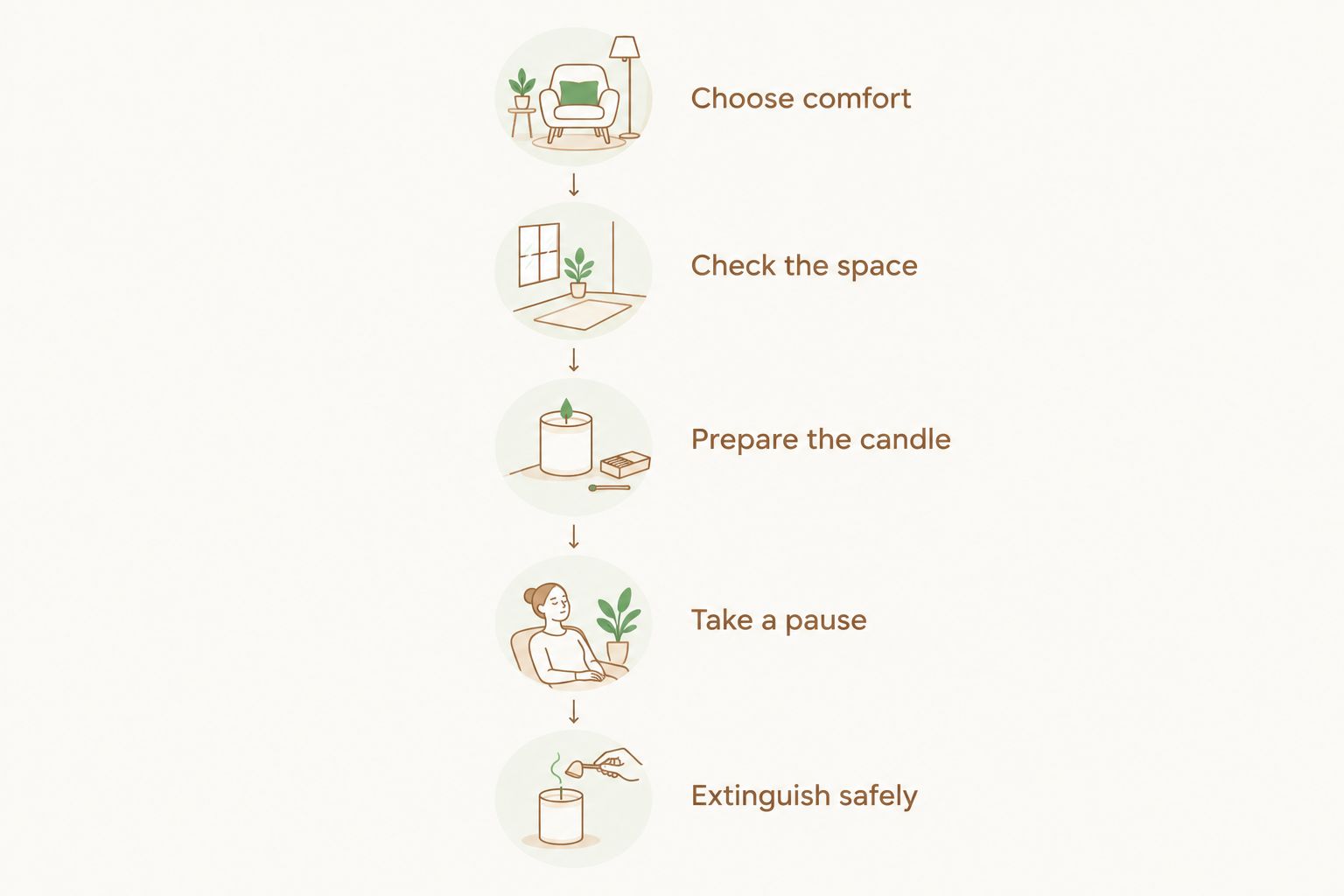
For a 2026 self-care routine, use these five steps as a practical sequence, not a prescribed anxiety protocol. There is no established candle exposure time or fragrance intensity that you should target to treat anxiety.
1. Choose comfort
Pick a scent you already enjoy, or start with a fragrance-free pause if you are unsure. Do not assume lavender, a botanical ingredient, or a non-toxic label makes a product suitable for your sensitivities.
Check the current product information and usage instructions. If you are choosing for a shared room, ask the other people using that space whether they welcome fragrance.
2. Check the space
Place the candle on a stable, heat-resistant surface where you can watch it. The National Fire Protection Association's candle-safety guidance recommends keeping candles at least 12 inches from anything that can burn.
Keep the candle away from curtains, bedding, paper, and other combustible materials. Avoid drafts, and keep flames out of reach of children and pets. A calming setting should not introduce a preventable fire hazard.
3. Prepare the candle
Follow the manufacturer's instructions for the candle you own. The National Candle Association's general candle-care guidance recommends trimming the wick to 1/4 inch before lighting; product-specific instructions take priority.
Do not turn wick maintenance into a wellness claim. It is a candle-care step, not a way to increase a fragrance's effect on anxiety.
4. Take a pause
Use the candle as a cue to stop multitasking. Sit comfortably, put aside the task you were doing, and let your breathing remain gentle rather than forcing deep breaths or a rigid breathing pattern.
Notice whether the fragrance is pleasant and whether the setting feels comfortable. You do not need to monitor your pulse, chase a particular sensation, or judge the pause by whether every anxious thought disappears.
5. Extinguish safely
Extinguish the flame before leaving the room or becoming drowsy. Never sleep with a candle burning, and follow the manufacturer's burn-time limits and extinguishing instructions.
Stop sooner if you notice headache, coughing, wheezing, nausea, or irritation. Do not keep burning the candle in the hope that discomfort means the fragrance is working.
The sequence is simple: Choose comfort, Check the space, Prepare the candle, Take a pause, Extinguish safely. The safety steps remain necessary even when a candle is marketed for relaxation.
Where does a ready-made ritual bundle fit?
If you already enjoy fragrance, the Caftari Evening Ritual Bundle: Scent of Nirvana and Nidra is relevant to an evening self-care shopping decision. Check the current product details rather than assuming the bundle contains a particular ingredient, delivers a measured exposure, or produces a sleep benefit.
Best for: shoppers who want a ready-made fragrance selection for an evening ritual. The benefit is choosing fragrance for a routine you enjoy; the limitation is that a bundle is not a treatment and still requires individual tolerance and appropriate usage precautions.
The same principle applies to wellness gifts. Ask whether the recipient likes fragrance before choosing a scented set. Present it as a thoughtful comfort item, not something they need to manage anxiety.
Are scented candles safe if you have asthma or fragrance sensitivity?
A candle is not automatically suitable because it is described as natural, clean, or non-toxic. Burning produces emissions, and fragrance can be uncomfortable for some people. The Environmental Protection Agency's indoor-air guidance identifies combustion and household products as relevant indoor pollution sources.
If fragrance has previously triggered respiratory symptoms or migraines, a fragrance-free routine avoids repeating that exposure. Ask your clinician for advice relevant to your condition rather than relying on a wax type or ingredient label.
Ventilation does not turn a candle into an air purifier or establish that it is safe for everyone. An unscented candle removes added fragrance but does not remove the flame or combustion. If you want neither, use a quiet pause without burning anything.
Can a candle replace anxiety treatment?
No. A candle is a comfort accessory, not a substitute for evidence-based anxiety care. The National Institute of Mental Health's anxiety-disorder guidance describes psychotherapy, medication, or both as treatment approaches, depending on the person and condition.
Seek professional support when anxiety interferes with work, relationships, sleep, or ordinary activities. You do not need to wait until a self-care routine stops feeling pleasant before asking for help.
A candle can remain part of your surroundings if you enjoy it. The boundary is the claim: enjoying fragrance alongside care is different from using fragrance instead of care.
FAQ
Can scented candles help with anxiety, or do they just smell nice?
Scented candles may support a feeling of relaxation when you enjoy the fragrance and setting, but they are not anxiety treatment. A pleasant ritual does not establish a clinical effect.
Is lavender the best candle scent for anxiety?
Lavender is not an established best candle scent for treating anxiety. Research on lavender preparations cannot be assumed to apply to a lavender-scented candle; choose a fragrance you comfortably enjoy.
How long should I burn a candle to feel calmer?
There is no established candle-burning duration for anxiety relief. Follow the manufacturer's instructions, remain present, and extinguish the candle before leaving or becoming drowsy.
Are non-toxic candles safe for everyone?
A non-toxic label does not guarantee that a candle is comfortable or suitable for everyone. Fragrance sensitivity and combustion remain relevant, so stop using a candle if it causes symptoms.
Can I sleep with a calming candle burning?
Never sleep with a candle burning. Extinguish the flame before bed, even if the fragrance is marketed for relaxation or an evening routine.
Are Caftari candles an alternative to anxiety medication?
Caftari candles are self-care fragrance products, not an alternative to anxiety medication or psychotherapy. Do not change prescribed treatment because of a candle or fragrance claim.
What should I try if scented candles make me uncomfortable?
Choose a fragrance-free pause without burning anything if scented candles make you uncomfortable. If symptoms are persistent, severe, or concerning, seek medical advice rather than trying a stronger or different fragrance.
One last thing
Try the quiet pause without the candle before deciding that fragrance is essential. Put the task aside, settle into the same comfortable space, and notice whether you enjoy the routine without scent or flame.
If you prefer adding fragrance, that preference is enough. Your 2026 wellness routine does not need a neuroscience claim to justify a pleasant moment, and it should never make you feel dependent on a candle to cope.

