

A melatonin candle is not a proven way to fall asleep faster: there is no established evidence that burning one delivers a reliable melatonin dose. In 2026, the useful question is whether its scent helps you settle into a bedtime routine—and whether you can enjoy it safely before turning out the lights.
- Does a melatonin candle work? Not as a proven way to deliver melatonin or shorten the time it takes to fall asleep.
- A familiar scent can be part of a calming bedtime ritual, but it is not a sleep treatment.
- Caftari candles are best for shoppers seeking a clean, non-toxic fragrance ritual, not a measured melatonin dose.
- Extinguish every candle before you get into bed or feel sleepy.
Can a melatonin candle actually help you fall asleep?
A melatonin candle can help you mark the start of a wind-down routine, but it is not an established method of delivering melatonin. A label that names melatonin does not tell you how much, if any, reaches your body when the candle burns. If you are comparing products, use the guide to melatonin candles to separate fragrance claims from claims about melatonin itself.
| Option | What you actually use | Best for | Advantage | Limitation |
|---|---|---|---|---|
| Melatonin-labeled candle | Light and scent from a burning candle | Someone who wants a scented wind-down ritual | Makes the routine distinct from the rest of the evening | The label does not establish a delivered melatonin dose or a sleep benefit |
| Scented candle without a melatonin claim | Light and scent from a burning candle | Someone who wants fragrance without a hormone-related claim | Keeps the purchase decision focused on scent and candle use | Fragrance is not a treatment for a sleep problem |
| Oral melatonin supplement | A product taken by mouth | Someone discussing melatonin use with a clinician | Has a direct route of administration | Evidence about a supplement cannot be transferred to a candle; suitability varies by person |
The distinction is the route of exposure. Research on swallowed melatonin concerns a known route of administration. Breathing air near a candle is different; a product name alone cannot establish what happens to an ingredient during burning or how much a person absorbs. For a 2026 purchase decision, do not treat evidence about an oral supplement as evidence about a candle.
Why this matters
Melatonin is a hormone involved in the body's sleep-wake timing. The National Institutes of Health's National Center for Complementary and Integrative Health discusses melatonin in the context of supplements and sleep research; that guidance does not establish a benefit from burning a candle labeled with melatonin. A candle can still have a place in your evening, but the reason to choose it is the experience of the scent and ritual, not an assumed hormone dose.
The difference matters when you are deciding what problem to solve. If your evenings feel rushed, a repeated wind-down routine gives you a clear stopping point. If you have persistent trouble falling asleep, buying another candle does not address the cause. Bring that concern to a healthcare professional rather than relying on a fragrance claim.
How would melatonin from a candle reach you?
A candle releases fragrance into the surrounding air as it burns. That explains why you can smell it; it does not prove that another named ingredient remains intact, enters the air in a useful form, reaches your body, or produces a predictable effect. Each of those is a separate claim requiring evidence about the finished candle and its use.
Ask a specific question of any melatonin-candle listing: Does it show evidence of melatonin delivery during ordinary burning, or does it only list melatonin as an ingredient? An ingredient list answers what was added to the product. It does not answer what you absorb. Likewise, a testimonial about feeling relaxed cannot identify whether the perceived change came from melatonin, scent, a quieter room, or the act of slowing down.
You do not need to settle that chemistry question to enjoy a candle. You do need to keep the claims separate. A fragrance can be pleasant, and a familiar smell can become part of a routine. Neither statement establishes that a melatonin candle changes your hormone levels or treats insomnia.
Can scent help even if candle-borne melatonin is unproven?
Scent can serve as a cue to begin a calming routine; it is not a guaranteed sleep aid. When you use the same fragrance while reading, stretching, or putting your phone away, you give that part of the evening a recognizable sensory context. Your response to a scent is personal, so choose one you find comfortable rather than one marketed with the strongest sleep claim.
Here is the practical separation to make in 2026:
- A scent preference is personal. Choose a fragrance you enjoy at a strength you find comfortable.
- A bedtime cue is a routine choice. Pair the fragrance with an activity you can repeat without keeping the candle lit overnight.
- A medical effect needs evidence. Do not translate a relaxing experience into a claim that a candle delivers melatonin or treats a condition.
The same distinction applies to other fragrance ingredients. Descriptions such as calming or neuroscience-inspired tell you how a product is positioned; they do not measure your response. If scent gives you a headache or bothers your breathing, stop using it. A clean or non-toxic description is not a promise that every person will tolerate every fragrance.
Why results vary from one evening to another
The outcome you notice depends on more than the candle. These factors help explain why a pleasant evening with a fragrance should not be mistaken for proof of a melatonin effect:
- Your response to the scent: A fragrance you find soothing can be unpleasant or distracting to someone else.
- What else you do before bed: Reading quietly and checking work messages create different routines, even beside the same candle.
- Light exposure: The candle adds light while it burns. A dark bedroom is a different setting from a room with an open flame.
- Your sleep schedule: A scented ritual does not replace a regular opportunity to sleep.
- Fragrance sensitivity: Discomfort can make a wind-down routine less comfortable, regardless of the candle's ingredient claims.
These are reasons to judge the candle as part of your routine rather than as a stand-alone intervention. If you change your schedule, screen use, room lighting, and fragrance at once, you cannot credit the candle alone for how you feel.
What is a safer way to use a candle before bed?
Use a candle during the awake portion of your evening, then extinguish it before you get into bed or become drowsy. A flame needs your attention; it does not belong in a room where you might fall asleep. The National Fire Protection Association advises keeping candles at least 12 inches from anything that can burn.
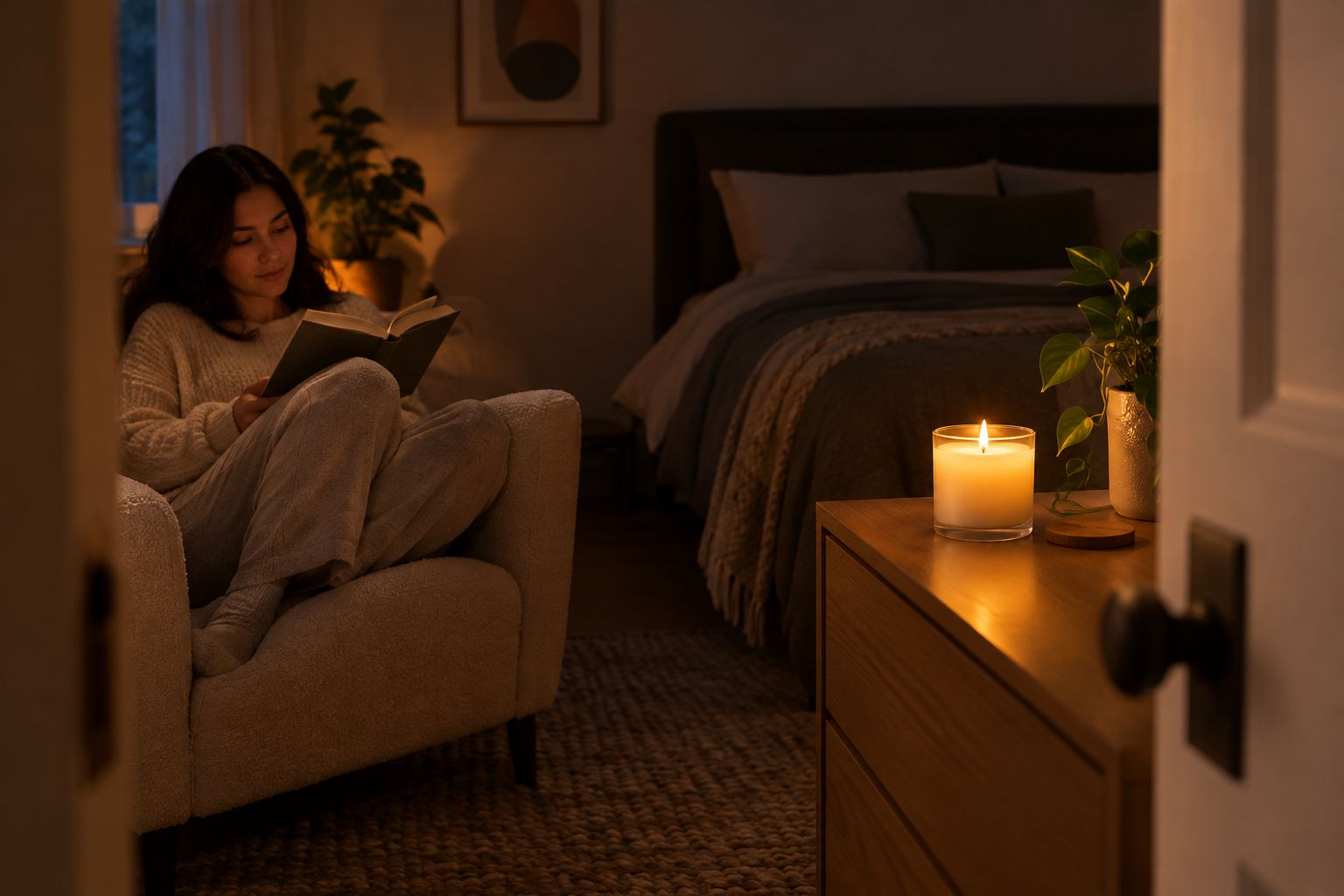
Build the routine around actions you can continue after the flame is out:
- Put the candle on a stable surface, away from bedding, curtains, paper, and other things that can burn.
- Use the time while it is lit for a quiet activity you enjoy. Stay in the room and keep the flame in sight.
- Extinguish the candle before you feel sleepy or move into bed. Do not leave it burning as you drift off.
- Continue your routine in a dark room. The Centers for Disease Control and Prevention advises turning off electronic devices at least 30 minutes before bedtime as part of healthy sleep habits.
For adults ages 18–60 years, the CDC recommends 7 or more hours of sleep per night. Those figures are general sleep guidance, not a measure of candle effectiveness. In 2026, a candle still needs to fit around those basics, not displace them.
Where does Caftari fit in an evening ritual?
Caftari is best for shoppers who want a clean, non-toxic scented-candle ritual, not a proven melatonin delivery method. The brand sells candles and perfume oils for daily self-care. That makes fragrance selection relevant here; it does not make a Caftari candle a medical product or establish that it contains melatonin.
If you want a candle for the awake part of your routine, Scent of Nirvana (Meditation Candle) is a named Caftari candle option. If you prefer a candle paired with a portable fragrance format, the Nidra Rollerball + Candle Bundle includes a rollerball and candle. Best for the first: a candle-focused ritual. Best for the bundle: someone who wants both formats. Neither choice comes with evidence here that it delivers melatonin or shortens the time it takes to fall asleep.
The trade-off is straightforward. A candle gives you a defined moment to pause, but you must supervise and extinguish its flame. A rollerball does not involve a flame, but applying a fragrance oil to skin raises different questions about personal sensitivity. Choose the format you will use comfortably and follow its product directions; do not pick either as a substitute for care for a sleep problem.


How should you read a melatonin-candle claim?
Look for the claim's actual subject before you buy. Is the seller describing the scent, listing an ingredient, promising that you absorb melatonin, or promising a sleep outcome? Those statements require different evidence. A pleasant scent needs your own preference; a claim about delivered melatonin needs evidence about delivery from the burning candle.
Use this short check when comparing listings:
- Ingredient claim: The listing says melatonin is present. That alone says nothing about a delivered dose.
- Fragrance claim: The listing describes a calming scent. Treat that as a description of the intended experience, not a prediction of your sleep.
- Outcome claim: The listing says you will fall asleep faster. Look for evidence tied to that finished candle and that outcome; do not borrow results from oral supplement research.
- Safety directions: Check how the maker says to use and extinguish the candle. No sleep-themed label makes an unattended flame safe.
For a 2026 comparison, favor a clear description of what a product is over a dramatic promise about what it will do to your body. Caftari's fragrance products can be considered on scent and format without assigning them an unsupported melatonin effect.
Does a melatonin candle work better than a regular scented candle?
No evidence here establishes that a melatonin-labeled candle works better for falling asleep than a regular scented candle. Both can provide scent and a visible cue to pause your evening. Without evidence that the melatonin-labeled candle delivers an effective dose and improves the outcome, its extra ingredient claim does not establish an advantage.
That does not mean the candles smell the same or suit the same person. Compare the fragrances and directions you can actually evaluate. If your goal is a quieter transition to bed, choose the scent you like, use it while awake, and let the rest of your routine do the work.
FAQ
Does a melatonin candle work for sleep in 2026?
A melatonin candle is not a proven way to deliver melatonin or help you fall asleep faster in 2026. Its scent can be part of a wind-down routine, but that is different from a demonstrated hormone effect.
Can you absorb melatonin by smelling a candle?
A melatonin label does not establish that smelling the candle delivers melatonin to your body. Evidence about an ingredient in a product is different from evidence of exposure during normal candle use.
Is a melatonin candle better than a regular scented candle?
No established evidence shows a melatonin-labeled candle is better for falling asleep than a regular scented candle. Compare them by scent, comfort, and safe-use directions instead of assuming a melatonin benefit.
Can I leave a sleep candle burning after I get into bed?
No. Extinguish the candle before you get into bed or feel drowsy; never leave a burning candle unattended. The National Fire Protection Association advises keeping candles at least 12 inches from anything that can burn.
Does a calming candle treat insomnia or anxiety?
No candle discussed here is established as a treatment for insomnia or anxiety. If trouble sleeping persists, speak with a healthcare professional rather than relying on a fragrance product.
How long before bed should I stop using my phone?
The Centers for Disease Control and Prevention advises turning off electronic devices at least 30 minutes before bedtime. You can use that screen-free time for a quiet activity and extinguish any candle before you go to bed.
Are clean, non-toxic candles safe for everyone?
No fragrance is comfortable for everyone, even when a candle is described as clean or non-toxic. Stop using a scent that causes discomfort and follow the candle's fire-safety directions.
One last thing
The strongest claim a candle needs to meet is often the simplest: Will you enjoy its scent while you are awake? In 2026, that is a more useful buying question than whether a melatonin label promises sleep. Keep the ritual if it helps you slow down; put out the flame before the part of the night that matters most.


