

Organic traffic for candle and perfume retailers in 2026 tracks content age more than brand size: stores under 12 months typically pull 5-15% of sessions from unpaid search, while multi-year publishers with deep guide libraries clear 35-50%. The gap is the single biggest lever a candle or perfume retailer has over paid acquisition costs.
- Organic traffic benchmarks for candle and perfume retailers in 2026 run from 5-15% of sessions at launch to 35-50% once a content library matures.
- Blog guides and gift-guide content typically drive a larger share of organic sessions than product pages alone in this category.
- Brands publishing 40+ guides see organic search compound faster than brands relying on 10 or fewer product listings.
- Corporate gifting and B2B guide content adds a second organic channel most candle and perfume retailers never build.
Why this matters
Candle and perfume retailers compete in a category where paid social costs keep climbing and repeat-purchase margins are thin on a single candle or rollerball sale. Organic search is the channel that doesn't scale in cost with volume, which is why the gap between a launch-stage store and an established publisher matters more here than in categories with lower acquisition costs.
The keyword economics behind that gap are covered in search volume benchmarks for candle and perfume keywords — worth reading alongside this page since traffic share and keyword volume move together. A retailer chasing high-volume, high-competition terms without a content base behind them will see organic share stall regardless of how many product pages it publishes in 2026.
Organic traffic share benchmarks by brand stage (2026)
The short answer: organic traffic typically runs 20-35% of total sessions across candle and perfume D2C brands overall, with the range widening sharply by how long the site has been publishing content and how many indexed pages it carries.
| Brand stage | Typical organic share of sessions | What's driving it |
|---|---|---|
| All D2C candle/perfume brands (overall) | 20-35% | Direct and paid channels still carry undifferentiated catalogs |
| Launch stage (0-12 months live) | 5-15% | Few indexed pages, no backlink base, paid and social carry volume |
| Growth stage (1-3 years, active blog) | 20-35% | Early gift-guide and product-review content starts ranking |
| Established (3+ years, 40+ published guides) | 35-50% | Compounding content library reduces dependence on paid spend |
| Enterprise/multi-channel beauty retailer | 25-40% | Branded search and marketplace listings pull share away from the owned site |
Established publishers lead at 35-50%; launch-stage stores trail at 5-15%. That 30-point-plus spread is the clearest signal in this data: the gap closes with content volume and time, not with catalog size or price point.
These ranges reflect directional patterns from aggregated ecommerce and SEO industry reporting on how organic traffic share moves with content maturity, not a published dataset specific to candle and perfume retailers. No public benchmark study segments organic traffic by this exact category — the ranges above are a proxy built from broader D2C beauty and wellness ecommerce reporting, and a retailer selling only fine fragrance at a premium price point may see a different curve than one selling mass-market candles.
How to use these benchmarks
- If your candle or perfume store sits below 15% organic share past its first year, the fix is content volume, not more product listings — a single product page rarely outranks a guide.
- Track organic share quarterly against the 20-35% growth-stage band; falling behind it after 18 months usually means backlinks, not content count, is the gap.
- Budget for the average CPC benchmarks for candle and perfume keywords alongside organic share — rising CPCs make the 35-50% established-brand range worth the multi-year build.
- Don't compare your organic share to enterprise beauty retailers in the 25-40% band; their branded-search volume skews the number in ways a smaller catalog can't replicate.
Where organic sessions come from: content mix benchmarks
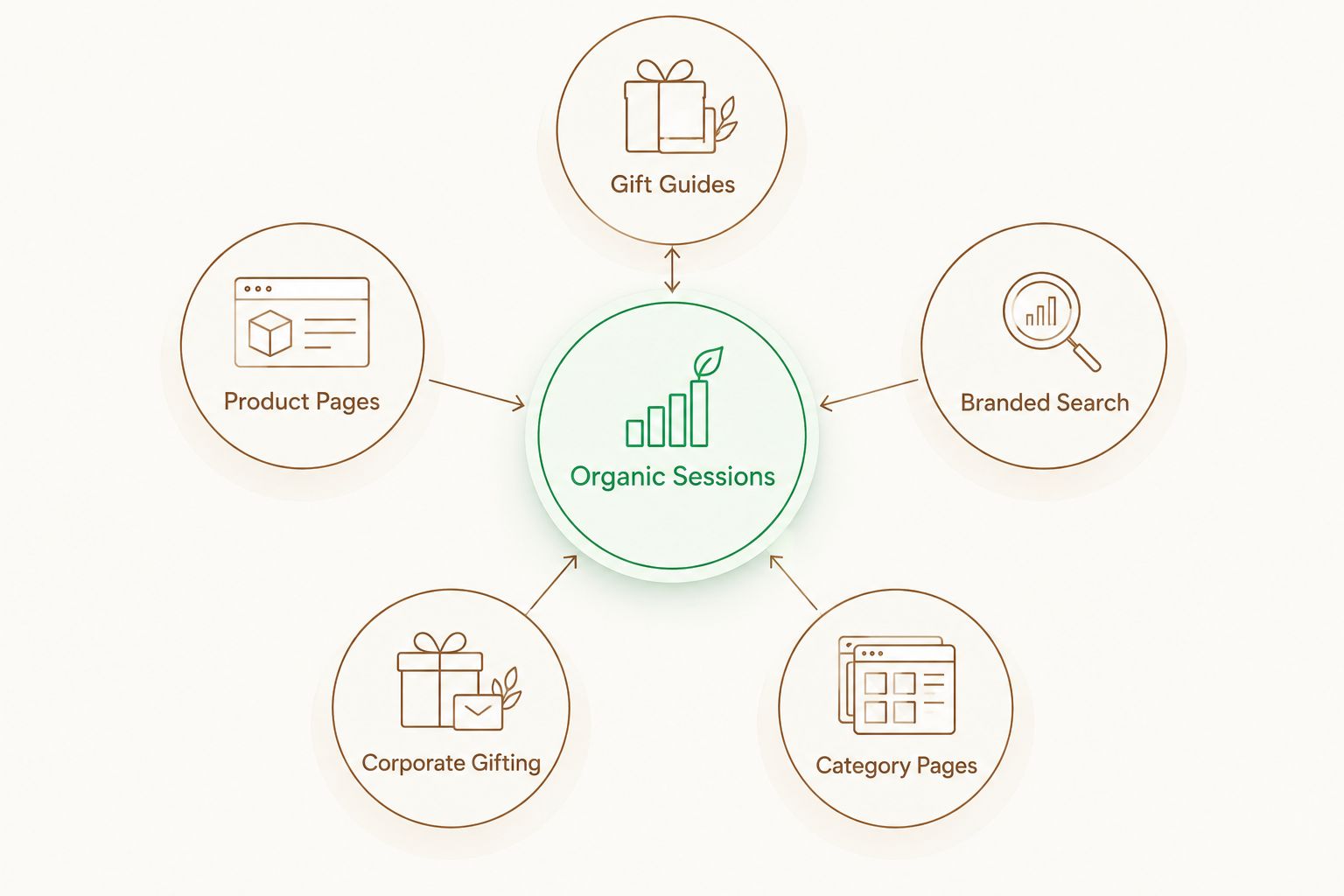
Within that organic share, the split between page types tells you where to invest next. The short answer: informational and gift-guide content typically pulls a larger share of organic sessions than product pages alone in the candle and perfume category, because search intent skews toward comparison and occasion-based queries before purchase intent.
| Content type | Typical share of organic sessions | Example query pattern |
|---|---|---|
| Informational/gift-guide posts | 35-45% | "best candle gift sets for [occasion]" |
| Product and collection pages | 25-35% | "[scent name] candle" or "rollerball perfume oil" |
| Branded search | 15-25% | "[brand] candle" or "[brand] rollerball" |
| Corporate/B2B gifting guides | 5-15% | "candle gift sets for law firms" or "corporate gifting for spas" |
Gift-guide and informational content leads at 35-45% of organic sessions; corporate/B2B gifting guides trail at 5-15%, even though that last row is often the least competitive to rank for. A retailer publishing dozens of occasion-based guides but zero B2B content is leaving a low-competition slice of the mix untouched.
The split above is drawn from how search intent typically distributes across informational, transactional and branded queries in fragrance and home-scent ecommerce, not a single named audit. The limitation worth naming here: content mix shifts by season — Q4 gift-guide traffic spikes distort the annual average, so a single month's snapshot will overstate the informational-content share.
Product pages that combine a rollerball and a candle in one bundle tend to hold a broader keyword footprint than a single-SKU listing, since they answer both a scent-preference query and a gift-set query on the same page. That's the pattern behind bundles like the one built around Nidra, where jasmine and soft musk notes carry both a wellness-routine angle and a standalone gift angle in the same listing.


A candle or perfume retailer sitting at caftari.com or any comparable D2C storefront should read these two tables together: organic share tells you the ceiling, content mix tells you which shelf to build first. Neither number moves without publishing volume behind it, and neither moves in a single quarter.
FAQ
What is a good organic traffic percentage for a candle or perfume ecommerce site in 2026?
A growth-stage candle or perfume retailer (1-3 years, active blog) typically sees 20-35% of sessions from organic search. Established publishers with 40+ guides often clear 35-50%.
Why is my new candle store's organic traffic so low?
Launch-stage stores under 12 months typically sit at 5-15% organic share because they lack indexed content and backlinks. This is normal and closes with consistent publishing over 18-24 months.
Do product pages or blog content drive more organic traffic for perfume brands?
Informational and gift-guide content typically pulls 35-45% of organic sessions versus 25-35% for product and collection pages, because most fragrance search intent starts as comparison or occasion-based.
Is corporate gifting content worth publishing for a candle brand?
Corporate and B2B gifting guides typically carry only 5-15% of organic sessions, but the competition for those terms is lower than consumer gift-guide queries, making them efficient to rank.
How long does it take a candle retailer to reach 35% organic traffic share?
Sites that reach the established tier (35-50% organic share) typically carry 40 or more published guides and multiple years of consistent publishing, not a single content sprint.
Does seasonality affect candle and perfume organic traffic benchmarks?
Yes. Q4 gift-guide search volume spikes shift the content mix toward informational pages, which can overstate that category's annual share if measured only in November or December.
Should a perfume brand compare itself to enterprise beauty retailers?
Not directly. Enterprise beauty retailers sit at 25-40% organic share, but branded search volume from existing customer bases skews that number in ways a smaller catalog can't replicate.
One last thing
The smallest row in the content-mix table, corporate and B2B gifting guides at 5-15% of organic sessions, is also the one most candle and perfume retailers skip entirely in 2026 — which is exactly why it's cheaper to rank for than another gift-guide post competing against a hundred others in Q4.

