

Natural perfumes smell different from synthetic ones because botanical extracts contain mixtures of aromatic molecules, while synthetic ingredients let perfumers select particular molecules and build more precisely controlled accords. The finished scent also depends on the formula, concentration, and carrier—not simply whether its ingredients came from a plant or a laboratory.
- Molecular composition explains why natural perfumes smell different than synthetic versions; ingredient origin alone does not predict scent.
- Botanical extracts bring layered aromatic mixtures; synthetic ingredients expand a perfumer’s control over fragrance notes.
- Perfume oils and alcohol-based fragrances can release the same aromatic ingredients differently.
- Caftari perfume oils suit shoppers seeking fragrance for a calming daily self-care ritual.
Why do natural perfumes smell different than synthetic ones?
Natural and synthetic perfumes differ when their aromatic ingredients, proportions, or delivery systems differ. Natural extracts often bring several facets together: a floral material can also smell green, spicy, earthy, or honeyed. A synthetic ingredient can emphasize a particular facet or introduce an odor that is difficult to obtain through botanical extraction.
Neither category describes a single smell. A natural perfume can be crisp and simple; a formula containing synthetic ingredients can smell richly botanical. For choosing a fragrance, the useful question is what the finished composition smells like—not whether its name sounds more natural.
Use this comparison alongside the guide to choosing non-toxic perfume oils by ingredient label. An ingredient description and a scent description answer different questions.
| Fragrance approach | What shapes the smell | Best for | What the label does not tell you |
|---|---|---|---|
| Botanical aromatic ingredients | Mixtures obtained from plant materials through processes such as distillation or extraction | Exploring the layered character of botanical extracts | Whether you will enjoy the finished blend or how long it will last |
| Synthetic aromatic ingredients | Selected manufactured molecules used individually or in combinations | Exploring precisely composed notes and a broader aromatic palette | Whether the perfume will smell sharp, soft, naturalistic, or abstract |
| A combination of both | Botanical mixtures balanced with selected aromatic molecules | Exploring compositions that combine botanical character with targeted scent effects | The proportions, performance, or complete ingredient origin |
These are formulation approaches, not quality rankings. Judge the actual perfume on its scent, ingredient information, and fit with your routine.
Why this matters when choosing a perfume
When you shop for fragrance in 2026, words such as natural, clean, botanical, and non-toxic can appear beside descriptions of woods, flowers, or citrus. Those words do not perform the same job. Ingredient language explains aspects of formulation; fragrance notes describe the experience the perfumer wants you to recognize.
Separating the two helps you choose more confidently. You can appreciate a botanical-inspired scent without assuming every aromatic ingredient is plant-derived, and you can value ingredient transparency without expecting all natural perfumes to smell alike.
A perfume that fits your self-care ritual should smell enjoyable through its development, not just at first application. The opening is an introduction. The scent you notice later is also part of what you are choosing.
Botanical extracts: several scent facets in one material
A plant extract is not necessarily a single aromatic substance. Its odor comes from the combined contribution of its constituents, including their relative amounts and how readily they enter the air. This explains why a botanical ingredient can smell more textured than a simplified version of the same note.
Consider rose as a general fragrance example. A rose-inspired perfume can express fresh petals, green stems, sweetness, or a warmer floral impression. Different materials and proportions bring different facets forward; the word rose alone does not specify the formula.
Extraction matters, too. Distillation, pressing, and solvent extraction recover materials differently. An extract's smell therefore reflects both the plant source and the way its aromatic components were obtained.
For you, the practical benefit is a more useful expectation: a botanical note can have edges, contrasts, and supporting aromas. Those details are part of its character, rather than a failure to smell like the neat description on a fragrance page.
Synthetic ingredients: control over individual scent effects
Synthetic aromatic ingredients give perfumers access to selected molecules and odor effects. Some molecules also occur in nature; others add possibilities that botanical extraction does not readily provide. Synthetic does not automatically mean an unfamiliar or artificial-smelling fragrance.
If an aromatic molecule has the same chemical structure, its origin alone does not give it a different odor. Differences arise when the surrounding mixture, purity, proportions, or molecular form differs. A whole botanical extract and a selected constituent are not equivalent comparisons.
This is why a synthetic floral accord can smell recognizably floral without containing the corresponding flower extract. The perfumer combines materials to create the impression. It is also why a botanical extract can smell less like your imagined flower than a carefully constructed accord does.
For shopping, focus on the described effect: fresh, soft, warm, green, woody, or sweet. Those terms help you anticipate the experience more directly than an ingredient-origin label alone.
Blended formulas: botanical character and selected molecules
Many fragrance compositions combine botanical materials with synthetic aromatic ingredients. This allows a perfumer to keep the character of an extract while adjusting particular parts of the composition. The result depends on the blend, not on a rule that one ingredient category must dominate.
A formula can emphasize a brighter opening, a fuller floral impression, or a quieter woody background by changing its materials and proportions. These are composition choices. They do not, by themselves, establish how the perfume performs on your skin.
A botanical carrier does not establish that the entire fragrance is natural. The carrier holds and delivers the aromatic blend; it does not determine the origin of every fragrance ingredient. Look for explicit ingredient information rather than inferring a complete formula from the base oil.
Why the smell varies from one perfume to another
Several factors explain differences between fragrances that share similar note descriptions. Use these factors to understand what you smell without treating natural and synthetic as opposing scent families.
- Aromatic composition: The particular molecules and their proportions determine which scent facets stand out. Two perfumes described as floral can have very different compositions.
- Extraction method: Different processes recover different components from botanical materials, changing the resulting aromatic profile.
- Carrier format: Oil and alcohol affect how a composition is delivered and released. Comparing an oil with an alcohol-based fragrance introduces more than an ingredient-origin difference.
- Wear context: Application amount, skin conditions, temperature, and other scented products influence the experience of wearing a perfume.
- Material variation: Botanical source materials can differ with growing conditions and processing. The finished formula, rather than origin alone, determines how that variation is expressed.
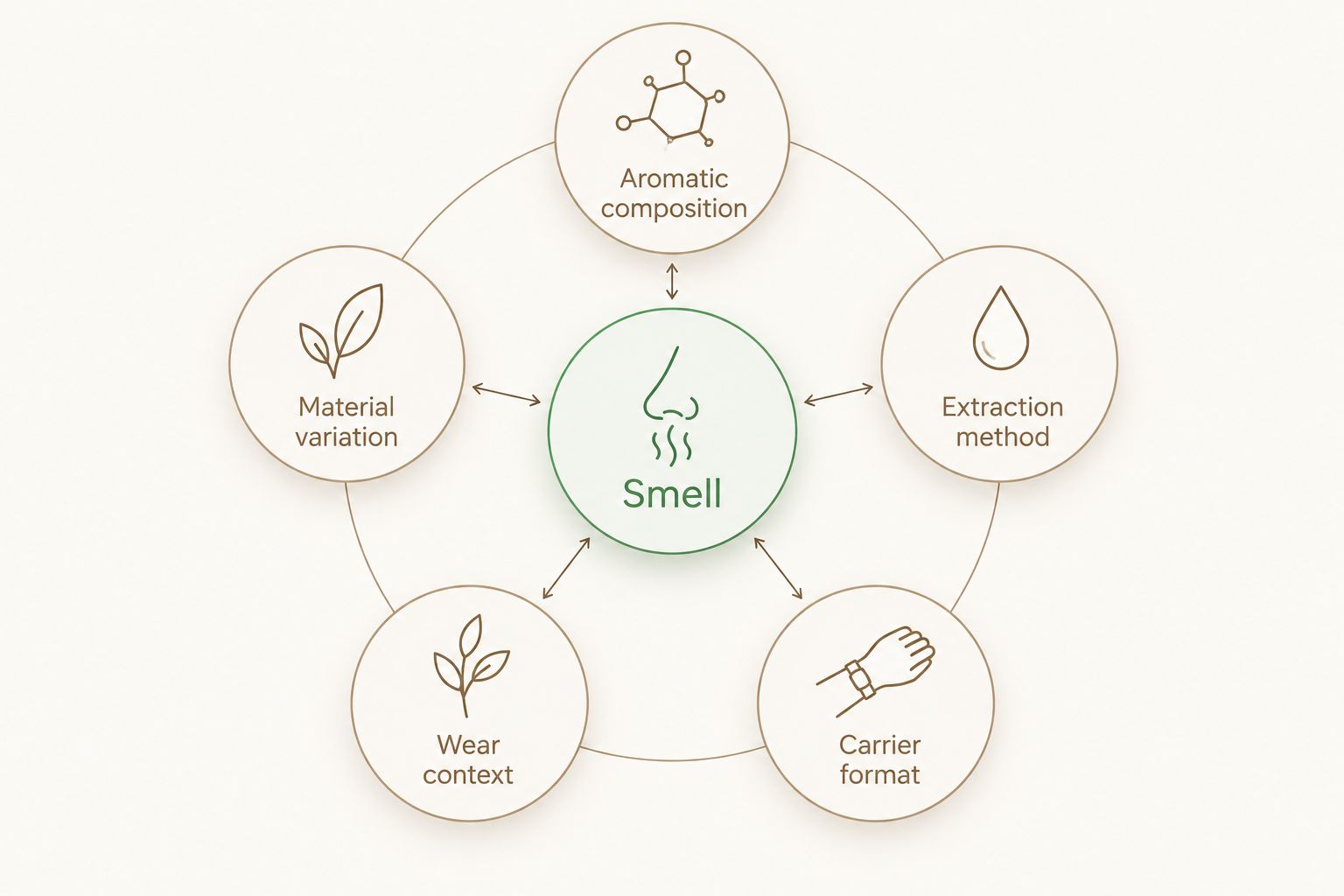
The most useful comparison holds as many factors steady as possible. If you change the fragrance, carrier, application amount, and setting together, you cannot attribute the difference solely to natural or synthetic ingredients.
How to compare perfumes before choosing
You do not need technical training to compare fragrances thoughtfully. You need a clear preference and a consistent way to notice the scent. For a 2026 fragrance purchase, keep your observations focused on what you enjoy wearing.
- Read the scent description. Identify the main fragrance direction and the supporting notes. Treat these as an olfactory description, not a complete ingredient list.
- Check the formulation information. Look for the stated carrier and any explanation of aromatic ingredients. Keep verified natural-origin information separate from words that describe a botanical mood.
- Follow the application directions. Use the product as directed rather than increasing the amount to force a stronger impression. Follow any stated skin-testing instructions, and stop using a product if irritation occurs.
- Notice the opening and later development. Write down simple impressions such as green, sweet, dry, floral, or woody. There is no need to identify every molecule or assign a technical score.
- Choose for your intended ritual. Ask whether you enjoy the scent during the part of your day when you plan to wear it. A quieter moment at home and an active day outside offer different wearing contexts.
Keep competing scents out of the comparison when practical. A scented lotion or another perfume can become part of what you smell, making it harder to recognize the new fragrance on its own.
Choose a Caftari rollerball by its scent profile
Caftari perfume oils are best for shoppers seeking fragrance as part of a calming daily self-care ritual. Compare the rollerballs by their described scent profiles, then choose the fragrance direction you enjoy. Each uses a jojoba and vitamin E base; the carrier and the aromatic blend play different roles in the scent experience.
| Caftari product | Verified fragrance details | Best for |
|---|---|---|
| Scent of Nirvana Rollerball | Oudh and patchouli in a jojoba and vitamin E base | Exploring an oudh-led fragrance |
| Dolce Far Niente Rollerball | Rose and sandalwood in a jojoba and vitamin E base | Exploring a floral and woody pairing |
| Nidra Rollerball | Jasmine and soft musks in a jojoba and vitamin E base | Exploring jasmine with a soft musk character |
| Discovery Set - Rollerball Perfume Oils | Three full-size 10 ml perfume oils: Scent of Nirvana, Dolce Far Niente, and Nidra | Comparing all three scents in your daily routine |
These product examples show why scent notes and carrier information are useful together. Rose, oudh, and jasmine describe different fragrance directions; a shared oil base does not make the finished scents identical or establish the origin of every aromatic ingredient.


How does a perfume oil change the scent experience?
A perfume oil uses an oil carrier to deliver its aromatic ingredients. An alcohol-based fragrance uses a different delivery medium, so its initial release can feel different even when the compositions share similar notes. This is a format comparison, not proof of a natural-versus-synthetic difference.
The carrier is only part of the explanation. Concentration and the aromatic blend also affect release and perception. Do not assume that every perfume oil stays closer to the skin or lasts longer than every alcohol-based perfume.
For your own routine, notice the scent at your usual application area and in the setting where you intend to wear it. That observation gives you a more relevant answer than a general claim about oils. It also helps you distinguish a softer presentation from a fragrance you simply enjoy less.
Do natural perfumes always smell more complex?
Natural perfumes do not always smell more complex. A botanical extract can contain a mixture of constituents, but the complexity you perceive depends on the whole formula and how its elements interact. Synthetic ingredients can also create intricate compositions.
More complexity is not automatically more enjoyable. If you prefer a clear, gentle fragrance direction, a simpler-smelling composition can be an excellent fit. When choosing perfume in 2026, prioritize the character you want to live with rather than the number of facets you can identify.
Can natural and synthetic perfumes smell the same?
Natural and synthetic perfumes can smell similar when they present similar aromatic profiles. They need not use identical materials to create a recognizable floral, woody, or citrus impression. Small compositional differences can still become noticeable as the fragrances develop.
The strongest comparison is between the actual finished perfumes. A shared note name is a starting point, not a promise that the opening, texture, and later scent will match.
FAQ
Why do natural perfumes smell different than synthetic perfumes?
Natural perfumes smell different when their botanical mixtures differ from the selected aromatic ingredients used in a synthetic composition. The formula, proportions, concentration, and carrier also shape the finished smell.
Does synthetic perfume always smell artificial?
Synthetic perfume does not always smell artificial. Synthetic aromatic ingredients can create recognizable botanical impressions, and some have the same chemical structures as molecules found in nature.
Is a perfume oil automatically a natural perfume?
A perfume oil is not automatically a natural perfume. Oil describes the carrier format; the aromatic ingredients can be botanical, synthetic, or a combination.
Does a rose note mean a perfume contains rose extract?
A rose note does not necessarily mean a perfume contains rose extract. It describes an aromatic impression that can be created with botanical materials, synthetic ingredients, or both.
Do natural perfumes last longer than synthetic ones?
Natural perfumes do not automatically last longer than synthetic ones. Longevity depends on the aromatic composition, concentration, carrier, application, and wearing conditions rather than ingredient origin alone.
How should I choose a Caftari perfume oil?
Choose a Caftari perfume oil by its described scent profile, current ingredient information, and fit with your daily ritual. Keep scent preference separate from skin tolerance, and follow the product's application and care directions.
What should I compare when buying perfume in 2026?
When buying perfume in 2026, compare the scent direction, stated ingredients, carrier format, and the fragrance's development during wear. These details give you a clearer basis for choosing than natural or synthetic labels alone.
One last thing
A note is an impression, not an ingredient certificate. That distinction explains why a botanical-sounding perfume can contain synthetic aromatic ingredients, and why a plant extract can smell different from the familiar note you expected.
For your next fragrance choice in 2026, write down the qualities you want to notice: fresh rather than sweet, soft rather than assertive, or woody rather than floral. Bring that short description to Caftari's perfume selection. You will have a clearer way to choose an enjoyable scent for your ritual without asking an ingredient-origin label to answer every question.


