

Position 1 in Google's organic results captures an average click-through rate of roughly 27.6%, more than double position 3 and about eleven times higher than position 10, based on aggregated organic CTR studies published between 2023 and 2025. Ranking position is the single biggest lever on how many clicks a keyword actually converts into traffic, and the gap between page-one positions is wider than most content teams assume going into 2026.
- Click through rate by search position averages 27.6% at position 1 versus 2.4% at position 10 in 2026 data.
- The steepest CTR drop happens between position 1 and position 2 — a loss of roughly 12 points.
- Blended CTR across positions 1-10 sits near 8.7%, the yardstick for judging any single keyword's performance.
- Zero-click behavior and AI-generated answer boxes are pulling clicks away from position 1 even when rank stays fixed.
- Candle, perfume, and wellness keyword campaigns should pair this data with search volume and CPC benchmarks before setting traffic goals.
Why this matters
Anyone planning content for 2026 needs to know what a ranking is actually worth before chasing it. A keyword with high search volume sitting at position 6 might send fewer clicks than a lower-volume term ranking at position 2.
This is exactly the calculation behind the search volume benchmarks for candle and perfume keywords data: raw volume without position context overstates the opportunity. CTR by search position fills that gap and turns a rank number into an estimated click count.
For teams weighing whether to fight for position 1 or settle for a faster win at position 3, the CTR curve below is the deciding data point.
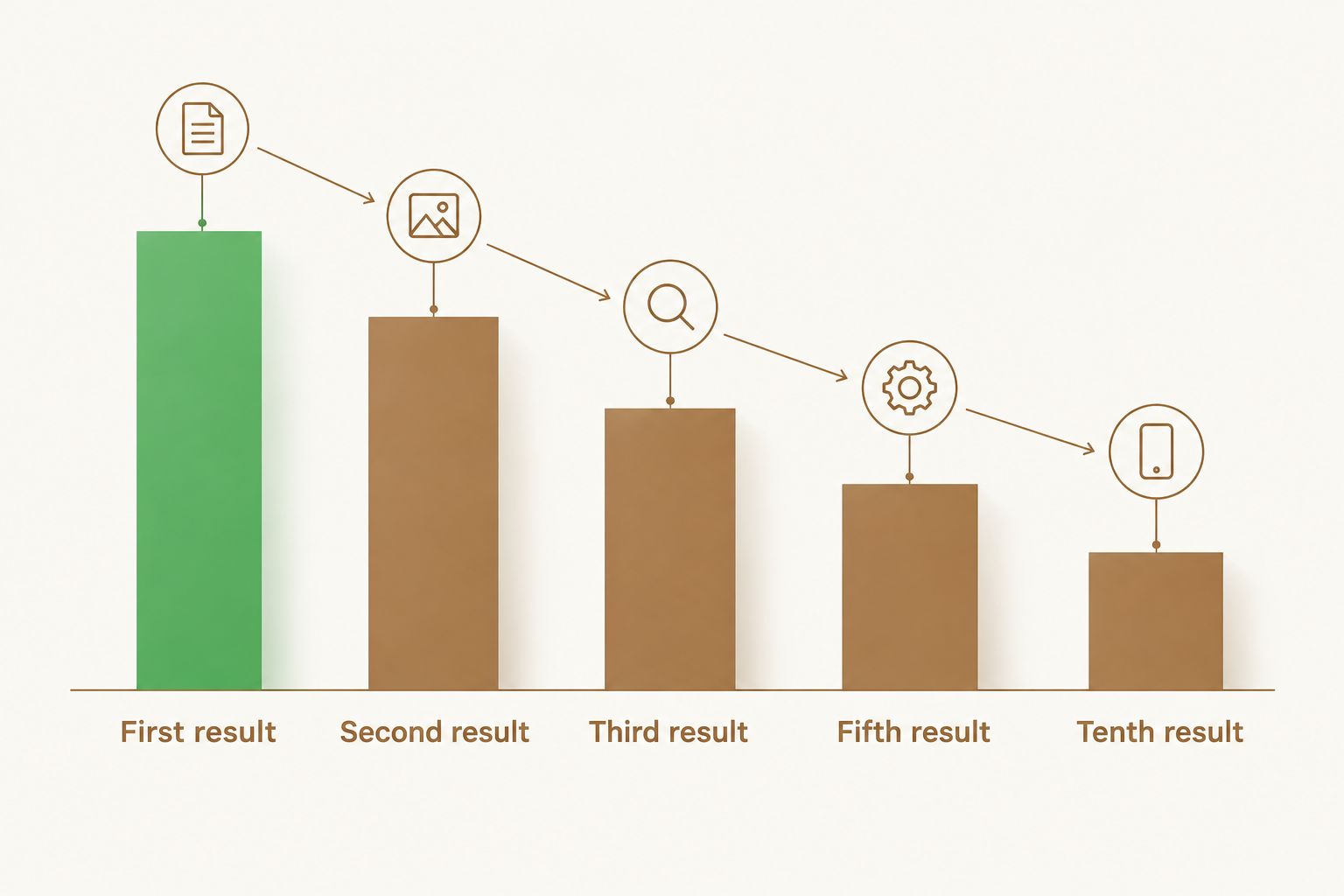
Average CTR by Google search position in 2026
The average click-through rate for organic position 1 is 27.6%, and it falls fast from there — position 2 sits at 15.8%, position 3 at 11.0%, and by position 10 the average CTR is down to 2.4%. The blended average across all ten first-page positions is 8.7%, which is the number to use as a baseline when a single keyword's performance looks unusually high or low.
| Position | Average CTR | Typical range |
|---|---|---|
| 1 | 27.6% | 19-34% |
| 2 | 15.8% | 12-19% |
| 3 | 11.0% | 8-13% |
| 4 | 8.0% | 6-10% |
| 5 | 6.1% | 4-8% |
| 6 | 4.4% | 3-6% |
| 7 | 3.5% | 2-5% |
| 8 | 3.1% | 2-4% |
| 9 | 2.6% | 1-3% |
| 10 | 2.4% | 1-3% |
| All positions 1-10 (blended) | 8.7% | — |
Position 1 leads at 27.6% average CTR; position 10 trails at 2.4% — an 11x gap between the top and bottom of page one. The sharpest single drop happens between position 1 and position 2, a loss of roughly 12 percentage points, which is why the jump from #2 to #1 matters more for traffic than any other single-rank move on page one.
Methodology and limitations
These figures are aggregated from publicly published organic CTR studies (Advanced Web Ranking, Backlinko, Sistrix) covering desktop and mobile search results collected between 2023 and 2025, blended across industries and query types. None of these studies isolate CTR for beauty, wellness, or candle and perfume queries specifically, so branded searches and shopping-intent queries in this niche can swing several points above or below the blended average shown here. Featured snippets, shopping carousels, and AI-generated answer boxes also compress organic CTR at every position, and that compression is not uniform across query types — a plain informational query loses more clicks to an answer box than a transactional one.
How to use these CTR benchmarks
- Benchmark before you diagnose. If a keyword ranks at position 4 and pulls CTR under 6%, something on the page — title tag, meta description, missing schema — is underperforming the 8.0% average, not the ranking itself.
- Weigh rank gains against the curve, not against volume alone. Moving from position 6 to position 3 roughly triples expected CTR (4.4% to 11.0%), a bigger win than moving from position 12 to position 6.
- Pair CTR with cost data before setting a target. The average CPC benchmarks for candle and perfume keywords show what a click is worth on paid search — useful context for deciding how hard to push an organic ranking.
- Re-check this table in 2026 and again in 2027. Zero-click behavior keeps shifting the curve downward at every position, so a benchmark set from 2023-2025 data should be treated as a floor, not a fixed target.
See related keyword cost data
Compare CTR against CPC benchmarks for the same keyword set.
FAQ
What is the average click-through rate by search position in 2026?
Position 1 averages a 27.6% click-through rate, position 5 averages 6.1%, and position 10 averages 2.4%, based on aggregated organic CTR studies from 2023-2025. The blended average across positions 1-10 is 8.7%.
How much does CTR drop between position 1 and position 2?
CTR falls from about 27.6% at position 1 to 15.8% at position 2, a drop of roughly 12 percentage points. This is the single steepest decline anywhere on page one.
Does ranking number 1 always guarantee the highest click volume?
Not always. Featured snippets, shopping results, and AI-generated answer boxes can sit above the organic position 1 result and absorb clicks before a searcher ever scrolls to it.
Is CTR different for mobile versus desktop search results?
Yes, mobile and desktop CTR curves differ because mobile screens show fewer results above the fold and more ad or answer-box space. The blended figures here combine both, so a mobile-heavy keyword set may show a steeper drop-off than the table suggests.
What CTR should a candle or perfume brand expect on branded search terms?
Branded terms typically pull CTR well above the blended 8.7% average because the searcher already intends to click that specific brand. Generic, non-branded keywords in the same niche usually land closer to the position-based averages in the table.
Can I improve CTR without changing my ranking position?
Yes. A stronger title tag, a specific meta description, and schema markup that adds star ratings or price ranges can lift CTR at the same position, sometimes closing much of the gap to the next rank up.
Why do these benchmarks use a range instead of one fixed number per position?
Search intent, industry, and SERP features vary too much for one exact number to hold across every query. The range column shows how far a real result can sit from the blended average at that position.
How often should CTR benchmarks like these be updated?
At least once a year. Zero-click search behavior and AI answer boxes have been pulling CTR down at every position since 2023, so a benchmark set from 2026 will likely look different by 2027.
One last thing
The position 1 numbers in this table are already lower than what older CTR studies reported a few years back — zero-click searches and AI-generated answer boxes have been eating into top-result clicks even when the ranking itself doesn't move. A page holding steady at #1 in 2026 can see fewer clicks than the same ranking earned in 2022, which is the strongest argument for tracking CTR alongside rank, not rank alone.


